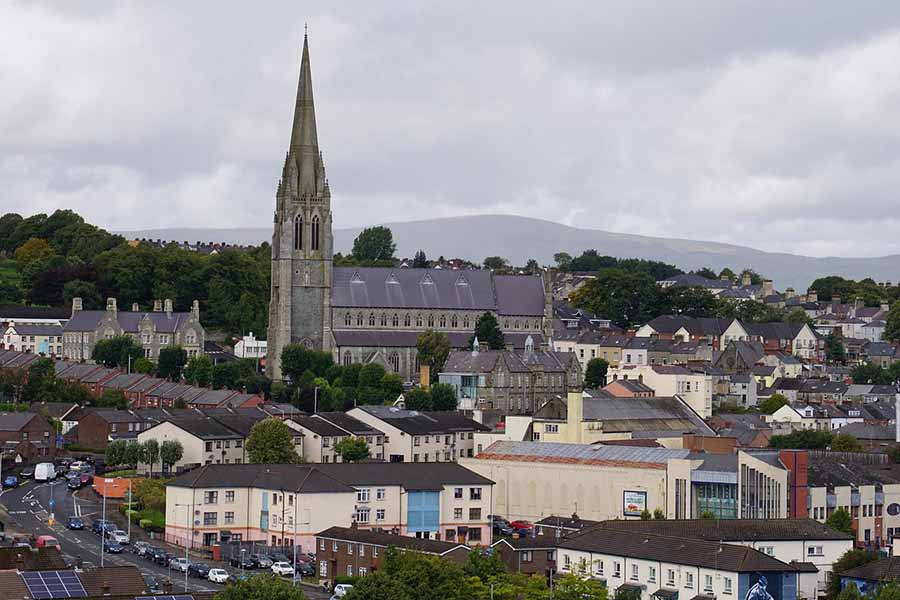
- St Columba’s Long Tower Church in Derry city stands on the site of the saint’s 6th-century monastic foundation in an ancient oak grove (Doire means “oak grove” in Irish). Tradition holds that St Columba planted an oak here and established his first major Irish monastery around 546 AD, making it a key pilgrimage centre. The modern Catholic church, with its heritage links and nearby St Columba’s Well, draws visitors honouring the saint who bridged Ireland and Scotland, with medieval pilgrimage routes once processing through the city.
- St Columba’s Holy Well near Long Tower Church serves as a focal point for devotion on the saint’s feast day (9 June), when blessings and processions occur. The well, tied to Columba’s legacy, continues ancient water veneration adapted to Christian practice, inviting pilgrims for prayer and reflection in the historic walled city.
- St Lurach’s Old Church (St Lowry’s) in Maghera preserves the ruins of a 10th-century church atop a 6th-century monastery founded by St Lurach, a bishop of Derry and patron of the area. This site, with its Romanesque doorway and graveyard, embodies early medieval sanctity and draws quiet visitors to contemplate the saint’s royal descent and poetic legacy amid rural tranquillity.
- St Patrick’s Well (or similar local traditions) in Derry connects to the patron saint’s missionary journeys, with folklore attributing blessings or curative properties to springs he touched. These wells, scattered in rural spots, preserve hydrolatry customs from pre-Christian times, now linked to Patrick’s evangelisation.
- St Augustine’s Church in Derry city lies near the reputed site of an early dúreigléas (“black church”) possibly tied to St Columba’s era. This Anglican church, on the city walls, offers a serene space for reflection on the layered spiritual history of the hilltop settlement.
- See also the nearby Grianán of Aileach in county Donegal, perched on a hilltop overlooking Lough Swilly, ranks as one of Ireland’s foremost pre-Christian ceremonial and inauguration sites. This Iron Age stone fort served as the royal seat of the northern Uí Néill kings, where rulers were symbolically enthroned in rituals echoing ancient kingship traditions. Its commanding views and mythic aura invite exploration of Ulster’s pre-Christian heritage.
County Derry:
Ireland’s county Derry offers a rich historical tapestry, with the city’s 17th-century walls providing a walkable journey through its past. The Guildhall and Tower Museum explore Derry’s maritime and political history, while the Peace Bridge offers scenic views over the River Foyle. Derry is Ireland’s 15th largest county by size (2,067 square km) and sixth largest by population (252,231). Population peaked at 222,174 in 1841 and reached its lowest point, 139,693 in 1926. In terms of hospitality, Derry is Ireland’s 16th most visited tourist county with around 135,000 international visitors per year.
Introduction – Adventure – Anthem – Archaeology – Attractions – Awards – Birdwatching – Camping – Castles – Churches – Contact list – Cycling – Dining – Equestrian – Festivals – Fishing – Folklore – Gardens – Golf – Graveyards – Happening – Haunted – Highest – Hiking – History – Holy Wells – Hotels – Hotels8 – Instagrammable – Itineraries – Largest town – Luxury – MICE – Movies – Musicians – New – Name – Novelists – Off the beaten track – Poets – Pubs – Quotes – Random Facts – Restaurant Awards– Sacred Places – Saints – Spas – Sports – Sunsets– Sustainable – Things to do – Towns – Video – Villages – Walking – Wanderlist – Weddings – Wild swimming – Writers – 1837 – 1846 – 1852 – 1909 – 1955 – 1980 –
Sacred Places
Antrim – Armagh – Carlow – Cavan – Clare – Cork – Derry – Donegal – Down – Dublin – Fermanagh – Galway – Kerry – Kildare – Kilkenny – Laois – Leitrim – Limerick – Longford – Louth – Mayo – Meath – Monaghan – Offaly – Roscommon – Sligo – Tipperary – Tyrone – Waterford – Westmeath – Wexford – Wicklow