- Mussenden Temple and Downhill Demesne: While not a traditional castle, Mussenden Temple is a key historical structure within the Downhill Demesne, near Castlerock. Built in 1785 by Frederick Augustus Hervey, Bishop of Derry and Earl of Bristol, this circular temple was inspired by the Temple of Vesta in Rome and served as a summer library. It sits dramatically on a 120-foot cliff overlooking the Atlantic, part of the 18th-century Downhill Castle estate, now a ruin. The temple and demesne are National Trust properties and iconic landmarks on the Causeway Coastal Route. Open year-round (grounds dawn–dusk, temple interior limited, check nationaltrust.org.uk), visitors can explore the temple’s exterior and the ruins of Downhill Castle, set in scenic parkland with views of Downhill Strand, Magilligan Point, and Donegal. The Hezlett House, a 17th-century thatched cottage nearby, offers guided tours (£6 adults, £3 children, £15 family). Expect a 1–2 hour visit with walking trails, picnic areas, and parking. Facilities include toilets and a small visitor center at Lion’s Gate. The temple’s clifftop setting is ideal for photography, but the interior is rarely open. Guided tours of the demesne highlight Hervey’s eccentric legacy. A must-visit for its dramatic coastal setting and historical charm, though not a medieval castle.
- Drenagh House: Drenagh House, near Limavady, is an 18th-century Georgian manor built on the site of the earlier Fruithill House, with origins dating back over 300 years. While not a fortified castle, it’s one of Derry’s finest country houses, set in 1,000 acres of parkland and oak woodland. Owned by the McCausland family, it’s a private estate but available for exclusive hire and events, known for its late Georgian architecture and romantic ambiance. Not open for regular public tours, Drenagh is primarily a wedding and event venue (check drenagh.com for availability). Visitors may access the estate by booking for events, afternoon tea, or private tours (by appointment, prices vary). The grounds feature formal gardens and woodland walks, with views of Benevenagh Mountain. Expect a luxurious, private experience with limited historical exploration unless arranged. Amenities include parking and catering for events. A 1–2 hour visit focuses on the estate’s elegance rather than medieval history. Best for those seeking a stately home experience or planning a special event.
- Dungiven Castle: Located in Dungiven, this 19th-century castle was built in 1839 by Robert Ogilby, replacing an earlier O’Cahan stronghold from the 13th century. The O’Cahans, a powerful Gaelic family, held the site until the 17th century. The current structure, a Victorian mock-castle, is now part of a private estate and occasionally used for events, with historical ties to the Gaelic chieftains and the Plantation of Ulster. The castle is privately owned and not generally open to the public, but the grounds may be accessible during community events or by arrangement (check locally). Visitors can view the exterior, a mix of Gothic and Victorian styles, set in lush parkland. Expect a brief 20–30 minute stop to see the facade and learn about its O’Cahan history via local guides or information boards in Dungiven. No formal facilities like restrooms or a visitor center are available, and parking is limited. Nearby, the Dungiven Priory (12th-century ruin) adds historical context. Suits history enthusiasts willing to explore a less accessible site with limited amenities.
- County Derry has few surviving castles due to historical conflicts and the Plantation of Ulster, which shifted focus to bawns and fortifications. Sites like Aghadowey Castle (a ruined bawn and tower house, no public access), Annaghmore Castle (destroyed in 1641, no remains), and Ardmore Castle (minimal ruins, private land) are noted in historical records but lack visitor infrastructure.
- Misattributions: Sources like TouristLink incorrectly list Antrim Castle, Ballygally Castle, and Belfast Castle as being in Derry. These are in County Antrim.
- Derry’s most famous historical feature is the 17th-century Derry City Walls, the only fully intact walled city in Ireland (1.5 km, free to walk, open dawn–dusk). While not a castle, they’re a key attraction with guided tours (£4–£6) via Visit Derry, offering insights into the Siege of Derry (1689). Visitors often combine wall walks with nearby attractions like the Guildhall or Tower Museum.
Castles
Antrim – Armagh – Carlow – Cavan – Clare – Cork – Derry – Donegal – Down – Dublin – Fermanagh – Galway – Kerry – Kildare – Kilkenny – Laois – Leitrim – Limerick – Longford – Louth – Mayo – Meath – Monaghan – Offaly – Roscommon – Sligo – Tipperary – Tyrone – Waterford – Westmeath – Wexford – Wicklow
County Derry:
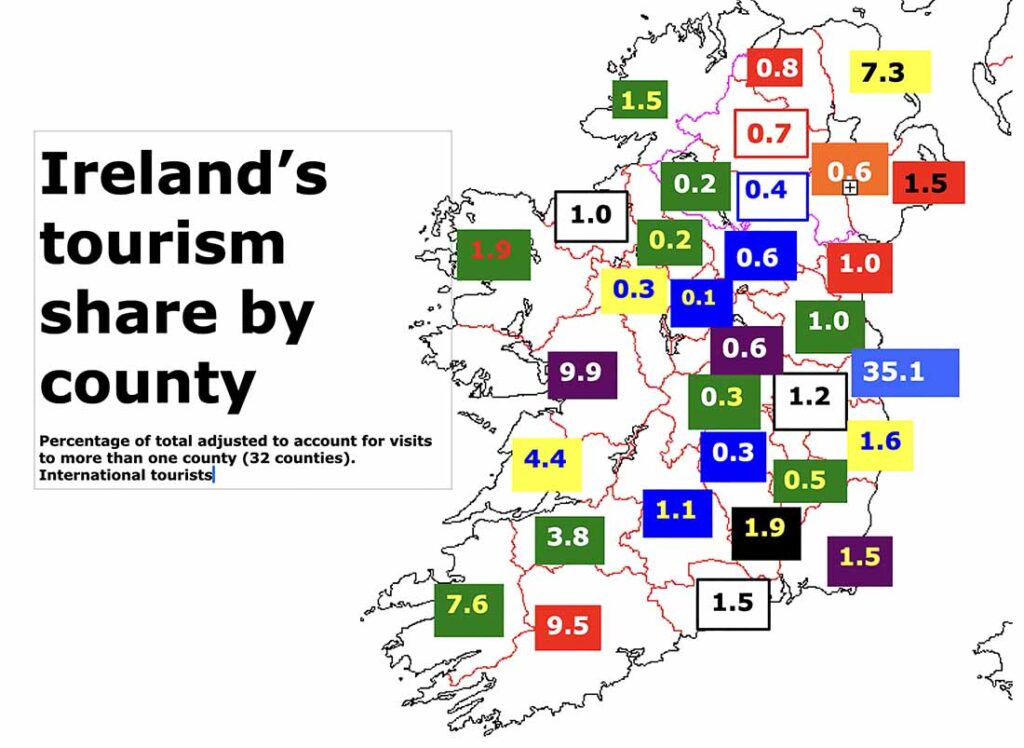
Ireland’s county Derry offers a rich historical tapestry, with the city’s 17th-century walls providing a walkable journey through its past. The Guildhall and Tower Museum explore Derry’s maritime and political history, while the Peace Bridge offers scenic views over the River Foyle. Derry is Ireland’s 15th largest county by size (2,067 square km) and sixth largest by population (252,231). Population previously peaked at 222,174 in 1841 and reached its lowest point, 139,693 in 1926. In terms of hospitality, Derry is Ireland’s 16th most visited tourist county with around 135,000 international visitors per year.
Introduction – Adventure – Anthem – Archaeology – Attractions – Awards – Birdwatching – Camping – Castles – Churches – Contact list – Cycling – Dining – Equestrian – Festivals – Fishing – Folklore – Gardens – Golf – Graveyards – Happening – Haunted – Highest – Hiking – History – Holy Wells – Hotels – Hotels top 8 – Hunting & shooting – Instagrammable – Itineraries – Largest town – Luxury – MICE – Movies – Music – New – Name – Novelists – Off the beaten track – Poets – Pubs – Quotes – Random Facts – Restaurant Awards– Sacred Places – Saints – Songs – Spas – Sports – Sunsets – Sustainable – Things to do – Towns – Video – Villages – Walking – Wanderlist – Weddings – Wild swimming – Writers – 1837 – 1846 – 1852 – 1909 – 1955 – 1980 –