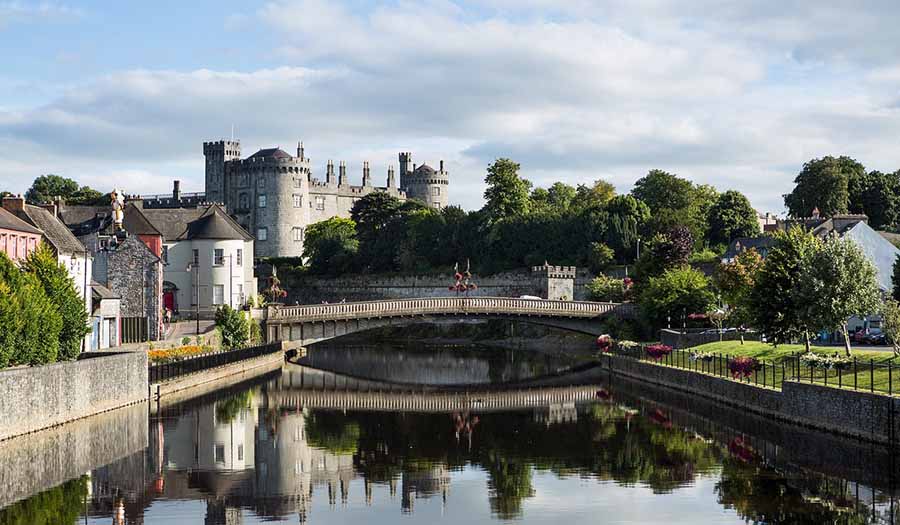
- St Canice’s Cathedral in Kilkenny city crowns a site of continuous Christian worship since the 6th century, when St Canice founded a monastery here as a daughter house of Aghaboe. The cathedral, with its 9th-century round tower climbable for views, honours the saint who gave the city its name (Cill Chainnigh, “Church of Canice”). Pilgrims visit to reflect on his legacy of scholarship and sanctity, atop a hill possibly echoing pre-Christian sacred elevations.
- St Canice’s Well (Kenny’s Well) on Kenny’s Well Road near the Black Abbey is a longstanding holy well linked to the saint, with traditions of curative waters dating back centuries. Used for healing and blessings, it draws devotees for quiet prayer and water collection, preserving ancient hydrolatry customs adapted to Christian intercession, with an annual Mass on the Feast of the Assumption.
- St Kieran’s Well in the city (one of several reputed holy wells) honours St Kieran of Saighir, an early saint and contemporary of St Patrick, with folklore attributing healing properties to the spring. This modest site invites reflection on early evangelisation in Ossory, blending pre-Christian water veneration with saintly devotion in an urban historic context.
- Knockroe Passage Tomb near Freshford stands as a significant Neolithic passage mound with intricate rock art, reflecting pre-Christian ceremonial practices possibly tied to seasonal rituals or ancestor veneration. This ancient tomb invites visitors to contemplate Ireland’s megalithic heritage before Christian overlays in the region.
- Kells Priory ruins, a sprawling medieval Augustinian complex founded in the 12th century, carry echoes of earlier monastic traditions in a defensive riverside setting. Though later in date, its serene atmosphere and graveyard draw those seeking peaceful pilgrimage amid Kilkenny’s ecclesiastical past.
County Kilkenny:
Ireland’s county Kilkenny is a county of medieval charm, with Kilkenny City’s castle and St Canice’s Cathedral showcasing well-preserved architecture and round towers. The Dunmore Cave offers intriguing limestone formations, while the Nore Valley’s walking trails provide scenic beauty. Other attractions include the historic Jerpoint Abbey’s intricate carvings. Kilkenny is Ireland’s 16th largest county by size (2,062 square km) and 21st largest by population (104,160). Population peaked at 202,420 in 1841 and reached its lowest point, 60,463 in 1966. In terms of hospitality, Kilkenny is Ireland’s eleventh most visited tourist county with around 207,000 international visitors per year.
Introduction – Adventure – Anthem – Archaeology – Attractions – Awards – Birdwatching – Camping – Castles – Churches – Contact list – Cycling – Dining – Equestrian – Festivals – Fishing – Folklore – Gardens – Golf – Graveyards – Happening – Haunted – Highest – Hiking – History – Holy Wells – Hotels – Hotels8 – Instagrammable – Itineraries – Largest town – Luxury – MICE – Movies – Musicians – Name – New – Novelists – Off the beaten track – Poets – Pubs – Quotes – Random Facts – Restaurant Awards – Sacred Places – Saints – Spas – Sports – Sunsets– Sustainable – Things to do – Towns – Video – Villages – Walking – Wanderlist – Weddings – Wild swimming – Writers – 1837 – 1846 – 1852 – 1909 – 1955 – 1980 –
Sacred Places
Antrim – Armagh – Carlow – Cavan – Clare – Cork – Derry – Donegal – Down – Dublin – Fermanagh – Galway – Kerry – Kildare – Kilkenny – Laois – Leitrim – Limerick – Longford – Louth – Mayo – Meath – Monaghan – Offaly – Roscommon – Sligo – Tipperary – Tyrone – Waterford – Westmeath – Wexford – Wicklow