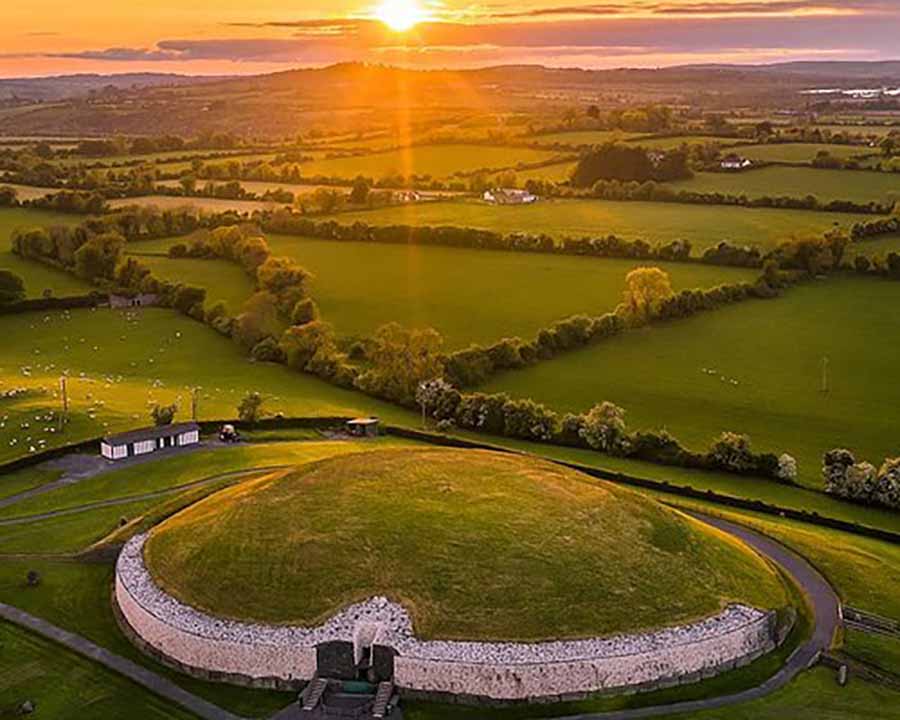
- Hill of Tara: This iconic hill is Ireland’s premier pre-Christian sacred and ceremonial site, revered for over 5,000 years as the seat of the ouose of Niall when they held the High Kingship of Ireland and a place of inauguration. The Lia Fáil (Stone of Destiny) stands here, said to roar when the rightful king placed his foot upon it. It features passage tombs, ringforts, and earthworks from the Neolithic to Iron Age, blending ancient pagan reverence with later Christian traditions, including St Patrick’s legendary visit.
- Hill of Slane: A hilltop site overlooking the Boyne Valley, it holds pre-Christian significance as a possible burial place of the Fir Bolg king Sláine in mythology. It is eternally linked to St Patrick, who lit the first Paschal fire here in defiance of the High King at Tara, marking the symbolic arrival of Christianity. The ruins of a medieval church and a holy well associated with St Patrick draw pilgrims and visitors seeking this pivotal moment in Irish spiritual history.
- Loughcrew Cairns (Sliabh na Caillí): A remarkable complex of Neolithic passage tombs and cairns on the hills near Oldcastle, dating to around 3300 BCE. These ancient megalithic structures reflect profound pre-Christian reverence for the dead, the cosmos, and seasonal cycles, with decorated stones and astronomical alignments. The site evokes Ireland’s earliest ritual landscape and remains a place of quiet wonder for those exploring pagan heritage.
- Trim (with St Patrick’s associations and St Lommán’s traditions): Trim features early Christian sites tied to St Patrick, including traditions of baptisms by his nephew St Lommán. The area includes the imposing Trim Castle (built on earlier ecclesiastical grounds) and nearby church ruins, reflecting the transition from pre-Christian sacred land to Patrician foundations. It attracts visitors interested in Ireland’s patron saint and the spread of Christianity in the Boyne Valley.
- Monasterboice: Founded in the 5th or 6th century by St Buíthe (Buite), a disciple of St Patrick, this early monastic site boasts some of Ireland’s finest high crosses, a round tower, and church ruins. It represents the flourishing of Celtic Christianity and draws pilgrims honouring the saint’s legacy amid a serene, ancient enclosure.
- Kells (with St Colmcille’s monastic site and holy well): An important early medieval monastic centre founded by St Colmcille (Columba) in the 6th century, famed for the Book of Kells. The site includes high crosses, a round tower, and St Colmcille’s Well, a place of pilgrimage for healing and devotion. It embodies the saint’s influence and the enduring spiritual importance of learning and faith.
- St Patrick’s Well, Tara: Located on the Hill of Tara, this holy well is traditionally associated with St Patrick’s presence and blessings. It serves as a focal point for devotion within the ancient royal landscape, where visitors perform prayers and rounds, linking pre-Christian sovereignty rites with Patrician tradition.
- St Ciaran’s Holy Well, Castlekeeran: Near the monastic ruins of Castlekeeran, this striking holy well dedicated to St Ciarán (Kieran) is renowned for its beauty and healing properties, including cures for back pain at its “chair” feature. Set beside a river with bedrock pools and a rag tree, it draws pilgrims for its Celtic origins, Christianised devotion, and serene atmosphere.
- St Brigid’s Well, Ardsallagh: One of the protected and significant holy wells in Meath, dedicated to St Brigid, Ireland’s patroness. It reflects her widespread veneration and possible pre-Christian roots in goddess traditions of fertility and healing. Visitors seek blessings here in a peaceful rural setting.
- St Colmcille’s Well, Calliaghstown: A remarkable holy well near Drogheda, associated with St Colmcille and famed for cures of warts and sores. Its striking structure and folklore make it a notable pilgrimage spot, highlighting the saint’s enduring role in local devotion.
- Trinity Well (source of the Boyne): An ancient well at the legendary source of the River Boyne, tied to pre-Christian mythology and later Christianised. It holds profound symbolic importance in Irish lore as a sacred origin place, attracting those exploring the spiritual geography of the Boyne Valley.
- St Patrick’s Well, Carlanstown (near Kells): A holy well linked to St Patrick, situated in a hamlet and known for its healing traditions. It exemplifies the many Patrician wells across Meath, where pilgrims continue to visit for spiritual renewal and cures, rooted in the saint’s missionary journeys through the county.
County Meath:
Ireland’s county Meath is steeped in Ireland’s ancient past, with the Hill of Tara offering a glimpse into royal history and panoramic views. The UNESCO-listed Brú na Bóinne complex, including Newgrange and Knowth, showcases intricate Neolithic tombs, while Trim Castle provides medieval grandeur. Other attractions include the Boyne River’s scenic walks and historic Slane Castle. Meath is Ireland’s 14th largest county by size (2,336 square km) and eighth largest by population (220,826). Population previously peaked at 183,828 in 1841 and reached its lowest point, 62,969 in 1926. In terms of hospitality, Meath is Ireland’s 19th most visited tourist county with around 122,000 international visitors per year.
Introduction – Adventure – Anthem – Archaeology – Attractions – Awards – Birdwatching – Camping – Castles – Churches – Contact list – Cycling – Dining – Equestrian – Festivals – Fishing – Folklore – Gardens – Golf – Graveyards – Happening – Haunted – Highest – Hiking – History – Holy Wells – Hotels – Hotels8 – Instagrammable – Itineraries – Largest town – Luxury – MICE – Movies – Musicians – Name – New – Novelists – Off the beaten track – Poets – Pubs – Quotes – Random Facts – Restaurant Awards – Sacred Places – Saints – Spas – Sports – Sunsets– Sustainable – Things to do – Towns – Video – Villages – Walking – Wanderlist – Weddings – Wild swimming – Writers – 1837 – 1846 – 1852 – 1909 – 1955 – 1980 –
Sacred Places
Antrim – Armagh – Carlow – Cavan – Clare – Cork – Derry – Donegal – Down – Dublin – Fermanagh – Galway – Kerry – Kildare – Kilkenny – Laois – Leitrim – Limerick – Longford – Louth – Mayo – Meath – Monaghan – Offaly – Roscommon – Sligo – Tipperary – Tyrone – Waterford – Westmeath – Wexford – Wicklow