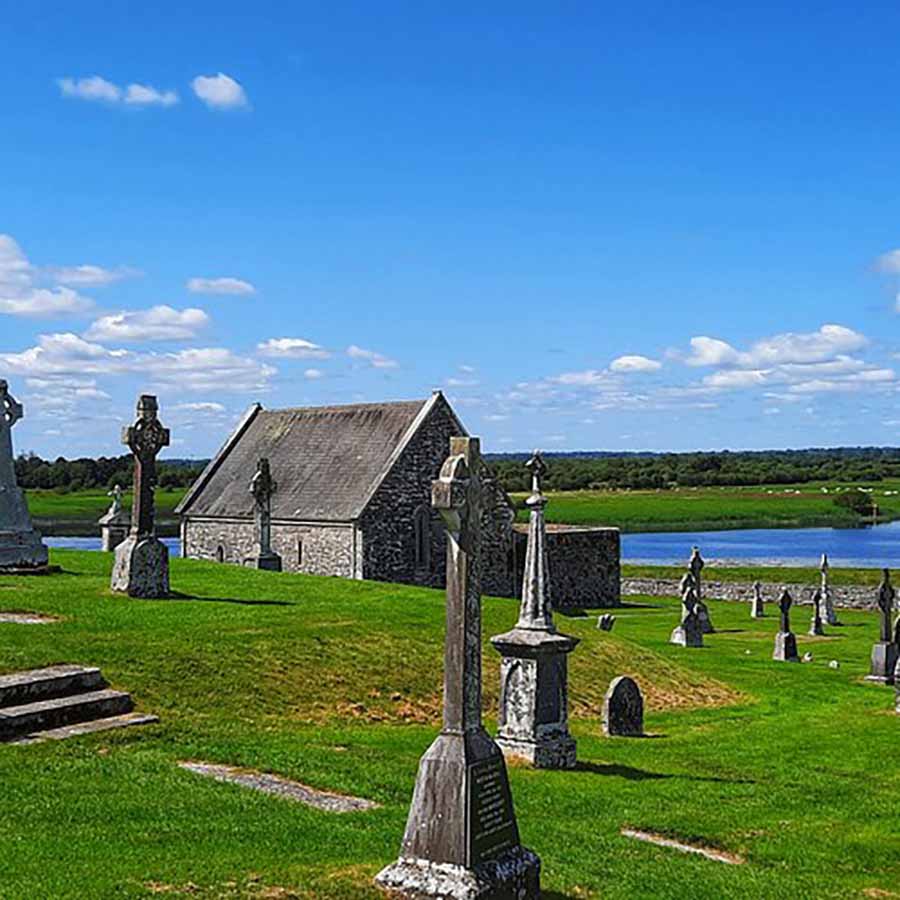
- Clonmacnoise: Founded in 544 by St Ciarán (Kieran), one of Ireland’s Twelve Apostles of Ireland, this is one of the country’s most important early Christian monastic sites. Set on the banks of the River Shannon, it features a cathedral, round towers, high crosses, numerous churches, and hundreds of grave slabs. It became a major centre of learning, pilgrimage, and scholarship, with traditions of rounds and devotion continuing to draw visitors honouring St Ciarán’s legacy. St Ciarán’s Holy Well lies nearby as a focal point for healing and prayer.
- Durrow Monastic Site: Established around 550 by St Colmcille (Columba), this early monastic foundation includes a superb 9th-century high cross, church ruins, and St Colmcille’s Holy Well set in a wooded glen. The site reflects the saint’s influence in spreading Christianity and learning, with the well renowned for curative powers and attracting pilgrims for its serene, ancient atmosphere tied to one of Ireland’s greatest saints.
- Lemanaghan (with St Manchan’s Monastery and Holy Well): An early medieval monastic site linked to St Manchan (Manchán), whose relics were venerated here. The area includes church ruins, a togher (ancient wooden trackway), and St Manchan’s Holy Well beside the ruins, surrounded by a wall, bullaun stone, and a notable ash tree adorned with clooties. It serves as a peaceful pilgrimage spot evoking the ascetic life of early Irish saints and their enduring local devotion.
- Seir Kieran (St Kieran’s Monastic Site and Holy Well): Founded by St Kieran of Seir (a distinct early saint), this ancient ecclesiastical centre features church ruins, a graveyard, and St Kieran’s Holy Well beside a “holy bush” where rounds and prayers are performed. The site highlights the saint’s role in early Christianity in the midlands, with traditions of healing and blessing drawing visitors to this understated yet spiritually significant location.
- Croghan Hill: An extinct volcano long revered in pre-Christian times as a sacred place, possibly linked to early inauguration or ritual use in the landscape. It was among the first areas in Ireland to be Christianised, with folklore of saints’ visits and a holy well tradition. The hill offers panoramic views and a sense of ancient spiritual centrality, attracting those exploring Ireland’s layered pagan and early Christian heritage.
- St Anthony’s Well, Killina: A notable holy well dedicated to St Anthony, set in a rural spot and known for its healing properties in local tradition. It exemplifies the many sacred springs in Offaly that blend pre-Christian reverence for water sources with Christian devotion, drawing pilgrims for prayers, offerings, and cures.
- St Brigid’s Well, Castlearmstrong: Dedicated to St Brigid, this holy well reflects her widespread veneration across Ireland, with possible roots in pre-Christian goddess traditions of fertility and healing. It remains a place of quiet pilgrimage where visitors seek blessings in a peaceful setting tied to one of Ireland’s patron saints.
- Killeigh (Seven Blessed Wells and Rag Tree site): Famous for its cluster of holy wells, including traditions of seven blessed springs, this area features wells and a prominent rag tree where offerings are left. Linked to early Christian devotion and possible pre-Christian sacred water rites, it attracts visitors for its concentration of healing wells and enduring folk practices of prayer and rounds.
County Offaly:
Ireland’s county Offaly is a county of historic depth and natural beauty, with the Clonmacnoise monastic site featuring ancient high crosses and a riverside setting along the Shannon. Tullamore’s historic distillery provides insights into Irish whiskey production, while the Bog of Allen Nature Centre explores the county’s unique peatlands. Other attractions include the Slieve Bloom Mountains’ hiking trails. Offaly is Ireland’s 18th largest county by size (1,998 square km) and ninth smallest by population (83,150). Population peaked at 146,857 in 1841 and reached its lowest point, 51,533 in 1961. In terms of hospitality, Offaly is Ireland’s 30th most visited (and third least visited) tourist county with around 37,000 international visitors per year.
Introduction – Adventure – Anthem – Archaeology – Attractions – Awards – Birdwatching – Camping – Castles – Churches – Contact list – Cycling – Dining – Equestrian – Festivals – Fishing – Folklore – Gardens – Golf – Graveyards – Happening – Haunted – Highest – Hiking – History – Holy Wells – Hotels – Hotels8 – Instagrammable – Itineraries – Largest town – Luxury – MICE – Movies – Musicians – Name – New – Novelists – Off the beaten track – Poets – Pubs – Quotes – Random Facts – Restaurant Awards – Sacred Places – Saints – Spas – Sports – Sunsets– Sustainable – Things to do – Towns – Video – Villages – Walking – Wanderlist – Weddings – Wild swimming – Writers – 1837 – 1846 – 1852 – 1909 – 1955 – 1980 –
Sacred Places
Antrim – Armagh – Carlow – Cavan – Clare – Cork – Derry – Donegal – Down – Dublin – Fermanagh – Galway – Kerry – Kildare – Kilkenny – Laois – Leitrim – Limerick – Longford – Louth – Mayo – Meath – Monaghan – Offaly – Roscommon – Sligo – Tipperary – Tyrone – Waterford – Westmeath – Wexford – Wicklow