Pre-1000 The Gaelic Nation
County Offaly, originally part of the kingdoms of Mide and house of Fáilghe (from which its name derives), was a Gaelic stronghold under the O’Connor Faly (Ó Conchobhair Failghe) clan, who ruled the region by the 8th century. Archaeological evidence, such as the Clonmacnoise monastic site (founded c. 544 by St. Ciarán), highlights Offaly’s early significance as a religious and cultural centre along the River Shannon. Clonmacnoise produced manuscripts and attracted pilgrims, as noted in The Annals of Ulster. The county’s bogs and fertile lands supported a cattle-based economy. Viking raids in the 9th century targeted Clonmacnoise, but its inland location offered some protection. The O’Connors, linked to the house of Niall, maintained regional power, with Durrow Abbey also emerging as a key monastic site.
1000–1100: Gaelic Dominance and Monastic Prosperity
Offaly remained under O’Connor Faly control, with Clonmacnoise at its peak as a centre of learning and ecclesiastical power. The O’Connors navigated alliances with the High Kings, including Máel Sechnaill II,. The Annals of the Four Masters record conflicts between Mide’s dynasties and Connacht’s O’Connors, with Offaly as a contested frontier. The county’s monasteries, including Clonmacnoise and Durrow, thrived, producing artifacts like the Cross of the Scriptures. Offaly’s strategic position along the Shannon made it a trade hub, though Viking raids persisted. The Synod of Kells (1152) later formalised Clonmacnoise’s diocesan role, underscoring its importance.
1100–1200: Norman Arrival and Gaelic Resistance
The Norman invasion (1169) impacted Offaly, with the Normans advancing into Mide. By 1170, Strongbow’s forces reached Offaly, but the O’Connor Faly resisted, maintaining control over the house of Failghe dynasty. Clonmacnoise faced Norman plundering but remained a Gaelic stronghold. The Normans built early fortifications, such as at Birr, but their influence was limited compared to Meath. The O’Connors allied with Connacht’s O’Connors to counter Norman expansion, as recorded in The Annals of Tigernach. Offaly’s bogs and rivers deterred large-scale Norman settlement, preserving Gaelic dominance. Monastic sites continued to drive local economy and culture, with Clonmacnoise’s wealth attracting both pilgrims and raiders.
1200–1300: Norman-Gaelic Coexistence
The Normans, under families like the de Berminghams, established a presence in Offaly, building castles at Birr and Kinnitty. The O’Connor Faly retained control over much of Uí Failghe, balancing submission to Norman lords with Gaelic autonomy. Clonmacnoise’s influence waned slightly due to Norman oversight, but new monasteries, like Seirkieran, emerged. The Black Death (1348–1350) reduced Offaly’s population. The county’s economy relied on agriculture, with oats and cattle prominent, as noted in historical surveys. The Annals of Connacht record the O’Connors’ resistance to Norman rule, while the lives of such as early de Berminghams highlight their integration into local power structures.
1300–1400: Gaelic Resurgence and Norman Decline
The decline of Norman authority allowed the O’Connor Faly to reassert control over Offaly. The dynasty built strongholds, such as Leap Castle, to defend their territory. The de Berminghams and other Anglo-Norman families adopted Gaelic customs, becoming Hiberno-Norman. Clonmacnoise remained a religious centre, though its wealth attracted English scrutiny. The county’s bogs and forests limited external control, preserving its Gaelic character. The Annals of Ulster note the O’Connors’ alliances with the O’Neills and O’Briens, reflecting Offaly’s role in regional politics. Offaly was a semi-autonomous frontier between the Pale and Gaelic territories.
1400–1500: Late Medieval Autonomy
Offaly remained under O’Connor Faly dominance, with the dynasty recognised as lords of Uí Failghe. The county’s castles, including Clonony and Leap, were fortified to counter threats from the Pale and neighbouring Gaelic lords. The O’Connors maintained autonomy by navigating alliances with the Burkes and O’Neills. Monastic decline continued, with Clonmacnoise losing prominence, though smaller abbeys like Rahan persisted. Offaly’s fertile lands supported agriculture, with trade along the Shannon. The Annals of Ulster record the O’Connors’ feuds. Offaly’s distance from Dublin ensured limited English interference, preserving its Gaelic identity.
1500–1600: Tudor Conquest and O’Connor Decline
The Tudor reconquest brought Offaly under English control. In 1556, the county was shired as King’s County, named for Philip II of Spain (husband of Mary I), marking the end of O’Connor Faly autonomy. The plantation of Laois and Offaly (1556) saw English settlers, including the Moores, granted lands,. The O’Connors resisted, with figures like Brian O’Connor Faly rebelling until his exile in 1562. The Nine Years’ War (1593–1603) saw limited fighting in Offaly, but its proximity to the Pale made it a strategic zone. Clonmacnoise’s lands were secularised, diminishing its role. The Annals of the Four Masters document the O’Connors’ decline, while early plantations reshaped Offaly’s demographics.
1600–1700: Plantation and Cromwellian Upheaval
The plantation of Offaly intensified, with English families like the Parsons settling in Birr and Tullamore. The 1641 Rebellion saw the O’Connors and Gaelic Catholics briefly reclaim lands, but Cromwell’s campaign (1649–1653) crushed resistance, confiscating estates for English settlers. The transplantation to Connacht forced many Gaelic families westward, though some O’Connors remained as tenants. The Williamite War (1689–1691) had minimal impact on Offaly, which aligned with William III. Birr Castle, developed by the Parsons, became a symbol of Anglo-Irish power, while Offaly’s Catholic majority faced Penal Law restrictions.
1700–1800: Anglo-Irish Ascendancy
Offaly’s Anglo-Irish landlords, including the Parsons and Moores, dominated under the Penal Laws. The county’s economy relied on agriculture, with Tullamore and Birr as market towns. The Royal Canal, begun in 1790, boosted trade, reaching Tullamore by 1804. The 1798 Rebellion saw minor unrest in Offaly, with local militias suppressing Catholic uprisings, entries on figures like Charles Moore. The Act of Union (1800) integrated Offaly into English rule, reducing local influence. Estates like Charleville Castle reflected Ascendancy wealth, as per archaeological surveys.
1800–1900: Famine and Reform
The Great Famine (1845–1852) devastated Offaly, with its population falling from 147,000 in 1841 to 112,000 by 1851, per census records. Workhouses in Tullamore and Edenderry were overwhelmed, and emigration surged. The county’s bogs were exploited for turf, supporting local economies. The Land League, active in Offaly, pushed for tenant rights, challenging landlords like the Parsons. The Gaelic Revival sparked interest in Clonmacnoise and Uí Failghe’s history. Tullamore’s distillery, established in 1829, grew in prominence, as noted in historical surveys.
1900–2025: Independence and Modernisation
Offaly played a role in the War of Independence (1919–1921), with IRA ambushes in Tullamore and Birr, as documented in History Ireland. The county joined the Irish Free State in 1922, reverting to the name Offaly from King’s County. The population stabilised, reaching 76,687 by 2022, per census data. Infrastructure, including the M6 and M7 motorways, enhanced connectivity. Tourism grew, focusing on Clonmacnoise (a UNESCO tentative site), Birr Castle’s gardens, and the Slieve Bloom Mountains. Offaly’s economy diversified, with agriculture, whiskey production (Tullamore D.E.W.), and renewable energy prominent. Offaly is one of 24 Irish counties that still has a smaller population than it did in 1841.
History of the county
Antrim – Armagh – Carlow – Cavan – Clare – Cork – Derry – Donegal – Down – Dublin – Fermanagh – Galway – Kerry – Kildare – Kilkenny – Laois – Leitrim – Limerick – Longford – Louth – Mayo – Meath – Monaghan – Offaly – Roscommon – Sligo – Tipperary – Tyrone – Waterford – Westmeath – Wexford – Wicklow
County Offaly:
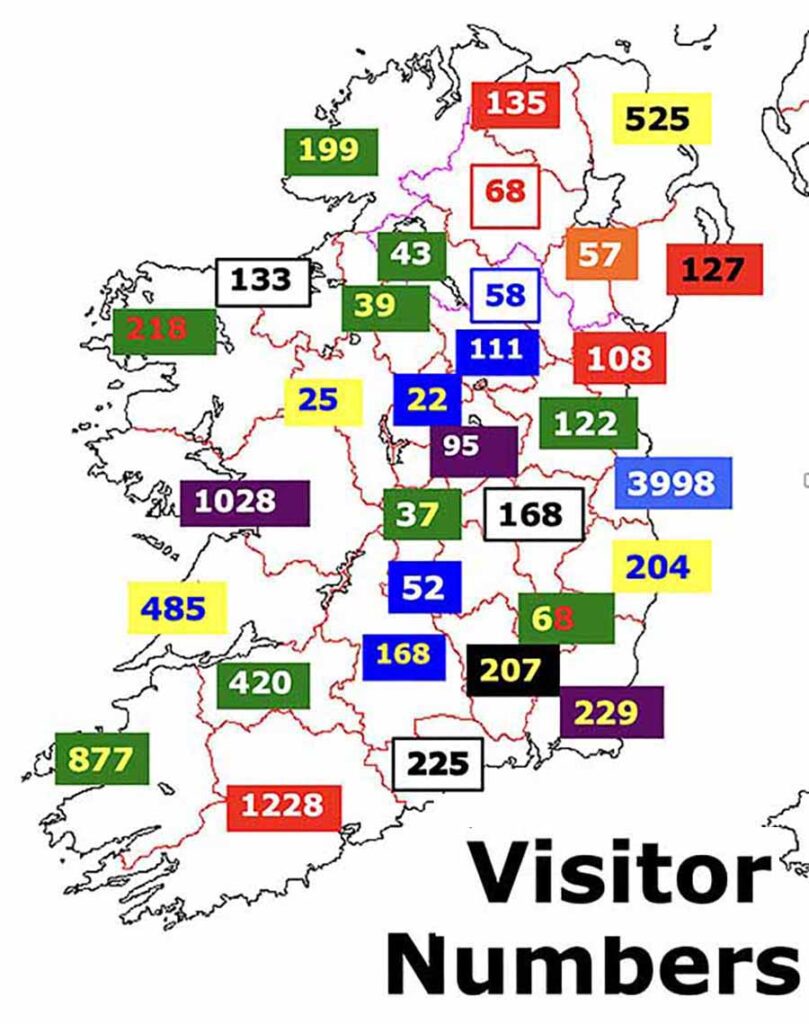
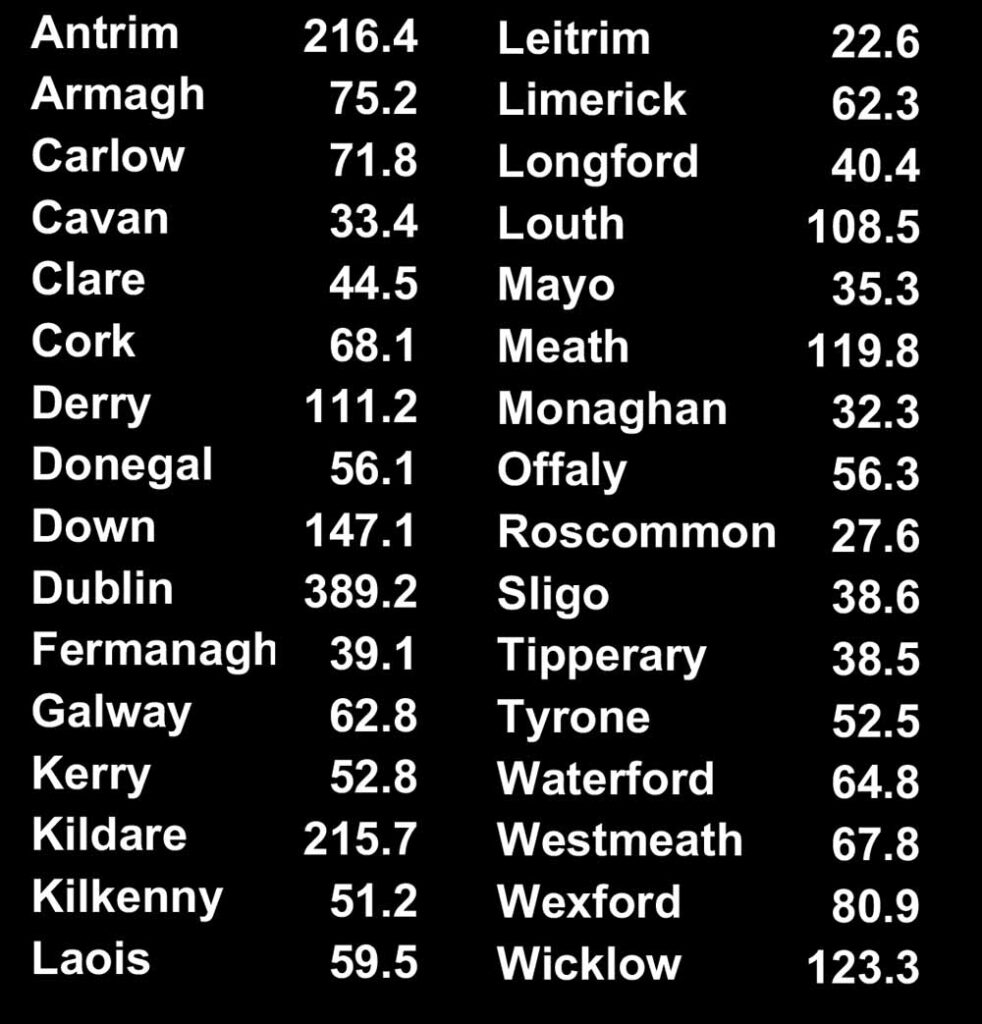
Ireland’s county Offaly is a county of historic depth and natural beauty, with the Clonmacnoise monastic site featuring ancient high crosses and a riverside setting along the Shannon. Tullamore’s historic distillery provides insights into Irish whiskey production, while the Bog of Allen Nature Centre explores the county’s unique peatlands. Other attractions include the Slieve Bloom Mountains’ hiking trails. Offaly is Ireland’s 18th largest county by size (1,998 square km) and ninth smallest by population (83,150). Population peaked at 146,857 in 1841 and reached its lowest point, 51,533 in 1961. In terms of hospitality, Offaly is Ireland’s 30th most visited (and third least visited) tourist county with around 37,000 international visitors per year.
Introduction – Adventure – Anthem – Archaeology – Attractions – Awards – Birdwatching – Camping – Castles – Churches – Contact list – Cycling – Dining – Equestrian – Festivals – Fishing – Folklore – Gardens – Golf – Graveyards – Happening – Haunted – Highest – Hiking – History – Holy Wells – Hotels – Hotels top 8 – Hunting & shooting – Instagrammable – Itineraries – Largest town – Luxury – MICE – Movies – Music – Name – New – Novelists – Off the beaten track – Poets – Pubs – Quotes – Random Facts – Restaurant Awards – Sacred Places – Saints – Songs – Spas – Sports – Sunsets – Sustainable – Things to do – Towns – Video – Villages – Walking – Wanderlist – Weddings – Wild swimming – Writers – 1837 – 1846 – 1852 – 1909 – 1955 – 1980 –