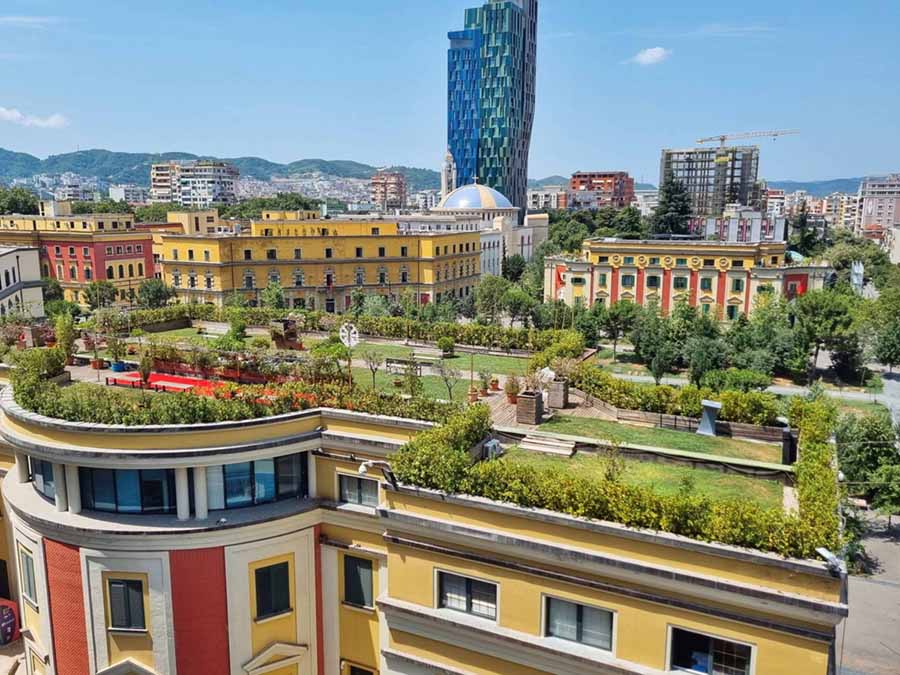
Begin your tour at Skanderbeg Square, the bustling heart of Tirana and the perfect starting point for this two-and-a-half-hour walking exploration of the city’s rich history.
Allow about twenty minutes here to absorb the atmosphere of this expansive pedestrianised space, which was redesigned in 2017 but whose story stretches back centuries. Dominating the square is the imposing bronze statue of Gjergj Kastrioti Skanderbeg (1405–1468), Albania’s national hero. A skilled Ottoman military commander who renounced Islam and returned to his Christian roots, Skanderbeg led a twenty-five-year rebellion against the Ottoman Empire from 1443 until his death, uniting Albanian principalities and earning the admiration of European leaders for delaying the Ottoman advance into the continent.
From the square, stroll a short two-minute walk south-west to the elegant Et’hem Bey Mosque, one of Tirana’s most beautiful and historically significant landmarks. Construction began in 1794 under Molla Bey and was completed in 1821 by his son, Haxhi Et’hem Bey, a prominent Ottoman-era administrator and philanthropist. The mosque’s delicate frescoes depicting landscapes and floral motifs (unusual for Islamic art of the period) reflect a blend of Ottoman and local Albanian artistry.
Remarkably, it survived the communist ban on religion imposed in 1967 and reopened to worshippers in 1991 after the fall of the regime.
Next, step just metres away to the adjacent Clock Tower, built in 1822 by the same Et’hem Bey family as a gift to the city. Standing thirty-five metres tall, it once served as a public timekeeper for merchants and residents alike; its bell was cast in 1824 in Venice. Climb the 90 steps (if you wish) for panoramic views—allow ten minutes here to appreciate how the tower symbolised Tirana’s transition from Ottoman provincial town to modern capital.
Continue your walk east for five minutes along the lively boulevard to the National Historical Museum, housed in a striking building completed in 1981 during the late communist period. Its vast mosaic façade, entitled “The Albanians”, depicts key moments in the nation’s story from Illyrian times to the partisan struggle. Inside (entry is optional but recommended for the tour’s pace), the museum traces Albania’s history through artefacts spanning prehistory to the 20th century; linger for twenty-five minutes to learn about the 1912 declaration of independence from the Ottomans and the turbulent interwar years under King Zog I (born Ahmed Muhtar Zogolli, 1895–1961).
From the museum, head north-west along the broad Dëshmorët e Kombit Boulevard for a pleasant ten-minute walk, passing the Palace of Culture (opened in 1963 as a Soviet-Albanian collaboration) before reaching the striking Pyramid of Tirana. Originally opened in 1988 as the Enver Hoxha Museum to honour the dictator who ruled Albania with an iron fist from 1944 until his death in 1985, the structure was designed by Hoxha’s daughter and son-in-law. After the fall of communism in 1991 it fell into disuse before being reborn in 2023 as a vibrant cultural and educational centre. Spend twenty minutes here reflecting on Hoxha’s isolationist regime, which left Albania one of Europe’s poorest and most closed nations.
Finally, wander five minutes south into the leafy Blloku district, once the exclusive enclave of communist party elites where ordinary citizens were forbidden entry until 1991. Stroll the stylish streets lined with cafés and boutiques that now occupy former villas of the nomenklatura; the area’s transformation symbolises Albania’s shift to democracy and European integration. Conclude your tour in this lively quarter after a final fifteen-minute reflective pause—perhaps over a coffee—having covered approximately four kilometres in a relaxed two-and-a-half hours while immersing yourself in Tirana’s journey from Ottoman outpost to vibrant Balkan capital.