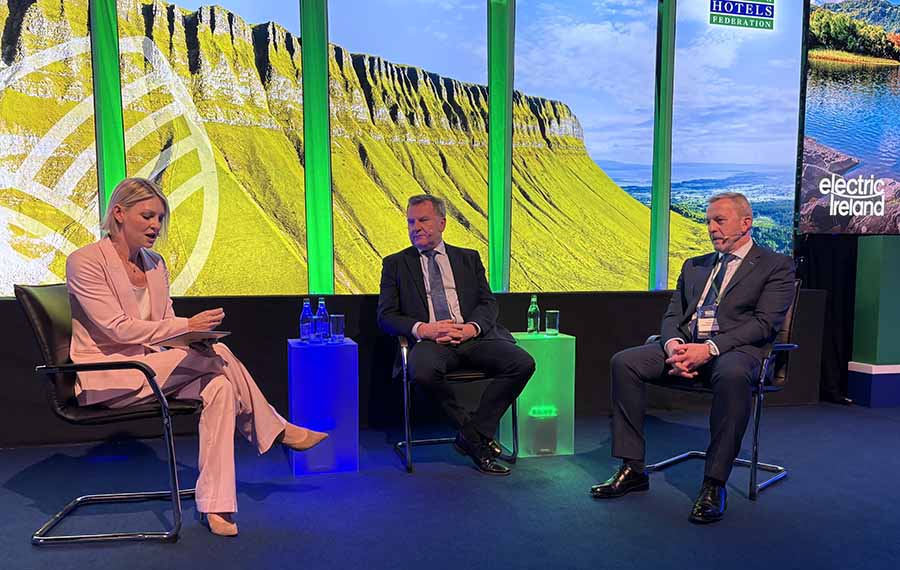
Urgent action is needed to expand accommodation outside cities, support staff housing, and diversify source markets, Irish Hotels Federation Chief Executive Paul Gallagher told delegates at the organisation’s Annual Conference in Killarney on 24 February 2026.
Gallagher praised Minister for Tourism Peter Burke for his engagement and leadership and said the relocation of tourism to a business-focused government department has delivered real progress for the sector, but. He credited the new departmental alignment with delivering a strong outcome in Budget 2026, including the VAT reduction on hospitality services. “Peter Burke means business,” he said. “We advocated hard and got what we wanted, maybe we should enjoy it while it lasts.”
He stressed the need for new hotel development beyond urban centres. “We are building hotels in cities, but to the detriment of the rest of the country. Tourism will not thrive if everything is centralised.” Competition for sites in cities is fierce, and local opposition to hotel construction is growing despite the jobs and taxes the sector generates.
To improve viability, Gallagher highlighted ongoing discussions around split mortgages: longer-term financing for core and shell structures, shorter-term for fit-out. With typical construction costs at €500,000 per room, such structures would extend debt tails and make projects more attractive to pillar banks.
Air access remains the main constraint on growth, but new gateways are opening. Gallagher expressed confidence in continued American visitation. “All things being equal, and we don’t have a war, Americans will keep coming. They have a great time here and find us very competitively priced compared with the States.”
He warned against over-reliance on the US market. “We cannot put all our eggs in one basket.” The British market, particularly group and escorted tours, requires renewed attention. Recent trade events in Britain showed too few Irish hospitality operators maintaining connections. “When things turn, and they will, we will regret not watching other markets more closely.”
Gallagher welcomed the short-term lets register for providing visibility on the scale and location of the sector. Compliance decisions on fire, health, safety, insurance and taxation now rest with government. While he did not want legitimate operators forced out by planning rules, he criticised large multi-unit operators in Dublin apartments for adding nothing to tourism spend, investing nothing in marketing, and disrupting the residential rental and staff accommodation markets.
Rising rents have reached a tipping point, he said. “Hotels need employees near their properties. There is no point running a hotel in Dublin with staff commuting from Clane, Naas or Drogheda. They will not stay in the industry. Affordable housing close to workplaces is essential to retain talent.”
At European level, Gallagher noted the new tourism commissioner is developing a pan-European plan, including integrated ticketing: “It would be great to buy a train ticket in Dublin to Rome without 15 separate bookings” and a unified tourism brand to encourage intra-European travel.
On digital issues, he reported progress under the Digital Markets Act. The IHF believes it has won its case against Booking.com over parity clauses. A penalty phase is under way, with Booking.com provisioning €2.7 million in its 2024 accounts for potential liability.
Gallagher also raised concerns about “dark patterns” and platform practices that disadvantage direct hotel bookings. He pointed out that Booking.com, which owns no hotels, generates more profit from room sales than the entire European hotel industry. “Something is wrong when intermediaries make more money doing nothing.”
On artificial intelligence, he predicted practical applications in back-office functions (HR, IT, finance), data insights for revenue management, robotic cleaning and self check-in. However, he emphasised the people-centric nature of hospitality. “No robot will replace your waiter or pull your pint anytime soon, that would be dangerous.”
Gallagher concluded that while Europe moves slowly, it is strengthening rules against unfair platform practices. The sector must continue advocating for faster progress to protect competitiveness.
IHF conference 2026
- WATCH: Inaugural speech of Matt O’Connor President of the Irish Hotels Federation
- WATCH: Michael Magner looks back on his two year term as president of the Irish Hotels Federation
- Irish Hotels Federation elects Matt O’Connor as 41st president
- ‘We need to reframe the narrative around tourism’ – minister Peter Burke at IHF Conference
- ‘Even a 1pc increase would generate €150m’ – Fáilte Ireland’s Caroline Bocquet speaks about new ‘Find Yourself on a Short Break’ campaign at IHF Conference
- ‘Suspending Dublin airport cap has unlocked 12pc increase in aircraft seats’ – Alice Mansergh at IHF Conference
- Challenging but rewarding’ – Michael Magner hands over chain after two years as hotel federation president
- ‘Travel and tourism is the fastest growing sector in the world’s economy’ – Ray Kearney at IHF Conference
- ‘Urgent action needed to expand accommodation outside cities’ – Paul Gallagher at IHF Conference
- ‘The first two seconds in all short form content matter most’ – Get Z marketer Erifili Gounari at IHF Conference
- ‘Nobody has ever told me that working from home is more fun’ – Peter Cosgrove at the IHF Conference
- BARRIERS: Hotel Federation conference is told 45pc of hotel expansions have been put on hold
- ‘Dishes made with minimal ingredients are the ones tourists will remember in 20 years time’ – chef Rory O’Connell at IHF Conference
- AI will push value back to human elements that are central to hospitality – IBEC CEO Danny McCoy at IHF Conference