A county of Ireland, in the province of Ulster. It is an inland county, bounded on the north by the co. Tyrone, on the east by the co. Armagh, on the south by the co. Louth, and on the west by the cos. Fermanagh and Cavan. Its greatest length, from north to south, is about 36 miles; its greatest breadth, from east to west, about 28 miles; and its area is computed at 319,876 acres, or 500 square miles, of which about 2,880 acres are water.
The general surface is undulating, and in some parts hilly, but nowhere mountainous. The highest grounds are in the north and north-west, where the principal elevations are Slieve Beagh, 1,385 feet, and other hills rising to 800-1,200 feet. The soil is generally a strong clay loam, in many districts very fertile, and well adapted to tillage; but in the hilly and northern parts, it is often cold, wet, and spongy, requiring much improvement by draining and liming. The county is well watered by the rivers Blackwater, which forms part of the southern boundary and flows into Lough Neagh; the Finn, flowing westward into Lough Erne; the Fane, flowing southward to Dundalk Bay; the Annalee or Dromore, flowing into the Erne system; and numerous smaller streams. The principal lakes are Lough Muckno (about 200 acres), Lough Egish, Lough Ross, and smaller sheets of water scattered over the surface.
The agriculture of the county is in a progressive state of improvement. The principal crops are oats, potatoes, barley, wheat (in the better districts), and flax. Dairy husbandry is carried on to a considerable extent, and large quantities of butter are sent to market. The farms are generally small, and subdivision has been carried to excess; but consolidation and better management are gradually taking place. Limestone is abundant, and is largely used as manure; marl and shell-sand are also employed in some districts.
The manufactures are not extensive. Linen-weaving, formerly carried on more largely, is now chiefly domestic; and some coarse woollens are made. There are several distilleries, breweries, and flour-mills.
The population, by the census of 1841, was 200,819, showing an increase of 12,890, or about 6.85 per cent, upon the population of 1831, which was 187,929. The inhabited houses in 1841 were 31,929; in 1831, 29,366. The families chiefly employed in agriculture in 1841 numbered 22,156; in manufactures and trade, 2,845; in other pursuits, 1,336. The number of males above 5 years who could read and write was 10,245; who could read only, 4,567; who could neither read nor write, 18,945. The corresponding numbers for females were 4,567 read and write; 3,456 read only; 22,345 neither.
The county is divided into the baronies of Dartree, Monaghan, and Trough; but older divisions recognize Cremorne (Upper and Lower), Farney, and others. It contains 28 civil parishes, and parts of others. It is included in the dioceses of Clogher and Armagh. The poor-law unions are Monaghan, Clones, Castleblayney, and Ballybay. The county returns two members to parliament (previously three until the Union); and the borough of Monaghan was disfranchised.
The chief towns are Monaghan (the county town, pop. 3,707 in 1841), Clones (pop. 2,944), Castleblayney (pop. 1,657), Ballybay (pop. 1,369), Carrickmacross (pop. 2,284), and smaller market villages like Emyvale, Rockcorry, and Scotstown.
The antiquities include remains of ancient castles, abbeys, and raths; the principal modern seats are Dartrey (Lord Cremorne), Castleblayney House (Lord Blayney), Monaghan House, and others.
Ireland in 1846
Antrim – Armagh – Carlow – Cavan – Clare – Cork – Derry – Donegal – Down – Dublin – Fermanagh – Galway – Kerry – Kildare – Kilkenny – Laois – Leitrim – Limerick – Longford – Louth – Mayo – Meath – Monaghan – Offaly – Roscommon – Sligo – Tipperary – Tyrone – Waterford – Westmeath – Wexford – Wicklow
County Monaghan:
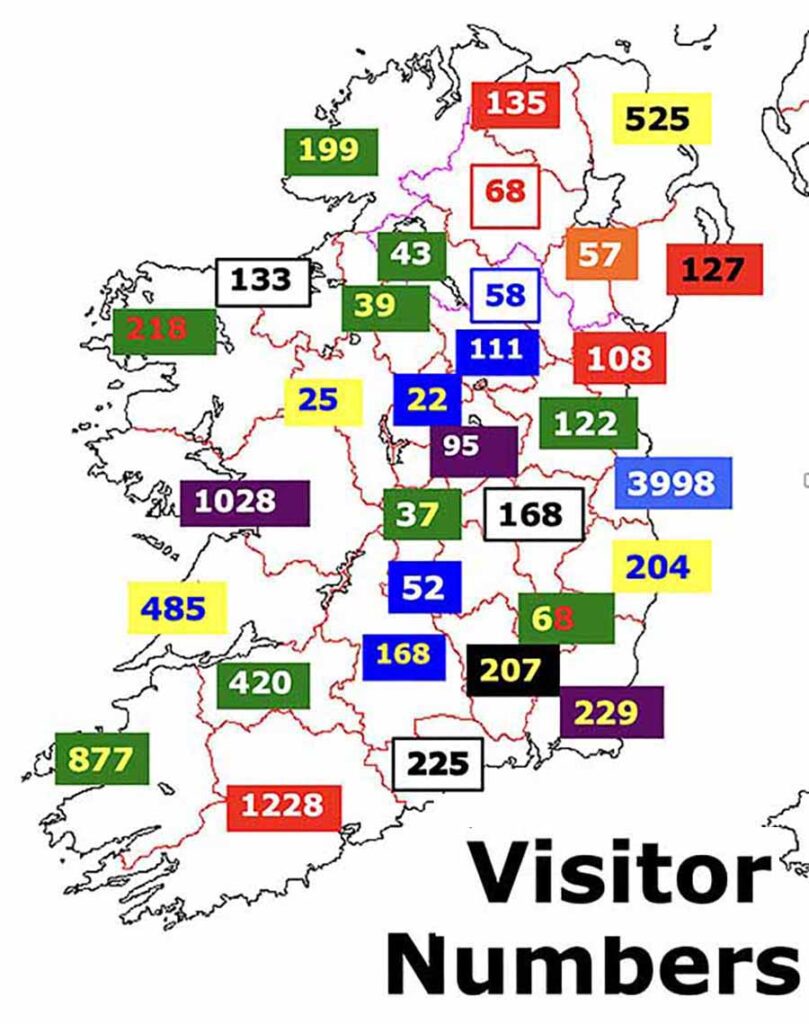
Ireland’s county Monaghan offers a serene blend of rolling hills and cultural heritage, with the Monaghan County Museum showcasing local history through artefacts and exhibits. The scenic Rossmore Forest Park provides walking trails amidst lakes and woodlands, while Castle Leslie’s historic estate offers a glimpse into aristocratic life. Other attractions include the county’s traditional lace-making heritage and quiet countryside. Monaghan is Ireland’s sixth smallest county by size (1,291 square km) and fifth smallest by population (65,288). Population peaked at 200,442 in 1841 and reached its lowest point, 45,732 in 1966. In terms of hospitality, Monaghan is Ireland’s 25th most visited tourist county with around 58,000 international visitors per year.
Introduction – Adventure – Anthem – Archaeology – Attractions – Awards – Birdwatching – Camping – Castles – Churches – Contact list – Cycling – Dining – Equestrian – Festivals – Fishing – Folklore – Gardens – Golf – Graveyards – Happening – Haunted – Highest – Hiking – History – Holy Wells – Hotels – Hotels top 8 – Hunting & shooting – Instagrammable – Itineraries – Largest town – Luxury – MICE – Movies – Music – Name – New – Novelists – Off the beaten track – Poets – Pubs – Quotes – Random Facts – Restaurant Awards – Sacred Places – Saints – Songs – Spas – Sports – Sunsets – Sustainable – Things to do – Towns – Video – Villages – Walking – Wanderlist – Weddings – Wild swimming – Writers – 1837 – 1846 – 1852 – 1909 – 1955 – 1980 –