A maritime county of Ireland, in the province of Munster, is bounded, on the north, by the counties of Tipperary and Kilkenny; on the east, by Waterford harbour and the Irish Sea; on the south, by the Irish Sea; and on the west, by the county of Cork. Its form is very irregular, but may be roughly described as an irregular curved triangle, with its apex at the north-east, and its base along the south coast. Its greatest length, from Knockmahon Head in the south-west to the eastern extremity of Gaultier, is about 48 miles; its greatest breadth, from the Suir at Carrick to the coast at Ardmore, is about 30 miles; and its narrowest part, in the vicinity of Cappoquin, is not less than 24 miles. Its area is computed at 719,716 acres, or 1,124 square miles, of which 10,000 acres are water, and the rest land. It is divided into the baronies of Decies-without-Drum, Decies-within-Drum, Middlethird, Upperthird, and Gaultier (a half-barony); and these are subdivided into 43 parishes, some of which are united for parochial purposes.
The surface is greatly diversified. A range of mountains, called the Cummeragh or Comeragh mountains, runs parallel to the south coast, at distances varying from 4½ to 18 miles, and attains elevations from 400 to 2,597 feet, the principal summits being Seefin 2,367 feet, Knockanaffrin 2,476 feet, and others ranging from 608 to 1,952 feet. Another range, the Drum hills, runs parallel to the coast at 1 to 8 miles distance, with summits from 452 to 993 feet. The Knockmealdown mountains form a broad interior range on the Tipperary border, 13 to 24 miles from the sea, about 15 miles long, with summits from 400 to 2,609 feet, including Knockmeledown 2,609 feet, Knocknafallia 2,199 feet, and Sugarloaf Hill 2,144 feet. The general elevation rises from the coast inland; about one-third is upland or mountain, and two-thirds dale or valley. The soil is various: rich black loam in the north, gravelly loam in the centre for pasture and dairy, sandy in the south improvable from heath and furze, limestone plain in the east, argillaceous in the uplands; valleys fertile, uplands moorish or rocky in parts, but in general of high fertility for mixed farming.
The principal rivers are the Suir, which forms the northern boundary, navigable for sea-vessels to Waterford and for river craft to Clonmel; the Blackwater, which enters from the west and flows south-east to the sea at Youghal; the Bride, Colligan, Brickey, Tay, Maghan, and various smaller streams. Lakes are small and few, chiefly in the mountains (e.g, in the Cummeragh range). The coast-line is about 40 to 80 miles, much indented with bays and harbours (Waterford Harbour navigable for large vessels, Dungarvan, Tramore, Youghal Bays), headlands (Hook Head, Crooke Point, Stradbally Head), cliffs, coves, and small islands.
The climate is mild and humid, with south-west winds prevalent, rainfall about 40 inches, harvests earlier than in the north, salubrious though moist, with occasional severe gales.
Minerals include limestone (abundant and fine for building and agriculture, especially near Lismore), marble, sandstone, slate, granite; small coal districts; no important metalliferous deposits.
Agriculture is the chief pursuit, with wheat, barley, oats, potatoes, flax, and green crops; dairy produce (butter, cheese), bacon, livestock (improved breeds of cattle, sheep, pigs, horses); farms generally 20 to 50 acres; enclosures good; produce abundant.
Manufactures include cotton (extensive at Portlaw, employing large numbers since about 1818), linen, woollen, brewing, distilling, soap; trade chiefly export of provisions, grain, butter, bacon, fisheries (salmon, herring, cod, hake).
Population in 1841: 159,799 (some computations vary to 174,795 or higher in broader contexts), showing increase from 145,136 in 1831; houses about 26,614 to 29,729. Families chiefly agricultural.
The county is well roaded (mail and coach routes to Dublin, Cork, &c.); Suir navigation improved; railways projected or in progress (e.g, lines connecting to great southern and western systems).
Antiquities include cromlechs (e.g, on Sugarloaf Hill), monastic ruins, castles (Lismore Castle, Knockmahon, &c.), ancient churches, round towers in places; historical notes on the ancient territory of the Decies, Norman settlements, &c.
The principal towns are Waterford (the county town and chief seaport), Dungarvan, Lismore, Cappoquin, Tallow, Portlaw (manufacturing), Tramore (bathing place), Stradbally, Kilmacthomas, &c.
Seats include Curraghmore (Marquis of Waterford), Lismore Castle (Duke of Devonshire), Mount Mellick, &c.
Ecclesiastically, it is in the diocese of Lismore (Established Church) and corresponding Roman Catholic diocese; numerous parishes, chapels, schools (National Board schools numerous).
Poor-Law unions: Waterford, Dungarvan, Lismore.
Ireland in 1846
Antrim – Armagh – Carlow – Cavan – Clare – Cork – Derry – Donegal – Down – Dublin – Fermanagh – Galway – Kerry – Kildare – Kilkenny – Laois – Leitrim – Limerick – Longford – Louth – Mayo – Meath – Monaghan – Offaly – Roscommon – Sligo – Tipperary – Tyrone – Waterford – Westmeath – Wexford – Wicklow
County Waterford:
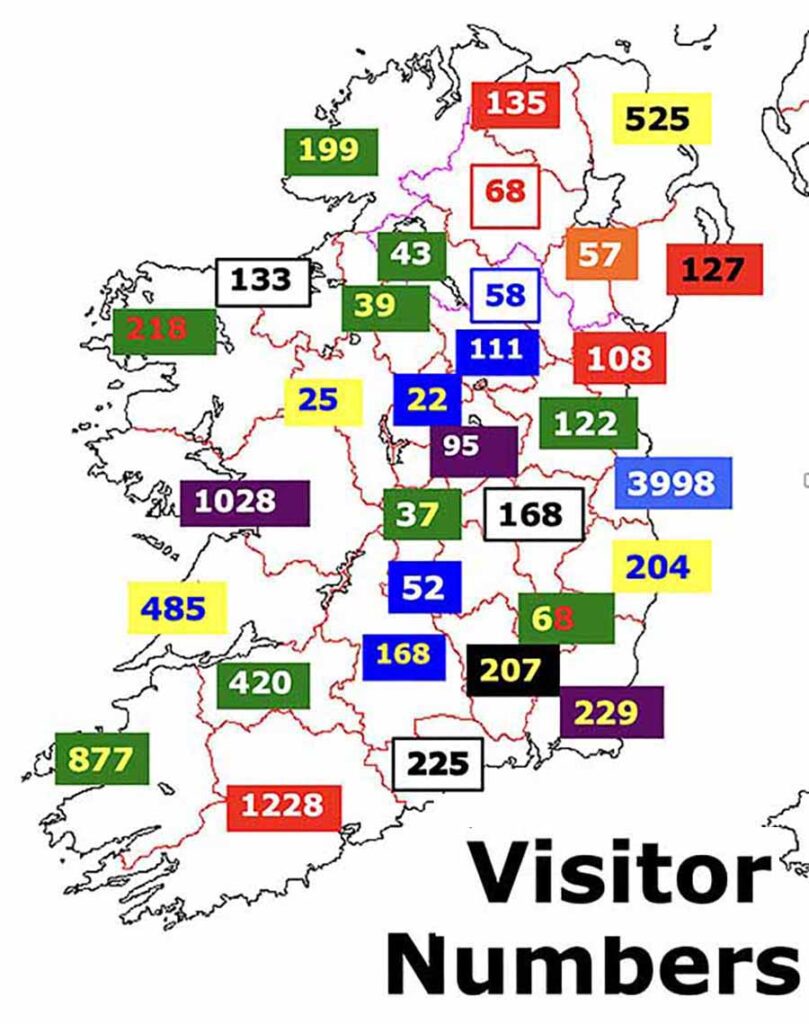
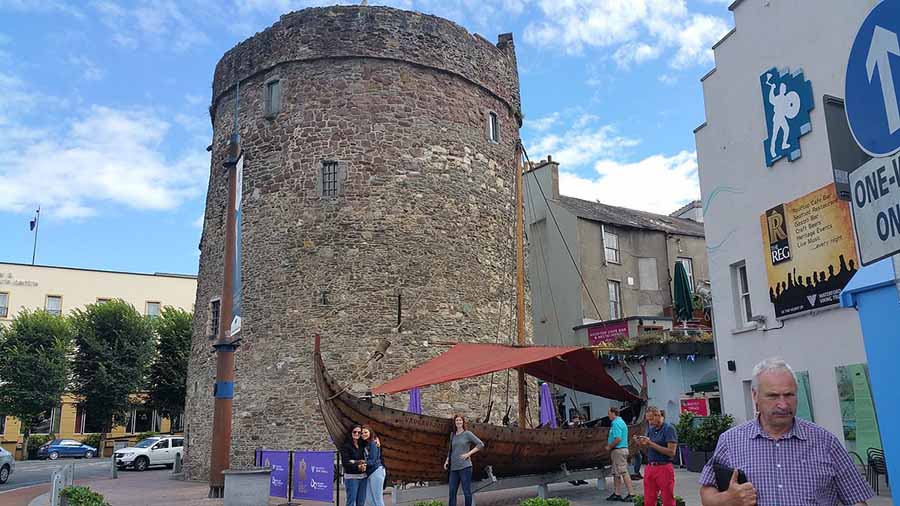
Ireland’s county Waterford is steeped in Viking and medieval history, with Waterford City’s Reginald’s Tower and Viking Triangle showcasing ancient artefacts. The Copper Coast, a UNESCO Geopark, offers dramatic coastal walks, while the Lismore Castle gardens provide serene beauty. Other attractions include the beaches of Tramore and historic Dunmore East. Waterford is Ireland’s 21st largest county by size (1,838 square km) and 20th largest by population (127,363). Population peaked at 196,187 in 1841 and reached its lowest point, 71,439 in 1961. In terms of hospitality, Waterford is Ireland’s ninth most visited tourist county with around 225,000 international visitors per year.
Introduction – Adventure – Anthem – Archaeology – Attractions – Awards – Birdwatching –– Camping –Castles – Churches – Contact list – Cycling – Dining – Equestrian – Festivals – Fishing – Folklore – Gardens – Golf – Graveyards – Happening – Haunted – Highest – Hiking – History – Holy Wells – Hotels – Hotels top 8 – Hunting & shooting – Instagrammable – Itineraries – Largest town – Luxury – MICE – Movies – Music – Name – New – Novelists – Off the beaten track – Poets – Pubs – Quotes – Random Facts – Restaurant Awards – Sacred Places – Saints – Songs – Spas – Sports – Sunsets – Sustainable – Things to do – Towns – Video – Villages – Walking – Wanderlist – Weddings – Wild swimming – Writers – 1837 – 1846– 1852 – 1909 – 1955 – 1980 –