- Saint Declan’s Well (Ardmore): Pattern day: July 24 (Saint Declan’s feast day, or the Sunday within its octave). Located near the Cliff Walk in Ardmore, this well is one of Ireland’s most significant, used by Saint Declan for baptisms around 416 AD, predating Saint Patrick’s arrival. Set above the bay with medieval stone crucifixes built into its masonry, it’s known for curing general ailments, with documented healings (e.g., a 1936 case reported in the Dungarvan Observer). Pilgrims perform clockwise rounds around the well and adjacent church ruins, reciting rosaries and leaving clooties or medals. The pattern, filmed in 1910 by the Horgan Brothers, remains a major event, drawing thousands for midnight Mass on July 23.
- Saint Bartholomew’s Well (Tobar Phárthanáin, Kinsalebeg, near Piltown): Pattern day: August 24 (Saint Bartholomew’s feast day). Situated in a field in Moord townland near the Blackwater estuary, this well is dedicated to Saint Bartholomew, one of the twelve apostles. Known for general healing, it was a pilgrimage site until the early 20th century, with a pattern last recorded in 1812 (Ordnance Survey Letters, 1840). Pilgrims performed rounds and left offerings like mugs or rags, with the well’s masonry whitewashed for maintenance. Its use has declined, and the stagnant water suggests few visitors today, but it remains a local landmark.
- Saint Brigid’s Well (Kilrossanty): Pattern day: February 1 (Saint Brigid’s feast day, though not actively observed). Part of the Kilrossanty Holy Wells complex, alongside Saint Mary’s Well and the Well of Jesus, this well is dedicated to Saint Brigid and known for curing skin ailments and general health issues. Located near a church, it was used for early Christian baptisms. Pilgrims performed rounds, leaving clooties or coins on nearby trees. Its rural setting and association with Brigid’s veneration make it significant, though active pilgrimage has waned.
- Saint Mary’s Well (Kilrossanty): Pattern day: August 15 (Feast of the Assumption, though not actively observed). Also in the Kilrossanty complex, this well is dedicated to the Blessed Virgin and associated with women’s health and fertility. Pilgrims historically performed rounds, reciting prayers and leaving rosaries or rags. Its proximity to an ancient church suggests pre-Christian origins, possibly tied to Celtic water worship. The well is maintained but sees fewer visitors today, reflecting a decline in traditional practices.
- Well of Jesus (Kilrossanty): Pattern day: Not specifically recorded, possibly August 15 (Assumption, due to the complex’s association). The third well in the Kilrossanty group, this is a rare dedication to Jesus, associated with general healing. Pilgrims performed rounds and left offerings like coins or medals, often seeking cures for chronic ailments. Its unique name and early Christian context make it notable, though it’s less visited now, with the complex overshadowed by larger pilgrimage sites like Ardmore.
- Holy Well (Kilronan, near Clonmel): Pattern day: Not specifically recorded, possibly August 1 (Lughnasa). Located in Glebe townland near the Tipperary border, this well is simply called “Holy Well” in the Ordnance Survey Letters (1840). Associated with general healing, it was venerated until the 1930s, with pilgrims performing rounds and leaving rags or coins. The stagnant water noted in recent visits suggests disuse, but its proximity to Kilronan’s medieval church indicates early Christian significance.
- Saint John’s Well (Kilmacthomas): Pattern day: June 24 (Saint John’s feast day, though not actively observed). One of several wells in Kilmacthomas, this well is linked to Saint John the Baptist and known for curing headaches and general ailments. Pilgrims performed rounds over 80 years ago, leaving offerings like medals or clooties. Its rural setting and early Christian associations suggest baptismal use, but it’s now largely forgotten, with no active pattern day.
- Saint Bernard’s Well (Ballypatrick, near Clonea): Pattern day: August 20 (Saint Bernard’s feast day, though not actively observed). Also called Saint Ita’s Well in some records, this well near Clonea is associated with curing eye ailments and general health. Pilgrims performed rounds, leaving rags or coins, and took water for healing. Documented in the Schools’ Collection, it’s unrecorded in the SMR, reflecting Waterford’s hidden wells. Active devotion has largely ceased.
- Saint Colman’s Well (Kilgabinet, near Dungarvan): Pattern day: Not specifically recorded, possibly November 24 (Saint Colman’s feast day). One of two wells in Kilgabinet, this well is dedicated to Saint Colman and known for general healing. Pilgrims performed rounds and left offerings like rosaries or clooties. Its proximity to a church ruin suggests early Christian use, but it’s less visited today, with sparse documentation in modern records.
- Saint Conlon’s Well (Youghalara, near Dungarvan): Pattern day: Not specifically recorded, possibly September 4 (Saint Conlon’s feast day). Known for curing paralysis, this well in Youghalara was a significant pilgrimage site, with pilgrims leaving crutches or sticks as tokens of cures. Documented in the Schools’ Collection, it attracted devotees for rounds and prayers, applying water to affected areas. Its use has declined, but it remains part of local folklore.
- Angels Well (Kilmofegue, near Portlaw): Pattern day: Not specifically recorded, possibly August 1 (Lughnasa). A unique well in Kilmofegue, associated with general blessings rather than a specific saint. Pilgrims performed rounds, leaving coins or rags, and sought spiritual guidance. Its name suggests a celestial connection, possibly tied to early Christian mysticism. Now largely forgotten, it’s noted in the Schools’ Collection for its historical significance.
- Mount Melleray Grotto Spring (near Cappoquin): Pattern day: August 15 (Feast of the Assumption, linked to Marian devotion). Near the Cistercian monastery of Mount Melleray, this spring became a holy well after 1985 visions of the Virgin Mary, who declared the water “blessed.” Known for general healing, it attracts pilgrims for rosary prayers, especially after the 1980s “moving statues” phenomenon. Offerings include rosaries and coins, with the well maintained by monks. Its modern sanctity contrasts with older wells.
Waterford’s holy wells often predate Christianity, with Celtic water worship adapted by early saints like Saint Declan for baptisms, lending them sacred status. Many are near churches or monastic sites, reflecting early Christian use.
Pattern days typically involve deiseal (clockwise) rounds, reciting rosaries, drinking or applying water, and leaving offerings like clooties, coins, or rosaries, believed to transfer ailments to the offering. These peaked during the Penal Laws (1695–1829) as covert worship sites but declined post-Catholic Emancipation due to church reforms, the Famine, and social changes.
.Holy Wells
Antrim – Armagh – Carlow – Cavan – Clare – Cork – Derry – Donegal – Down – Dublin – Fermanagh – Galway – Kerry – Kildare – Kilkenny – Laois – Leitrim – Limerick – Longford – Louth – Mayo – Meath – Monaghan – Offaly – Roscommon – Sligo – Tipperary – Tyrone – Waterford – Westmeath – Wexford – Wicklow
Sacred Places
Antrim – Armagh – Carlow – Cavan – Clare – Cork – Derry – Donegal – Down – Dublin – Fermanagh – Galway – Kerry – Kildare – Kilkenny – Laois – Leitrim – Limerick – Longford – Louth – Mayo – Meath – Monaghan – Offaly – Roscommon – Sligo – Tipperary – Tyrone – Waterford – Westmeath – Wexford – Wicklow
County Waterford:
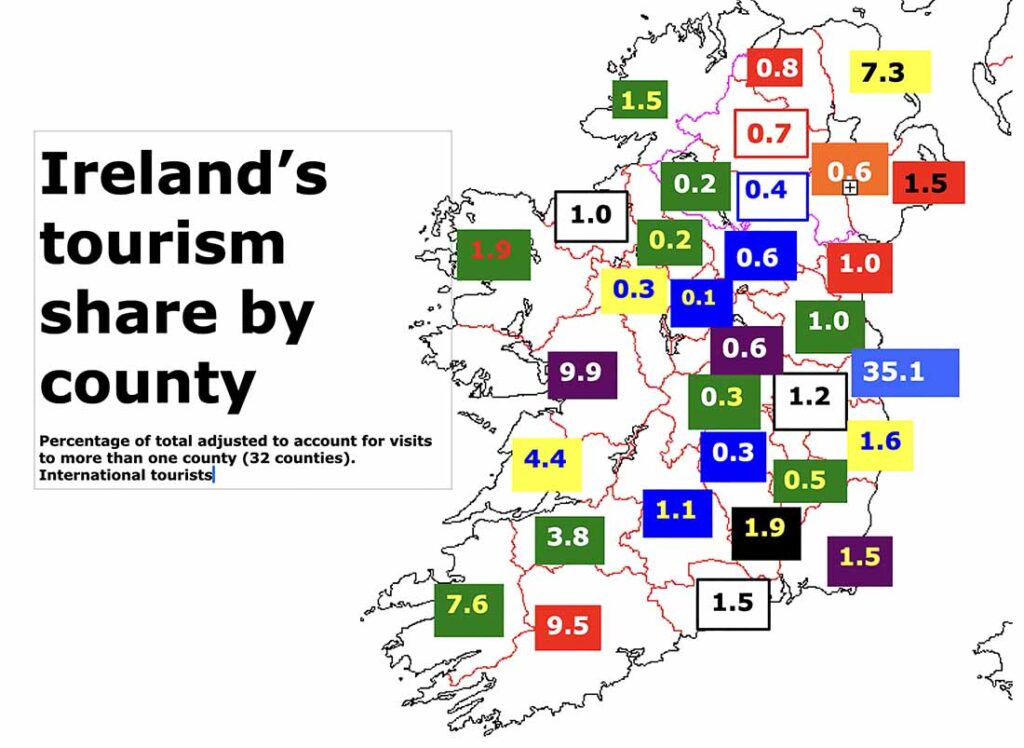
Ireland’s county Waterford is steeped in Viking and medieval history, with Waterford City’s Reginald’s Tower and Viking Triangle showcasing ancient artefacts. The Copper Coast, a UNESCO Geopark, offers dramatic coastal walks, while the Lismore Castle gardens provide serene beauty. Other attractions include the beaches of Tramore and historic Dunmore East. Waterford is Ireland’s 21st largest county by size (1,838 square km) and 20th largest by population (127,363). Population peaked at 196,187 in 1841 and reached its lowest point, 71,439 in 1961. In terms of hospitality, Waterford is Ireland’s ninth most visited tourist county with around 225,000 international visitors per year.
Introduction – Adventure – Anthem – Archaeology – Attractions – Awards – Birdwatching –– Camping –Castles – Churches – Contact list – Cycling – Dining – Equestrian – Festivals – Fishing – Folklore – Gardens – Golf – Graveyards – Happening – Haunted – Highest – Hiking – History – Holy Wells – Hotels – Hotels top 8 – Hunting & shooting – Instagrammable – Itineraries – Largest town – Luxury – MICE – Movies – Music – Name – New – Novelists – Off the beaten track – Poets – Pubs – Quotes – Random Facts – Restaurant Awards – Sacred Places – Saints – Songs – Spas – Sports – Sunsets – Sustainable – Things to do – Towns – Video – Villages – Walking – Wanderlist – Weddings – Wild swimming – Writers – 1837 – 1846– 1852 – 1909 – 1955 – 1980 –