- Brú na Bóinne (Newgrange, Knowth, and Dowth): Near Donore, County Meath, approximately 8 km west of Drogheda (Coordinates: 53.694°N, 6.475°W).. Brú na Bóinne is a UNESCO World Heritage Site and one of the world’s most significant Neolithic complexes, dating to c. 3200–3000 BC. It includes three major passage tombs: Newgrange, Knowth, and Dowth. Newgrange, the most famous, is a 85-metre-wide mound with a passage aligned to the winter solstice sunrise, featuring intricate megalithic art. Knowth contains multiple passages and the largest collection of Neolithic art in Western Europe. Dowth, less accessible, has similar features. The complex reflects a sophisticated society with advanced astronomical and engineering knowledge, predating Stonehenge and the pyramids. The site is linked to Irish mythology, particularly the Tuatha Dé Danann. Managed by Heritage Ireland, the Brú na Bóinne Visitor Centre near Newgrange offers guided tours to Newgrange and Knowth (Dowth is not guided but accessible externally). Open year-round; admission fees apply. Check www.heritageireland.ie for tickets and hours.
- Hill of Tara: Near Skryne, County Meath, approximately 12 km south of Navan (Coordinates: 53.579°N, 6.611°W).. The Hill of Tara is a ceremonial and political centre dating from the Neolithic to the Iron Age (c. 3000 BC–AD 500), traditionally the seat of the High Kings of Ireland. The complex includes a passage tomb (Mound of the Hostages, c. 3000 BC), ring forts, a standing stone (Lia Fáil), and earthworks like the Rath of the Synods. Archaeological surveys reveal over 30 monuments, indicating Tara’s role as a ritual and royal site in Gaelic Ireland, tied to myths like the Táin Bó Cúailnge. It remained significant into the early medieval period. Managed by Heritage Ireland, the site is open year-round with a visitor centre in a converted church offering guided tours. Admission fees apply; check www.heritageireland.ie for details.
- Trim Castle: Trim, County Meath, approximately 45 km northwest of Dublin (Coordinates: 53.555°N, 6.790°W).. Built in the late 12th century (c. 1172) by Hugh de Lacy, Trim Castle is Ireland’s largest Anglo-Norman castle. Its 20-sided keep, curtain walls, and gatehouse reflect Norman military architecture. The castle served as an administrative and defensive hub in the Lordship of Meath, featuring in historical events like the 13th-century sieges and as a filming location for Braveheart. Archaeological excavations have uncovered medieval structures and artefacts, highlighting its role in Norman governance. Managed by Heritage Ireland, the castle is open year-round (seasonal hours apply) with guided tours of the keep and grounds. Admission fees apply; check www.heritageireland.ie for hours and tickets.
- Loughcrew Cairns (Sliabh na Calliagh): Near Oldcastle, County Meath, approximately 20 km northwest of Kells (Coordinates: 53.744°N, 7.112°W).. Loughcrew is a Neolithic passage tomb complex (c. 3500–3000 BC) spread across three hills, with over 30 tombs, the most notable being Cairn T and Cairn L. Cairn T, aligned with the equinox sunrise, features intricate megalithic art, including spirals and solar motifs. Known as the “Hills of the Witch” in local folklore, the site is linked to the mythical hag Cailleach. It represents a significant prehistoric ritual landscape, comparable to Brú na Bóinne but less developed for tourism. Managed by the OPW, the site is accessible year-round with free entry to the hills. Guided tours of Cairn T are available seasonally (June–August); keys for access are available locally. Check www.heritageireland.ie for details.
- Kells Monastic Site: Kells, County Meath, approximately 16 km northwest of Navan (Coordinates: 53.727°N, 6.879°W).. Founded in the 6th century by St. Columba (Colmcille), Kells became a major monastic centre by the 9th century, famous for the Book of Kells (now in Trinity College Dublin). The site includes a 10th-century round tower, five high crosses (including the Market Cross with biblical carvings), and the remains of St. Columba’s House, a stone oratory. Archaeological evidence suggests Viking raids and later Norman influence. The site reflects early Christian Ireland’s artistic and religious significance. Managed by the OPW, the site is open year-round with free access to the grounds and round tower. The heritage centre in Kells offers exhibits on the Book of Kells. Check www.heritageireland.ie for details.
- Hill of Ward (Tlachtga): Near Athboy, County Meath, approximately 15 km southwest of Navan (Coordinates: 53.628°N, 6.891°W).. The Hill of Ward, or Tlachtga, is an Iron Age hillfort (c. 500 BC–AD 500) with four concentric earthworks, traditionally associated with Samhain, the Celtic festival marking the start of winter. Linked to the druid Tlachtga in Irish mythology, it was a site for ritual gatherings and fire ceremonies. Archaeological surveys indicate activity from the Bronze Age, with later medieval use. The site’s prominence in pre-Christian Ireland underscores its cultural significance. Located on private land but publicly accessible with permission. No formal facilities; check www.archaeology.ie or www.discoverireland.ie for access guidance.
- Bective Abbey: Near Bective, County Meath, approximately 8 km east of Trim (Coordinates: 53.581°N, 6.702°W).. Founded in 1147 as a Cistercian abbey, Bective was the second Cistercian foundation in Ireland after Mellifont. Built under the patronage of the O’Connor family, it features a 13th-century church, cloister, and a 15th-century fortified tower, reflecting adaptations for defence. The abbey was suppressed during the Dissolution of the Monasteries (1536) and later used as a manor house. Archaeological excavations have revealed medieval tiles and structures, highlighting its economic and religious role. Managed by the OPW, the site is open year-round with free entry. Limited facilities; check www.heritageireland.ie for access details.
Archaeological sites
Antrim – Armagh – Carlow – Cavan – Clare – Cork – Derry – Donegal – Down – Dublin – Fermanagh – Galway – Kerry – Kildare – Kilkenny – Laois – Leitrim – Limerick – Longford – Louth – Mayo – Meath – Monaghan – Offaly – Roscommon – Sligo – Tipperary – Tyrone – Waterford – Westmeath – Wexford – Wicklow
County Meath:
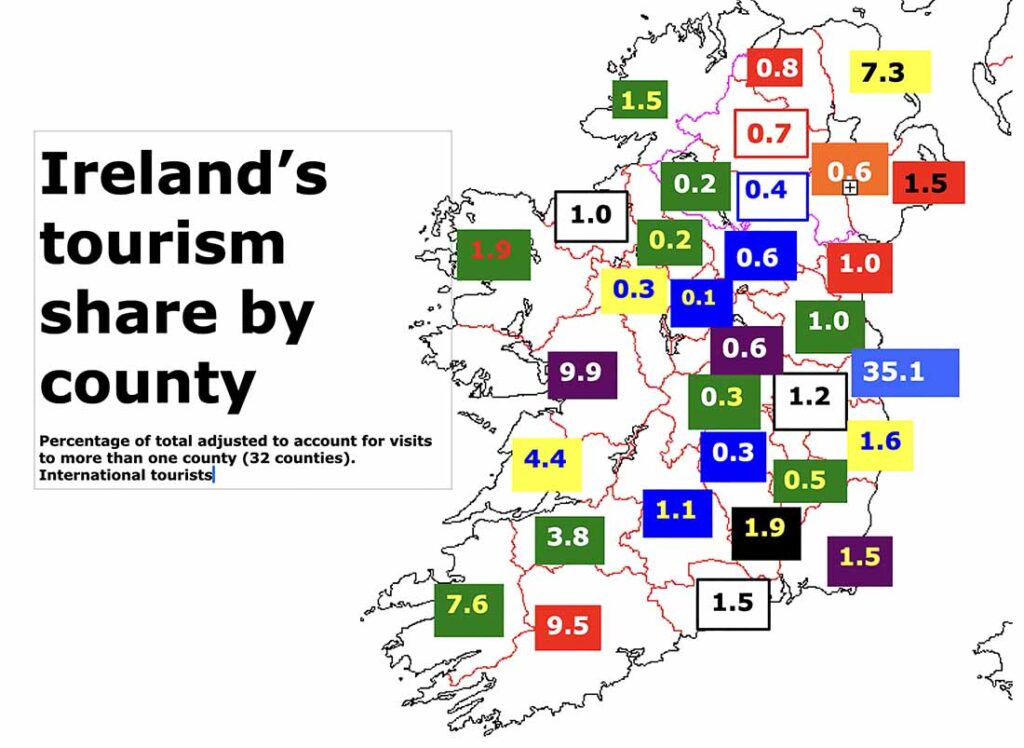
Ireland’s county Meath is steeped in Ireland’s ancient past, with the Hill of Tara offering a glimpse into royal history and panoramic views. The UNESCO-listed Brú na Bóinne complex, including Newgrange and Knowth, showcases intricate Neolithic tombs, while Trim Castle provides medieval grandeur. Other attractions include the Boyne River’s scenic walks and historic Slane Castle. Meath is Ireland’s 14th largest county by size (2,336 square km) and eighth largest by population (220,826). Population previously peaked at 183,828 in 1841 and reached its lowest point, 62,969 in 1926. In terms of hospitality, Meath is Ireland’s 19th most visited tourist county with around 122,000 international visitors per year.
Introduction – Adventure – Anthem – Archaeology – Attractions – Awards – Birdwatching – Camping – Castles – Churches – Contact list – Cycling – Dining – Equestrian – Festivals – Fishing – Folklore – Gardens – Golf – Graveyards – Happening – Haunted – Highest – Hiking – History – Holy Wells – Hotels – Hotels top 8 – Hunting & shooting – Instagrammable – Itineraries – Largest town – Luxury – MICE – Movies – Music – Name – New – Novelists – Off the beaten track – Poets – Pubs – Quotes – Random Facts – Restaurant Awards – Sacred Places – Saints – Songs – Spas – Sports – Sunsets – Sustainable – Things to do – Towns – Video – Villages – Walking – Wanderlist – Weddings – Wild swimming – Writers – 1837 – 1846 – 1852 – 1909 – 1955 – 1980 –