- Downpatrick Cathedral and St. Patrick’s Grave: Cathedral Hill, Downpatrick, Co. Down, BT30 6AB. This site, linked to St. Patrick’s 5th-century mission, includes a 12th-century cathedral built on an earlier monastic foundation. A granite slab marks St. Patrick’s reputed grave (c. 461 AD). Excavations suggest a pre-Christian hillfort. Managed by the Church of Ireland, it’s accessible with a visitor centre, reflecting Down’s early Christian significance.
- Inch Abbey: Inch, near Downpatrick, Co. Down, BT30 9AY. A Cistercian abbey founded in 1180 by John de Courcy, replacing an earlier Celtic monastery. Its well-preserved ruins, including a church and cloister, reflect Norman ecclesiastical architecture. Used as a Game of Thrones filming location, it’s a state-care monument managed by the Department for Communities, freely accessible with parking.
- Nendrum Monastic Site: Mahee Island, Strangford Lough, Co. Down, BT23 6EP. An early Christian monastery, founded c. 5th century, possibly by St. Mochaoi. Features include a round tower stump, three concentric enclosures, and a church with a sundial (c. 7th-10th century). Excavations revealed tidal mills, among Ireland’s earliest. Managed by the Department for Communities, it’s accessible via a causeway with a visitor centre.
- Struell Wells: Struell, near Downpatrick, Co. Down, BT30 6EQ. A pre-Christian holy well site, Christianised by St. Patrick in the 5th century. The complex includes 17th-century bathhouses, a drinking well, and an eye well, used for healing pilgrimages. A state-care monument, it’s freely accessible, offering insight into Down’s sacred traditions spanning pagan and Christian eras.
- Legananny Dolmen: Slieve Croob, near Dromara, Co. Down, BT32 5ER. A Neolithic portal tomb, dating to c. 3500-3000 BC, with a dramatic tripod-like structure and a large capstone. Used for communal burials, it’s set in the Mourne Mountains with scenic views. A state-care monument managed by the Department for Communities, it’s accessible via a short uphill path on private land.
- Drumbo Round Tower: Drumbo Presbyterian Church, Drumbo, Co. Down, BT27 5LE. An early Christian round tower, c. 9th-10th century, part of a lost monastic site. Standing 10m tall, it served as a bell tower and refuge. The adjacent churchyard suggests continuity of worship. A state-care monument, it’s accessible via public paths, reflecting Down’s monastic heritage.
- Ballynoe Stone Circle: Ballynoe, near Downpatrick, Co. Down, BT30 8AN. A Bronze Age stone circle, c. 2000-1500 BC, with over 50 stones enclosing a cairn, possibly used for rituals or burials. Its oval shape and outlier stones suggest astronomical alignments. A state-care monument, it’s accessible via a short walk on private land, showcasing Down’s prehistoric landscape.
- Dundrum Castle: Dundrum, Co. Down, BT33 0NQ. A 12th-century Norman castle built by John de Courcy, overlooking Dundrum Bay. Its circular keep and gatehouse reflect early medieval fortification. Used during the Anglo-Norman conquest, it later fell to the Magennis clan. Managed by the Department for Communities, it’s accessible with parking, offering views of the Mournes.
- Annadorn Dolmen: Loughinisland, near Downpatrick, Co. Down, BT30 8JQ. A Neolithic portal tomb, c. 3500-3000 BC, with a large capstone supported by uprights, used for burials. Set near Loughinisland’s medieval churches, it suggests multi-period ritual use. A state-care monument, it’s accessible via public paths on private land, reflecting Down’s megalithic tradition.
- Greencastle: Greencastle Road, Kilkeel, Co. Down, BT34 4QE. A 13th-century Anglo-Norman castle, built c. 1230 by Hugh de Lacy to control Carlingford Lough. Its rectangular keep and curtain walls reflect military architecture. Used until the 17th century, it’s a state-care monument managed by the Department for Communities, accessible with guided tours, showcasing Down’s Norman heritage.
Archaeological sites
Antrim – Armagh – Carlow – Cavan – Clare – Cork – Derry – Donegal – Down – Dublin – Fermanagh – Galway – Kerry – Kildare – Kilkenny – Laois – Leitrim – Limerick – Longford – Louth – Mayo – Meath – Monaghan – Offaly – Roscommon – Sligo – Tipperary – Tyrone – Waterford – Westmeath – Wexford – Wicklow
County Down:
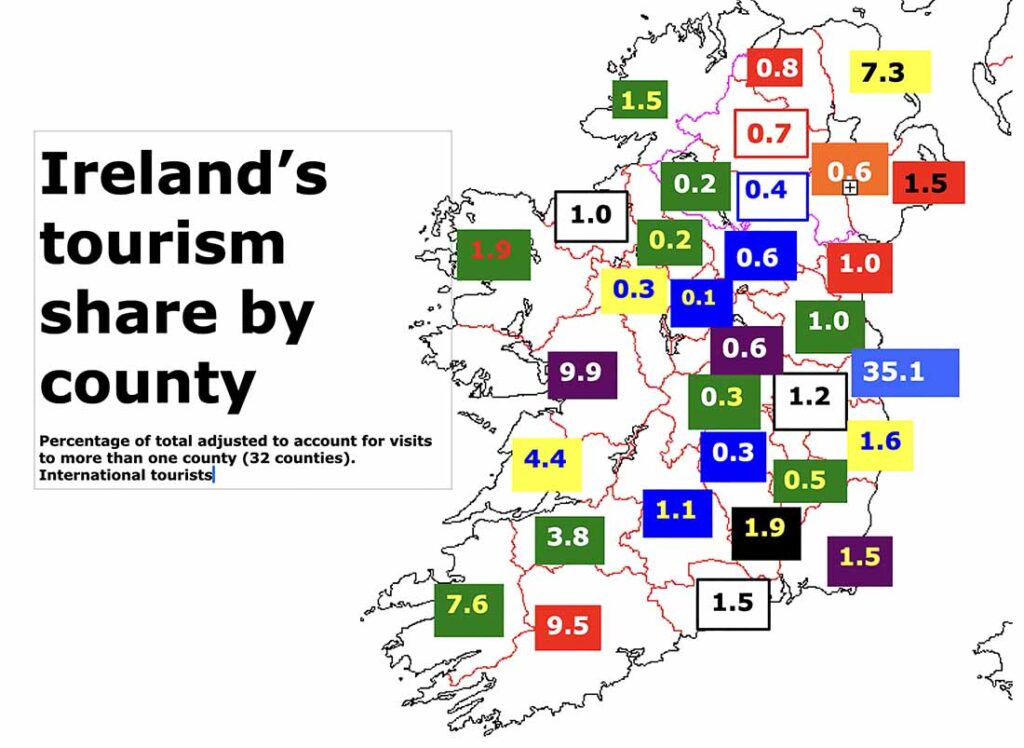
Ireland’s county Down offers a mix of historic sites and scenic landscapes, with Downpatrick’s Saint Patrick Centre and cathedral providing insights into Ireland’s patron saint. The Mourne Mountains offer hiking trails with sweeping views, while Strangford Lough provides kayaking and wildlife spotting. Other attractions include the historic Tollymore Forest Park. Down is Ireland’s 12th largest county by size (2,447 square km) and fourth largest by population (553,261). Population peaked at 361,446 in 1841 and reached its lowest point, 204,303, in 1911. In terms of hospitality, Down is Ireland’s 18th most visited tourist county with around 127,000 international visitors per year.
Introduction – Adventure – Anthem – Archaeology – Attractions – Awards – Birdwatching – Camping – Castles – Churches – Contact list – Cycling – Dining – Equestrian – Festivals – Fishing – Folklore – Gardens – Golf – Graveyards – Happening – Haunted – Highest – Hiking – History – Holy Wells – Hotels – Hotels top 8 – Hunting & shooting – Instagrammable – Itineraries – Largest town – Luxury – MICE – Movies – Music – New – Name – Novelists – Off the beaten track – Poets – Pubs – Quotes – Random Facts – Restaurant Awards – Sacred Places – Saints – Songs – Spas – Sports – Sunsets – Sustainable – Things to do – Towns – Video – Villages – Walking – Wanderlist – Weddings – Wild swimming – Writers – 1837 – 1846 – 1852 – 1909 – 1955 – 1980 –