The highest point in County Down is Slieve Donard, standing at 850 meters (2,789 feet). Slieve Donard is located in the Mourne Mountains, near the coastal town of Newcastle in southeast County Down. It is part of the Mourne Area of Outstanding Natural Beauty (AONB), a dramatic granite mountain range renowned for its rugged beauty and cultural significance.
- Elevation: At 850 meters, Slieve Donard is the highest peak in County Down and County Down, dominating the Mourne Mountains and offering unparalleled views.
- Terrain: The mountain features a mix of well-trodden paths, rocky slopes, and a steep, granite-strewn summit. The Mourne Wall, a 35-km dry-stone wall built in the early 20th century, crosses the summit and is a notable landmark.
Starting Point and Access:
- Driving Route: The most popular trailhead is at Donard Park in Newcastle, accessible via the A2 coastal road from Belfast (45 minutes, 50 km) or Downpatrick (30 minutes, ~25 km). The car park at Donard Park is well-equipped, with toilets and space for vehicles, though it can be busy on weekends. From Derry city, the drive takes about 1.5 hours (100 km).
- Alternative Access: Other routes start from Bloody Bridge (3 km south of Newcastle) or Carrick Little near Annalong, offering more challenging ascents with coastal views. These are less crowded but require more navigation.
- Public Transport: Newcastle is served by buses from Belfast (Translink Ulsterbus 237 or 520, ~1 hour). From the Newcastle bus station, it’s a short walk or taxi ride to Donard Park. Guided hikes, such as those offered by Walks in the Mournes or Mourne Adventures, provide transport from Belfast or local towns.
Donard Park Route (Glen River Path):
- Distance: Approximately 9–10 km round trip.
- Duration: 4–6 hours, depending on pace and conditions.
- Description: This is the most popular route, starting at Donard Park. The trail follows the Glen River through a scenic wooded valley, passing waterfalls and crossing small bridges. After 2–3 km, it emerges onto open moorland, where the path becomes steeper and rockier. Hikers follow the Mourne Wall to the summit, marked by a trig pillar and cairn. The descent retraces the same path, with care needed on rocky sections.
- Difficulty: Moderate to strenuous, suitable for hikers with good fitness. The path is well-worn and clear, but the steep ascent and exposure near the summit require stamina and caution.
Bloody Bridge Route:
- Distance: 7–8 km round trip.
- Duration: 3.5–5 hours.
- Description: Starting at Bloody Bridge car park, this route follows the Bloody Bridge River before ascending steeply to join the Mourne Wall near the saddle between Slieve Donard and Slieve Commedagh. It’s shorter but steeper than the Glen River path, with stunning coastal views. The descent follows the same route.
- Difficulty: Strenuous, due to the steep incline and rocky terrain, best for experienced hikers.
Carrick Little to Slieve Donard Circuit:
- Distance: 12–15 km round trip.
- Duration: 6–8 hours.
- Description: This route starts at Carrick Little and follows the Mourne Wall, incorporating Slieve Donard and nearby peaks like Slieve Commedagh (767 meters). It offers a longer, more challenging hike with varied terrain and panoramic views.
- Difficulty: Challenging, requiring navigation skills and stamina for extended hiking.
Navigation Tips:
- Use an Ordnance Survey map (Discoverer Series Sheet 29) or apps like HiiKER, AllTrails, or PeakVisor for navigation, as fog can reduce visibility on the summit.
- The Mourne Wall is a reliable guide, but a compass or GPS is essential in poor weather.
- Wear sturdy, waterproof hiking boots with good grip, as the upper slopes are rocky and can be slippery. Trekking poles help with steep sections.
Scenery and Views:
- Summit Views: On clear days, Slieve Donard offers spectacular 360-degree views, including the Irish Sea, the Isle of Man, the Wicklow Mountains, and even parts of Scotland and Wales on exceptional days. Closer views include Newcastle’s coastline, Dundrum Bay, and the rolling Mourne Mountains. The summit’s prominence makes it a highlight of the landscape.
- Landscape: The lower slopes feature lush forest along the Glen River, transitioning to open moorland and rocky granite peaks. The Mourne Wall, a feat of early 20th-century engineering, adds historical interest. The summit is exposed, with a trig pillar and large cairn.
- Unique Features: Slieve Donard is named after St. Domangard (or Donard), a 5th-century saint, and has spiritual significance, with a tradition of pilgrimage ascents. The Mourne Wall and nearby megalithic cairns add archaeological intrigue.
Hiking Experience:
- Duration: The Glen River route takes 4–6 hours, Bloody Bridge 3.5–5 hours, and the Carrick Little circuit 6–8 hours, including summit time.
- Conditions: The lower paths are well-maintained, but the upper slopes are rocky and exposed, with strong winds and fog common. Spring and summer (April–September) offer the best conditions, with vibrant heather in August. Winter hikes are feasible but challenging due to snow, ice, and shorter days.
- Cultural Significance: The Mournes inspired C.S. Lewis’s Narnia, with their dramatic peaks and valleys. The area is steeped in folklore, and the annual Mourne Wall Challenge (a 35-km trek along the entire wall) attracts adventurers.
- Weather: The summit is highly exposed, with rapid weather changes, strong winds, and frequent mist. Check forecasts (e.g., Met Office) and avoid hiking in severe conditions.
- Terrain: The rocky upper slopes and steep inclines require sure footing, especially on the descent. The Bloody Bridge route is particularly steep and eroded in places.
- Safety: Inform someone of your plans, as there are no rangers. Bring water, snacks, and warm clothing, as temperatures drop significantly at the summit. Solo hikers should be confident in navigation or join guided tours.
- Wildlife: Expect to see birds like ravens, peregrine falcons, or wheatears, and possibly hares or red grouse. The Mournes support unique flora, including heather and bilberries.
Highest point in county
Antrim – Armagh – Carlow – Cavan – Clare – Cork – Derry – Donegal – Down – Dublin – Fermanagh – Galway] – Kerry – Kildare – Kilkenny – Laois – Leitrim – Limerick – Longford – Louth – Mayo – Meath – Monaghan – Offaly – Roscommon – Sligo – Tipperary – Tyrone – Waterford – Westmeath – Wexford – Wicklow
County Down:
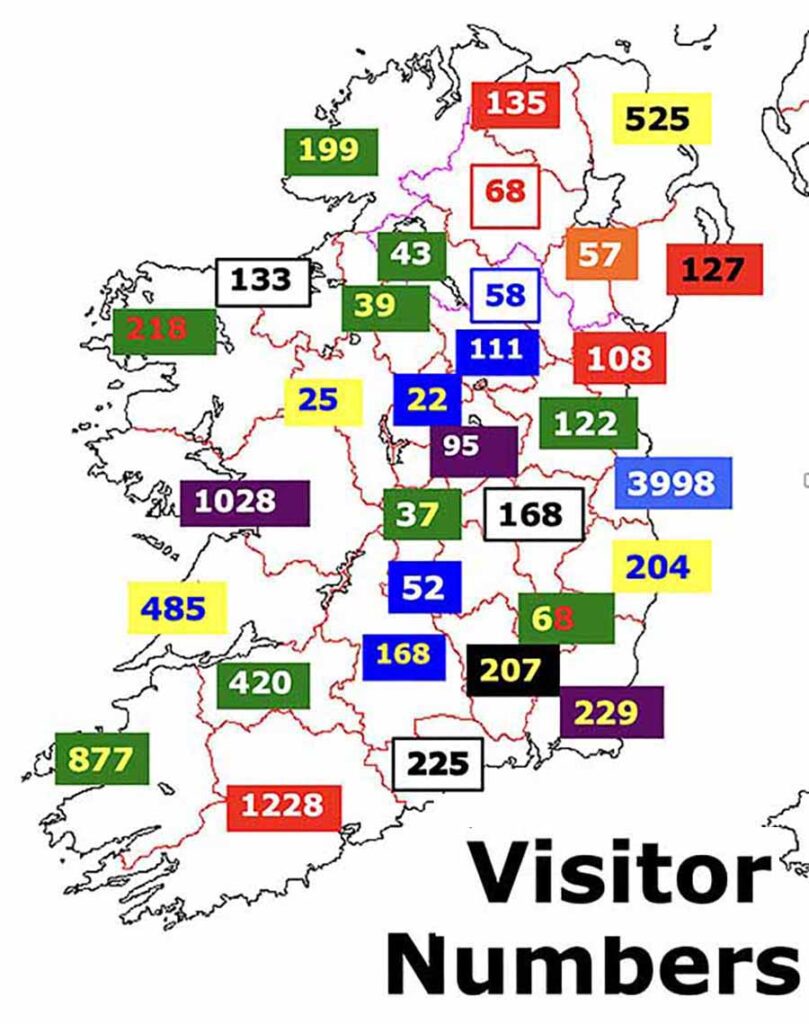
Ireland’s county Down offers a mix of historic sites and scenic landscapes, with Downpatrick’s Saint Patrick Centre and cathedral providing insights into Ireland’s patron saint. The Mourne Mountains offer hiking trails with sweeping views, while Strangford Lough provides kayaking and wildlife spotting. Other attractions include the historic Tollymore Forest Park. Down is Ireland’s 12th largest county by size (2,447 square km) and fourth largest by population (553,261). Population peaked at 361,446 in 1841 and reached its lowest point, 204,303, in 1911. In terms of hospitality, Down is Ireland’s 18th most visited tourist county with around 127,000 international visitors per year.
Introduction – Adventure – Anthem – Archaeology – Attractions – Awards – Birdwatching – Camping – Castles – Churches – Contact list – Cycling – Dining – Equestrian – Festivals – Fishing – Folklore – Gardens – Golf – Graveyards – Happening – Haunted – Highest – Hiking – History – Holy Wells – Hotels – Hotels top 8 – Hunting & shooting – Instagrammable – Itineraries – Largest town – Luxury – MICE – Movies – Music – New – Name – Novelists – Off the beaten track – Poets – Pubs – Quotes – Random Facts – Restaurant Awards – Sacred Places – Saints – Songs – Spas – Sports – Sunsets – Sustainable – Things to do – Towns – Video – Villages – Walking – Wanderlist – Weddings – Wild swimming – Writers – 1837 – 1846 – 1852 – 1909 – 1955 – 1980 –