- Mountsandel Fort: Mountsandel Wood, Coleraine, Co. Derry, BT52 1TA. Ireland’s oldest known human settlement, dating to 7900-7600 BC (Mesolithic period). Excavations in the 1970s uncovered hearths, flint tools, and evidence of hunter-gatherer life near the River Bann. The site, a low mound in a wooded area, is accessible via public paths managed by Coleraine Borough Council, offering insight into Ireland’s earliest inhabitants.
- Banagher Old Church and Cross: Magheramore, near Dungiven, Co. Derry, BT47 4PZ (Grid Ref: C6755 0600). An early Christian site, founded c. 6th century by St. Muiredach, with a 12th-century church ruin and a termon cross (c. 9th-10th century) marking sanctuary boundaries. The site, linked to the O’Cahan clan, includes a possible portal tomb (Cove Stones). A state-care monument, it’s accessible via public roads, reflecting Derry’s monastic heritage.
- Ballybriest Dual Court Tomb (Carnanbane): Near Bellarena, Co. Derry, BT49 0NH (Grid Ref: H7617 8857). A Neolithic court tomb, dating to c. 4000-3000 BC, with two burial chambers and a central court, used for communal burials. Known locally as Carnanbane, it represents early agricultural communities’ funerary practices. A state-care monument, it’s accessible on private land with permission, offering a glimpse into Derry’s megalithic past.
- Carrick East Stone Circle and Court Tomb: Near Limavady, Co. Derry, BT49 0JQ (Grid Ref: C7044 1738). A Bronze Age stone circle and adjacent Neolithic court tomb, dating to c. 4000-2000 BC. The circle, possibly used for rituals, complements the tomb’s burial function. This multi-period site reflects evolving prehistoric practices. Accessible via public paths, it’s a state-care monument, though less developed for tourism.
- Mullagh Hill (Drumceatt Mound): Near Limavady, Co. Derry, BT49 0LG (Grid Ref: C6665 2168). A possible Iron Age assembly site or mound, linked to the 6th-century Synod of Drumceatt, where St. Columba mediated disputes. Known as Daisy Hill, it may have served ceremonial or political functions. Accessible on private land with permission, it highlights Derry’s early medieval significance.
- Dungiven Priory: Priory Road, Dungiven, Co. Derry, BT47 4PF. A 12th-century Augustinian priory, built by the O’Cahan clan, with a church featuring a 13th-century effigy tomb of Cooey na Gall O’Cahan. The site, possibly on an earlier monastic foundation, reflects medieval Gaelic patronage. A state-care monument, it’s freely accessible, showcasing Derry’s ecclesiastical and clan history.
- Magheramore Court Tomb and Portal Tomb (Cove Stones): Near Dungiven, Co. Derry, BT47 4PZ (Grid Ref: C6853 0541). A Neolithic complex with a court tomb and portal tomb remnants, dating to c. 4000-3000 BC. Known as the Cove Stones, it was likely used for burials and rituals. Close to Banagher Church, it’s a state-care monument accessible on private land with permission, illustrating Derry’s megalithic diversity.
- Gortnamoyagh Inauguration Stone (Giant’s Track): Near Garvagh, Co. Derry, BT51 5BP (Grid Ref: C8059 1497). An Iron Age inauguration stone, possibly linked to St. Adamnan, with footprints carved into it, used for Celtic king-making ceremonies c. 500 BC-400 AD. Known as Shane’s Leap or Giant’s Track, it’s a state-care monument. Access is on private land with permission, reflecting Derry’s pre-Christian traditions.
- Derry City Walls: Derry City Centre, Co. Derry, BT48 6BA. Built in 1613-1619 by the Honourable The Irish Society, these 17th-century fortifications are among Europe’s best-preserved city walls. Designed to protect the Plantation city, they withstood sieges, including the 1689 Siege of Derry. Managed by the Department for Communities, they’re freely accessible with guided tours, offering insight into Derry’s colonial and military history.
Archaeological sites
Antrim – Armagh – Carlow – Cavan – Clare – Cork – Derry – Donegal – Down – Dublin – Fermanagh – Galway – Kerry – Kildare – Kilkenny – Laois – Leitrim – Limerick – Longford – Louth – Mayo – Meath – Monaghan – Offaly – Roscommon – Sligo – Tipperary – Tyrone – Waterford – Westmeath – Wexford – Wicklow
County Derry:
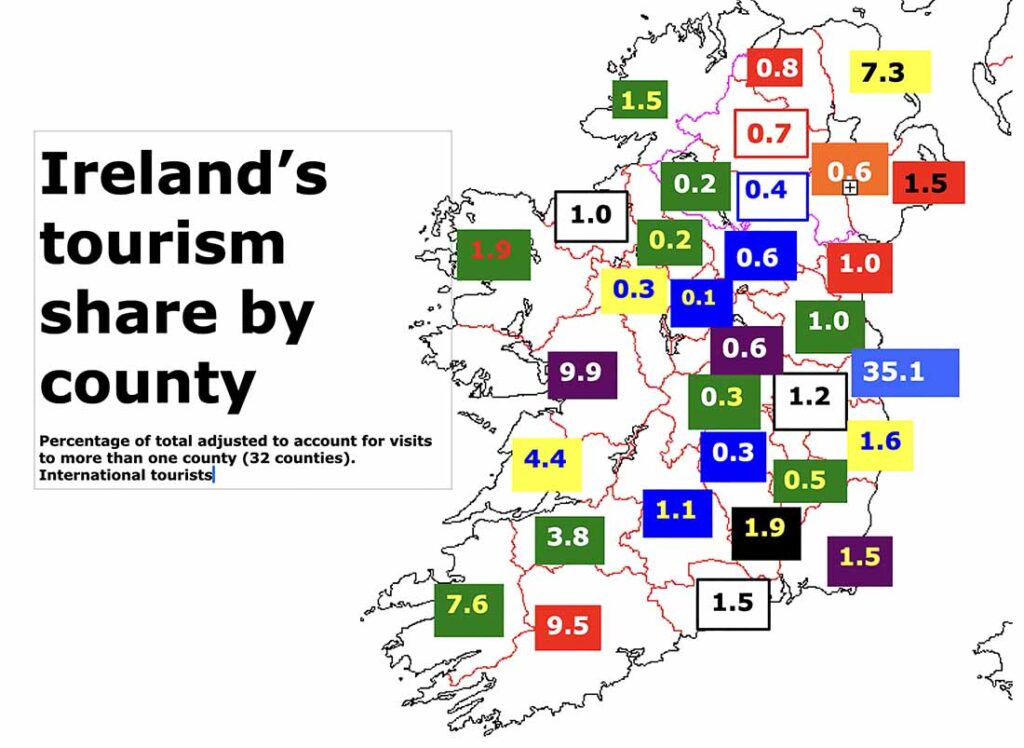
Ireland’s county Derry offers a rich historical tapestry, with the city’s 17th-century walls providing a walkable journey through its past. The Guildhall and Tower Museum explore Derry’s maritime and political history, while the Peace Bridge offers scenic views over the River Foyle. Derry is Ireland’s 15th largest county by size (2,067 square km) and sixth largest by population (252,231). Population previously peaked at 222,174 in 1841 and reached its lowest point, 139,693 in 1926. In terms of hospitality, Derry is Ireland’s 16th most visited tourist county with around 135,000 international visitors per year.
Introduction – Adventure – Anthem – Archaeology – Attractions – Awards – Birdwatching – Camping – Castles – Churches – Contact list – Cycling – Dining – Equestrian – Festivals – Fishing – Folklore – Gardens – Golf – Graveyards – Happening – Haunted – Highest – Hiking – History – Holy Wells – Hotels – Hotels top 8 – Hunting & shooting – Instagrammable – Itineraries – Largest town – Luxury – MICE – Movies – Music – New – Name – Novelists – Off the beaten track – Poets – Pubs – Quotes – Random Facts – Restaurant Awards– Sacred Places – Saints – Songs – Spas – Sports – Sunsets – Sustainable – Things to do – Towns – Video – Villages – Walking – Wanderlist – Weddings – Wild swimming – Writers – 1837 – 1846 – 1852 – 1909 – 1955 – 1980 –