A maritime county of Ireland, province of Connacht, it is bounded, on the north, by the Atlantic ocean; on the east, by Sligo and Roscommon; on the south, by Galway and the Atlantic ocean; and on the west, by the Atlantic ocean. Its greatest length, from north-east to south-west, is about 70 miles; its greatest breadth, from east to west, about 55 miles; and its area is computed at 1,290,240 acres, or 2,016 square miles, including about 70,000 acres of water.
SURFACE AND TOPOGRAPHY. The surface is greatly diversified, and in many parts highly picturesque, but chiefly mountainous, boggy, and barren. The northern and western districts are occupied by lofty mountains and rugged promontories; the central and eastern by extensive bogs and low hills; and the southern by more level and fertile tracts. The principal mountains are the Nephin range, in the north-east, rising to 2,646 feet; the Mweelrea group, on the south-west border, attaining 2,688 feet (the highest in Connacht); Croagh Patrick, on Clew bay, 2,510 feet; the Partry mountains, in the centre-south; the Bengorm range; and various detached eminences such as Nephin Beg, Ben Gorm, Muilrea, and the Twelve Pins (partly in Galway). The coast is bold and indented, with numerous bays, inlets, and islands; the chief headlands are Erris Head, Benwee Head, the Stags of Broadhaven, Downpatrick Head, and Achill Head; the principal bays are Donegal bay (partly), Killala bay, Broadhaven bay, Blacksod bay, Clew bay (one of the finest in Ireland, studded with islands), and Killary harbour (a magnificent fiord on the south border). The islands are very numerous, particularly off the west coast; the chief are Achill (the largest off Ireland, about 57 square miles), Clare island, Inishbofin, Inishark, Inishturk, Inishgort, Caher, and many smaller. The lakes are very numerous and often beautiful; the principal are Lough Conn, Lough Carra, Lough Mask (partly in the county, but chiefly in Galway), Lough Furnace, Lough Beltra, Lough Feeagh, and hundreds of smaller mountain tarns. The principal rivers are the Moy, which forms part of the northern boundary and falls into Killala bay; the Owenmore or Ballysadare river (partly); the Deel; the Palmerstown; the Cloonaghmore; the Newport; the Burrishoole; the Bundorragha; and various short mountain streams.
SOIL AND SUBSOIL. The soil is extremely various. In the eastern and southern districts, particularly in the baronies of Gallen, Clanmorris, and Costello, it is fertile, consisting of good loam or limestone pasture; but over the greater part of the county it is poor, boggy, or rocky. Large tracts are irreclaimable mountain or blanket bog. The subsoil is chiefly gneiss, mica slate, quartz rock, granite, and limestone; coal is found in small quantity in the north-east, but not worked; iron ore, lead, copper, and silver exist, but are not profitably mined; slate quarries are worked to some extent.
CLIMATE. The climate is moist, changeable, and stormy, with heavy rainfall, especially on the western mountains, which intercept Atlantic vapours. The temperature is mild near the coast, but raw and cold in the interior highlands.
AGRICULTURE. The agriculture is backward, the farms small, the tenantry poor, and the modes of culture rude. Potatoes and oats are the staple crops; barley, wheat, and flax are grown to a limited extent. Pasturage occupies much of the better land; cattle, sheep, and pigs are reared, but the breeds are indifferent. Kelp-burning and turf-cutting are important occupations. Much land remains uncultivated or improvable only at great expense.
MANUFACTURES AND TRADE. Manufactures are very limited, chiefly coarse linen, frieze, and domestic produce. The trade consists in the export of cattle, pigs, butter, grain, kelp, fish, and whiskey; and the import of coal, salt, timber, iron, and manufactured goods. The bays afford good anchorage, but trade is chiefly coastal or with Liverpool and Glasgow.
FISHERIES. The fisheries are extensive and valuable, particularly herring, cod, ling, haddock, mackerel, and salmon; the coast and islands abound in fish; curing and export are carried on at Westport, Killala, and other places.
ROADS AND COMMUNICATION. The roads are generally poor, especially in the mountainous west, but improving. Mail-coach routes connect Castlebar with Dublin via Ballina and Longford; other lines to Westport, Ballinrobe, &c.
POPULATION, &c. The population in 1841 was 388,887. The inhabited houses were about 48,000. The density is high in some districts, but the people suffer from poverty and occasional destitution. The inhabitants are almost exclusively Roman Catholics; Protestants are few, chiefly resident gentry and officials.
ADMINISTRATIVE DIVISIONS. The county contains the baronies of Burrishoole, Clanmorris, Costello, Erris, Gallen, Murrisk, and Tirawley. It is divided into poor-law unions of Ballina, Ballinrobe, Belmullet, Castlebar, Claremorris, Swinford, and Westport. The assize town is Castlebar; quarter sessions are held at Castlebar, Ballina, Westport, and Claremorris.
TOWNS. The principal towns are Castlebar (the county town, pop. about 4,800), Ballina (about 6,000), Westport (about 4,500), Claremorris, Swinford, Ballinrobe, Killala, Newport, and Crossmolina.
ANTIQUITIES. There are numerous antiquities, ancient forts, raths, cromlechs, cairns, round towers (as at Killala, Turough), abbeys (Rosserk, Moyne, Burrishoole, Cong partly), castles (Deel castle, Rockfleet, &c.), and remains of early ecclesiastical establishments.
Ireland in 1846
Antrim – Armagh – Carlow – Cavan – Clare – Cork – Derry – Donegal – Down – Dublin – Fermanagh – Galway – Kerry – Kildare – Kilkenny – Laois – Leitrim – Limerick – Longford – Louth – Mayo – Meath – Monaghan – Offaly – Roscommon – Sligo – Tipperary – Tyrone – Waterford – Westmeath – Wexford – Wicklow
County Mayo:
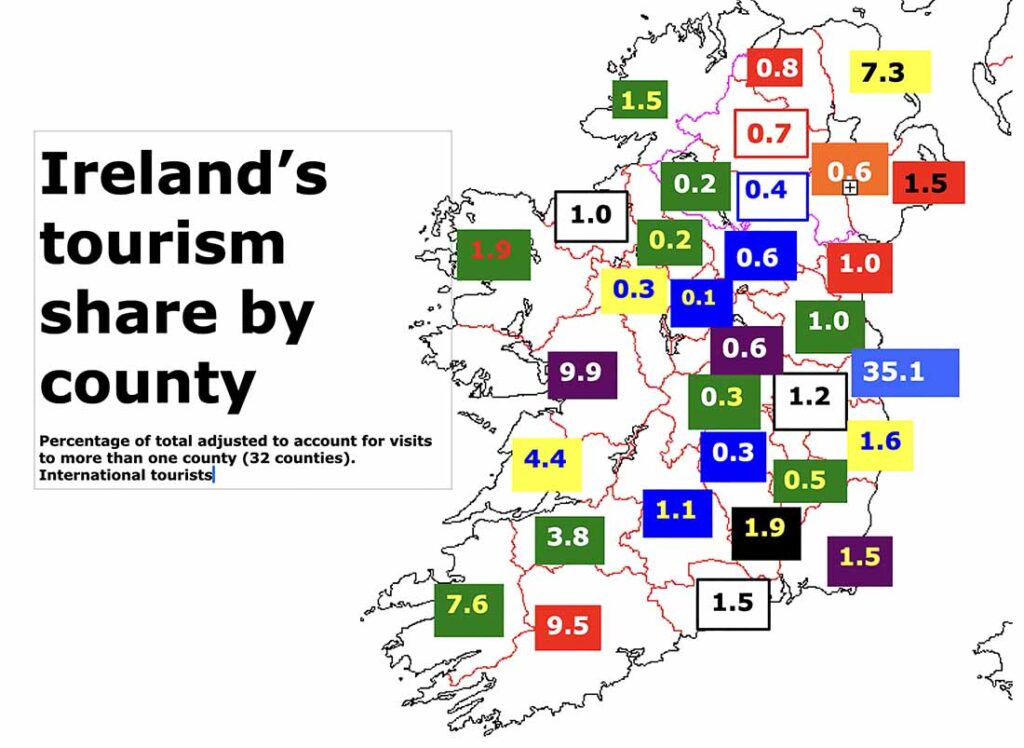
Ireland’s county Mayo offers dramatic scenery and ancient heritage, with the Cliffs of Moher’s rugged beauty and Croagh Patrick’s pilgrimage trail providing stunning vistas. The town of Westport features Georgian architecture and access to Clew Bay’s islands, while the Ceide Fields showcase a prehistoric farming landscape. Other attractions include the celebrity beaches of Achill Island. Mayo is Ireland’s third largest county by size (5,398 square km) and 18th largest by population (137,970). Population peaked at 388,887 in 1841 and reached its lowest point, 109,525 in 1971. In terms of hospitality, Mayo is Ireland’s tenth most visited tourist county with around 218,000 international visitors per year.
Introduction – Adventure – Anthem – Archaeology – Attractions – Awards – Birdwatching – Camping – Castles – Churches – Contact list – Cycling – Dining – Equestrian – Festivals – Fishing – Folklore – Gardens – Golf – Graveyards – Happening – Haunted – Highest – Hiking – History – Holy Wells – Hotels – Hotels top 8 – Hunting & shooting – Instagrammable – Itineraries – Largest town – Luxury – MICE – Movies – Music – Name – New – Novelists – Off the beaten track – Poets – Pubs – Quotes – Random Facts – Restaurant Awards – Sacred Places – Saints – Songs – Spas – Sports – Sunsets – Sustainable – Things to do – Towns – Video – Villages – Walking – Wanderlist – Weddings – Wild swimming – Writers – 1837 – 1846 – 1852 – 1909 – 1955 – 1980 –