- Tobar Mhuire (Saint Mary’s Well), Rosserk, Ballina: Pattern day: August 15 (Feast of the Assumption) to September 8, with Mass on the Sunday nearest August 15. Near Rosserk Friary, this unique well is covered by a chapel built in 1798 by John Lynott, dedicated to the Virgin Mary. Pilgrims follow a Rosary path, opened in 2007, and visit seven stone circle stations, reciting prayers. A hawthorn bush protruding through the chapel roof holds rags, rosary beads, and scapulars, reflecting clootie traditions. Known for healing, especially eyesight, it’s a vibrant pilgrimage site. Rosserk, near Ballina, Co. Mayo.
- Saint Patrick’s Well, Ballintubber: Pattern day: Last Sunday in July (Garland Sunday), with historical pilgrimages. Near Ballintubber Abbey, this well is linked to Saint Patrick, who reportedly baptized converts here. Used for healing sore eyes and general ailments, pilgrims performed rounds and left clooties. Part of the Tóchar Phádraig pilgrim route to Croagh Patrick, it remains a significant site, though patterns are less formal today. Ballintubber, Co. Mayo.
- Saint Patrick’s Well, Carrowdangan, Kiltimagh: Pattern day: Unknown, possibly March 17 (Saint Patrick’s Day). In Carrowdangan, this well, once a Druidic sacred site, was Christianized as Saint Patrick’s Well. Known for curing various ailments, pilgrims performed rounds, as noted in www.mayo-ireland.ie. Its association with Saint Patrick’s missionary work in Mayo, possibly documented by Bishop Tirechan, adds historical weight. Now obscure, it’s on private land. Carrowdangan, near Kiltimagh, Co. Mayo.
- Saint Brigid’s Well, Kildara, Ballyhaunis: Pattern day: February 1 (Saint Brigid’s Day), with historical devotions. In Kildara (meaning “church of the oak tree”), this well is dedicated to Saint Brigid. Used for healing, particularly women’s ailments, pilgrims performed rounds and left Brigid’s crosses or rags. A 2000 pilgrimage from Saint Patrick’s Parish Church included prayers and a plaque ceremony, per www.mayo-ireland.ie. Now less active, it retains local significance. Kildara, Ballyhaunis, Co. Mayo.
- Tobar Mhuire, Caher Island: Pattern day: August 15 (Feast of the Assumption), with annual pilgrimage. On uninhabited Caher Island, this well, dedicated to the Virgin Mary, is part of a complex pilgrimage landscape with leachta (dry-stone altars) and a medieval church. Pilgrims visit before an open-air Mass, performing rounds for healing. Linked to Croagh Patrick’s pilgrimage, it draws devotees despite weather-dependent access, per pilgrimagemedievalireland.com. Caher Island, off Roonagh Pier, Co. Mayo.
- Tober na Bachaille (Well of the Crozier), Rusheens West, Kilmovee: Pattern day: Unknown, possibly tied to Saint Mobhí’s feast day (October 12). In a marshy field near Kilmovee, this well is linked to Saint Mobhí, who used it to baptize converts. Known for general healing, pilgrims performed rounds, per pilgrimagemedievalireland.com. On private farmland, access requires permission from Kilmovee Community & Heritage Centre. Its rural setting preserves its sanctity. Rusheens West, Kilmovee, Co. Mayo.
- Saint Patrick’s Well, Holywell, Ballyhaunis: Pattern day: Last Sunday in July (Garland Sunday), with historical patterns. Three miles from Ballyhaunis, this well is dedicated to Saint Patrick, who brought Christianity to the area in 440 AD. Used for healing, pilgrims performed rounds and left clooties on an old tree, per www.mayo-ireland.ie. A 2000 pilgrimage included prayers led by Canon Cooney. Now less frequented, it remains a heritage site. Holywell, near Ballyhaunis, Co. Mayo.
- Tobar na Súl, Near Castlebar: Pattern day: Unknown, possibly Lughnasa (August 1). Known as the “Eye Well,” this well near Castlebar was famed for curing eye ailments. Pilgrims bathed their eyes with the water and tied clooties to bushes, believing ailments would fade as the rags decayed, per Patrick Logan’s The Holy Wells of Ireland. Its location is obscure, with no modern patterns recorded. Near Castlebar, Co. Mayo.
- Tobar na nGealt, Near Ballinrobe: Pattern day: Unknown, possibly summer festivals. The “Well of the Insane” near Ballinrobe was believed to cure mental illnesses, reflecting pre-Christian Otherworldly beliefs. Pilgrims performed rounds and left clooties, per Logan’s The Holy Wells of Ireland. Its rural setting keeps it hidden, with no active devotion but strong folklore ties. Near Ballinrobe, Co. Mayo.
- Blessed Wells (Three Wells), Barralackey, Kilmovee: Pattern day: Unknown, possibly tied to Saint Mobhí’s Day (October 12). In Barralackey, folklore from dúchas.ie tells of three wells formed when Saint Mobhí’s sister, a nun, was aided by a boy against accusations of witchcraft. Used for healing, pilgrims performed rounds. Only one well, enclosed by a low stone wall, is visible today, per pilgrimagemedievalireland.com. Access requires permission. Barralackey, Kilmovee, Co. Mayo.
- Saint Cronán’s Well, Balla: Pattern day: August 15 (Feast of the Assumption), historically observed. Near Balla’s round tower, this well, originally dedicated to Saint Cronán (Mo-Chúa), was later associated with the Virgin Mary. Known for healing sore eyes, it drew 15,000–20,000 pilgrims in the 19th century for “Long Stations,” per pilgrimagemedievalireland.com. Now quieter, it’s part of the Tóchar Phádraig route. Balla, Co. Mayo.
- Saint Feichin’s Well, Cong: Pattern day: January 20 (Saint Feichin’s Day), though patterns have lapsed. Near Cong Abbey, this well is dedicated to Saint Feichin, a 7th-century monk. Used for healing, particularly rheumatism, pilgrims performed rounds and left offerings like coins or rags, per general traditions in Stone and Tree Sheltering Water. Its monastic setting adds historical depth, but it’s now obscure and rarely visited. Cong, Co. Mayo.
Practical Notes:
- Access and Condition: Many Mayo wells are on private land (e.g., Tober na Bachaille, Barralackey) or remote (e.g., Caher Island); seek permission where needed (check www.mayo.ie or Kilmovee Community & Heritage Centre for Kilmovee wells). Tobar Mhuire (Rosserk) and Ballintubber are maintained, while others, like Tobar na Súl, are neglected or hard to locate.
- Visiting Tips: Use a map or GPS (www.ihwcbc.omeka.net) (www.ihwcbc.omeka.net), as signage is often absent. Wear waterproof boots for boggy or island sites, and respect offerings like clooties, rosary beads, or statues. For Tobar Mhuire, attend the August 15–September 8 novena; for Caher Island, book with O’Malley Ferries from Roonagh Pier, weather permitting.
- Pattern Days: Where unknown, visits likely peaked in summer (May-August), tied to saints’ feast days or Lughnasa. Patterns declined post-19th century due to Penal Laws, Famine, and church reforms (e.g., Cardinal Cullen’s 1850s decrees), but Rosserk, Caher Island, and Ballintubber remain active.
- Cultural Context: Mayo’s wells were Mass sites during Penal Times, with sunwise rounds (deiseal), Rosary prayers, and clooties to transfer ailments, reflecting Celtic rites. Specialized cures (e.g., eyes, mental illness) and sacred trees or stones (e.g., Rosserk’s hawthorn) highlight pre-Christian influences.
Holy Wells
Antrim – Armagh – Carlow – Cavan – Clare – Cork – Derry – Donegal – Down – Dublin – Fermanagh – Galway – Kerry – Kildare – Kilkenny – Laois – Leitrim – Limerick – Longford – Louth – Mayo – Meath – Monaghan – Offaly – Roscommon – Sligo – Tipperary – Tyrone – Waterford – Westmeath – Wexford – Wicklow
Sacred Places
Antrim – Armagh – Carlow – Cavan – Clare – Cork – Derry – Donegal – Down – Dublin – Fermanagh – Galway – Kerry – Kildare – Kilkenny – Laois – Leitrim – Limerick – Longford – Louth – Mayo – Meath – Monaghan – Offaly – Roscommon – Sligo – Tipperary – Tyrone – Waterford – Westmeath – Wexford – Wicklow
County Mayo:
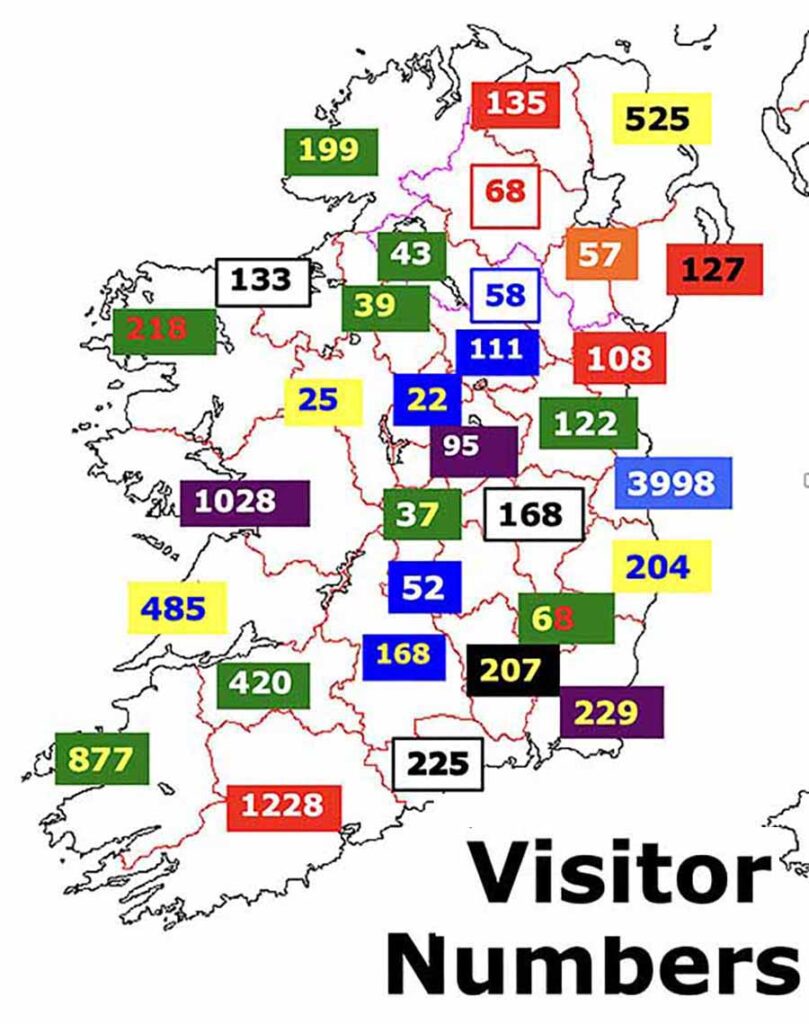
Ireland’s county Mayo offers dramatic scenery and ancient heritage, with the Cliffs of Moher’s rugged beauty and Croagh Patrick’s pilgrimage trail providing stunning vistas. The town of Westport features Georgian architecture and access to Clew Bay’s islands, while the Ceide Fields showcase a prehistoric farming landscape. Other attractions include the celebrity beaches of Achill Island. Mayo is Ireland’s third largest county by size (5,398 square km) and 18th largest by population (137,970). Population peaked at 388,887 in 1841 and reached its lowest point, 109,525 in 1971. In terms of hospitality, Mayo is Ireland’s tenth most visited tourist county with around 218,000 international visitors per year.
Introduction – Adventure – Anthem – Archaeology – Attractions – Awards – Birdwatching – Camping – Castles – Churches – Contact list – Cycling – Dining – Equestrian – Festivals – Fishing – Folklore – Gardens – Golf – Graveyards – Happening – Haunted – Highest – Hiking – History – Holy Wells – Hotels – Hotels top 8 – Hunting & shooting – Instagrammable – Itineraries – Largest town – Luxury – MICE – Movies – Music – Name – New – Novelists – Off the beaten track – Poets – Pubs – Quotes – Random Facts – Restaurant Awards – Sacred Places – Saints – Songs – Spas – Sports – Sunsets – Sustainable – Things to do – Towns – Video – Villages – Walking – Wanderlist – Weddings – Wild swimming – Writers – 1837 – 1846 – 1852 – 1909 – 1955 – 1980 –