Pre-1000 The Gaelic Nation
County Mayo, part of the ancient kingdom of Connacht, was shaped by Gaelic dynasties, notably the house of Fiachrach Muaidhe, who dominated the region. Archaeological sites, such as the Céide Fields (c. 3500 BCE), reveal one of Europe’s oldest farming landscapes, with stone walls and settlements indicating a sophisticated Neolithic society. By the 5th century, Christianity spread, with St. Patrick associated with Croagh Patrick, Mayo’s sacred mountain, where he reputedly fasted in 441 AD. Monastic sites, like Ballintubber Abbey (founded later but rooted in early Christian activity), emerged as cultural centres. The O’Dowda (Ó Dubhda) and O’Malley (Ó Máille) dynasties rose to prominence, with the latter linked to coastal strongholds. Viking raids in the 9th century targeted Mayo’s coast, particularly Clew Bay, as noted in The Annals of Ulster, but Gaelic resilience preserved local power structures.
1000–1100: Gaelic Dominance and Monastic Growth
Mayo remained a Gaelic stronghold under the house of Fiachrach and O’Dowda dynasties, with the O’Malleys gaining influence along the coast. The county’s monastic sites, such as those at Inishmurray and Killala, flourished as centres of learning and spirituality. The Synod of Kells (1152), though post-dating this period, built on earlier ecclesiastical reforms in Mayo, with Killala emerging as a diocesan centre. The Annals of the Four Masters record conflicts between Connacht’s kings, including the O’Connors, who occasionally asserted overlordship over Mayo. The county’s rugged terrain and coastal access made it a strategic but isolated region, limiting external influence.
1100–1200: Norman Arrival and Gaelic Resistance
The Norman invasion (1169) had a delayed impact on Mayo due to its western location. By the late 12th century, Norman adventurers, led by the de Burghs (Burkes), entered Connacht, challenging Gaelic lords. The O’Dowdas and O’Malleys resisted, maintaining control over much of Mayo. Ballintubber Abbey, founded in 1216 (just outside this period), reflects the growing influence of monasticism, supported by Gaelic kings like Cathal O’Connor. Mayo’s coastal strongholds, such as those in Clew Bay, were defended by the O’Malleys, who later produced Grace O’Malley (Gráinne Ní Mháille). The Annals of Connacht note regional power struggles, while Mayo’s isolation preserved its Gaelic character, with limited Norman settlement compared to eastern counties.
1200–1300: Norman-Gaelic Coexistence
The de Burghs established a foothold in Mayo, building castles like Rockfleet and Ballinrobe, but Gaelic lords, including the O’Dowdas and O’Malleys, retained significant autonomy. The Normans adopted Gaelic customs, becoming ‘Hiberno-Norman’ Burkes, who intermarried with local clans. Mayo’s economy relied on agriculture and fishing, with Clew Bay a hub for maritime activity. The Black Death (1348–1350) reduced the population, with the towns and the colonial population suffering mortality rates of up to 50pc, while the native Irish suffered less devastation. Ecclesiastical sites, such as Ballintubber and Burrishoole Abbeys, grew in influence, as documented in historical surveys. The Annals of Loch Cé record Connacht’s conflicts, suggesting Mayo’s lords navigated a delicate balance between Gaelic loyalty and Norman alliances.
1300–1400: Gaelic Resurgence and Burke Ascendancy
The decline of Norman central authority allowed Gaelic and Hiberno-Norman lords to reassert control in Mayo. The Burkes became the dominant power, ruling as the ‘Lords of Mayo’ and adopting Gaelic culture, earning the title ‘Mac William Íochtar’. The O’Dowdas held Tireragh, while the O’Malleys controlled the coastal barony of Murrisk. Castles like Castlebourke and Doona strengthened local defences. Monastic foundations, including Burrishoole and Murrisk Abbeys, supported by the Burkes, thrived as cultural hubs. The Annals of Connacht detail the Burkes’ feuds with other Connacht lords, while early Burke figures highlight their integration into Gaelic society. Mayo remained a semi-autonomous region, distant from English control.
1400–1500: Late Medieval Autonomy
Mayo’s Gaelic and Hiberno-Norman lords maintained relative independence, with the Burkes consolidating power as the Mac William Íochtar dynasty. The O’Malleys, based in Clew Bay, developed a maritime empire, with figures like Grace O’Malley’s ancestors laying the groundwork for her later prominence. The county’s landscape, with bogs and mountains, deterred English intervention, preserving local autonomy. Ecclesiastical sites like Ballintubber remained influential, hosting pilgrimages to Croagh Patrick. The Annals of Ulster note the Burkes’ conflicts with the O’Donnells of Donegal, reflecting Mayo’s role in regional power struggles. Mayo’s isolation ensured limited external interference.
1500–1600: Tudor Conquest and Grace O’Malley
The Tudor reconquest brought Mayo under English scrutiny. Grace O’Malley (c. 1530–1603), the ‘Pirate Queen’, epitomised Mayo’s resistance, commanding a fleet from Clew Bay and negotiating with Elizabeth I in 1593. The Burkes resisted Tudor control, but the Composition of Connacht (1585) forced their submission, integrating Mayo into English administration. The county saw early plantation efforts, with English settlers granted lands, though Gaelic and Hiberno-Norman influence persisted. The Nine Years’ War (1593–1603) involved Mayo’s lords, with the Burkes briefly supporting Hugh O’Neill. The Annals of the Four Masters document these conflicts, while the extraordinary life story of Grace O’Malley has secured an enduring legacy and romantic appeal down to modern times.
1600–1700: Cromwellian Devastation and Plantation
The 17th century was tumultuous for Mayo. The 1641 Rebellion saw the Burkes and O’Dowdas join Confederate forces, briefly seizing Castlebar. Cromwell’s conquest (1649–1653) devastated Mayo, with lands confiscated and redistributed to English settlers like the Brownes (later Lords Sligo). The transplantation to Connacht under Cromwell’s policy forced many Gaelic families into Mayo, reshaping its demographics. The Williamite War (1689–1691) saw further upheaval, with Jacobite forces active in the county. Westport House, built by the Brownes, emerged as a symbol of Anglo-Irish ascendancy. The Confederate Wars documents and the lives of figures like John Browne detail these shifts, while Mayo’s Catholic population faced increasing marginalisation.
1700–1800: Anglo-Irish Dominance and Rebellion
Mayo’s Anglo-Irish landlords, such as the Brownes of Westport and the Binghams, dominated under the Penal Laws, which restricted Catholic rights. The county’s economy relied on linen, agriculture, and fishing, with Westport emerging as a planned town. The 1798 Rebellion was significant in Mayo, with French forces landing at Killala and briefly establishing the ‘Republic of Connacht’ before defeat at Ballinamuck (in nearby Longford). General Humbert’s campaign,, galvanised local resistance. Croagh Patrick remained a pilgrimage site, sustaining Catholic identity. The Act of Union (1800) integrated Mayo into English rule, reducing local autonomy.
1800–1900: Famine and Emigration
The Great Famine (1845–1852) devastated Mayo, with its population plummeting from 435,000 in 1841 to 274,000 by 1851, per census records. Starvation, disease, and emigration to America and England decimated communities, particularly in rural areas like Erris. Workhouses in Castlebar and Ballina were overwhelmed. Land reforms followed, with tenant agitation challenging landlords like the Brownes. The Gaelic Revival sparked interest in Mayo’s heritage, including myths like the Táin Bó Cúailnge and Croagh Patrick’s pilgrimage tradition. The Land League, active in Mayo, saw figures like Michael Davitt (born in Straide) lead reform efforts. Westport and Castlebar grew as administrative centres.
1900–2025: Independence and Modernisation
Mayo played a key role in the War of Independence (1919–1921), with IRA flying columns active in Castlebar and Ballina, as noted in History Ireland. The county joined the Irish Free State in 1922, with Michael Davitt’s legacy inspiring nationalist sentiment. The population stabilised, reaching 130,507 by 2022, per census data. Infrastructure improvements, including the N5 and N17 roads, enhanced connectivity, while Knock Shrine, established after an 1879 apparition, became a global pilgrimage site. Tourism grew, focusing initially on the landscapes of the Quiet Man, the pilgrimage site of Croagh Patrick, and then on the Wild Atlantic Way, and archaeological sites like the Céide Fields. Mayo’s economy diversified, with agriculture, fishing, and tech industries in Castlebar. Mayo is one of 24 Irish counties that still has a smaller population than it did in 1841.
History
Antrim – Armagh – Carlow – Cavan – Clare – Cork – Derry – Donegal – Down – Dublin – Fermanagh – Galway – Kerry – Kildare – Kilkenny – Laois – Leitrim – Limerick – Longford – Louth – Mayo – Meath – Monaghan – Offaly – Roscommon – Sligo – Tipperary – Tyrone – Waterford – Westmeath – Wexford – Wicklow
County Mayo:
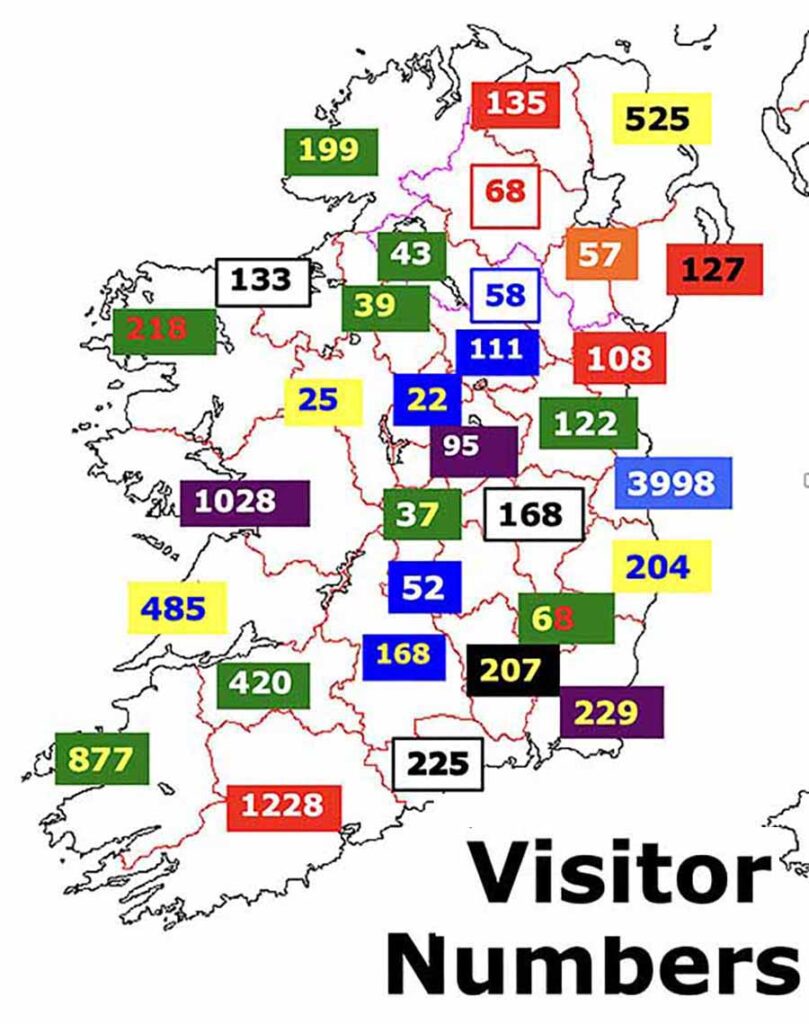
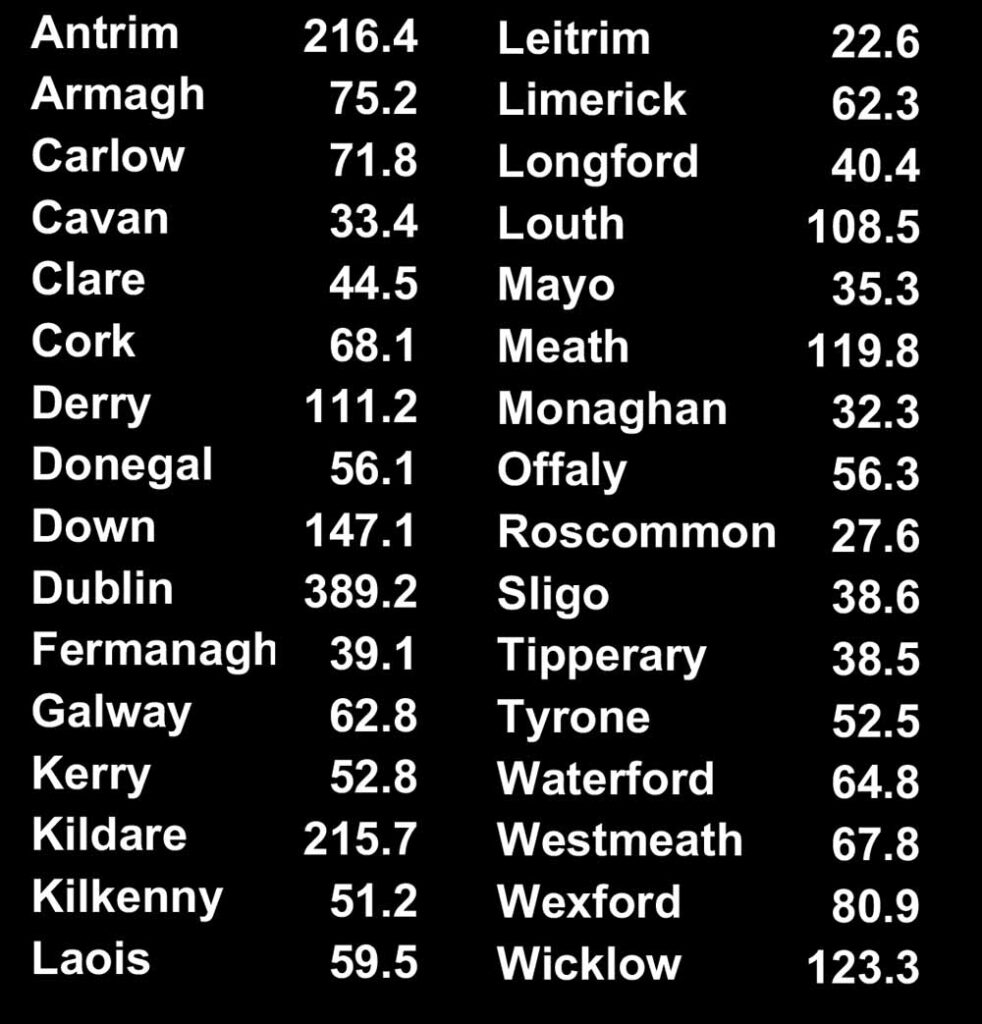
Ireland’s county Mayo offers dramatic scenery and ancient heritage, with the Cliffs of Moher’s rugged beauty and Croagh Patrick’s pilgrimage trail providing stunning vistas. The town of Westport features Georgian architecture and access to Clew Bay’s islands, while the Ceide Fields showcase a prehistoric farming landscape. Other attractions include the celebrity beaches of Achill Island. Mayo is Ireland’s third largest county by size (5,398 square km) and 18th largest by population (137,970). Population peaked at 388,887 in 1841 and reached its lowest point, 109,525 in 1971. In terms of hospitality, Mayo is Ireland’s tenth most visited tourist county with around 218,000 international visitors per year.
Introduction – Adventure – Anthem – Archaeology – Attractions – Awards – Birdwatching – Camping – Castles – Churches – Contact list – Cycling – Dining – Equestrian – Festivals – Fishing – Folklore – Gardens – Golf – Graveyards – Happening – Haunted – Highest – Hiking – History – Holy Wells – Hotels – Hotels top 8 – Hunting & shooting – Instagrammable – Itineraries – Largest town – Luxury – MICE – Movies – Music – Name – New – Novelists – Off the beaten track – Poets – Pubs – Quotes – Random Facts – Restaurant Awards – Sacred Places – Saints – Songs – Spas – Sports – Sunsets – Sustainable – Things to do – Towns – Video – Villages – Walking – Wanderlist – Weddings – Wild swimming – Writers – 1837 – 1846 – 1852 – 1909 – 1955 – 1980 –