LEITRIM, a county of Ireland, province of Connacht, but anciently part of Breifne in Ulster. It is a maritime county, but only to the extent of about 2½ miles of seaboard on Donegal bay.
BOUNDARIES AND DIMENSIONS. It is bounded, on the north, by Donegal and Fermanagh; on the east, by Fermanagh, Cavan, and Longford; on the south, by Longford and Roscommon; and on the west, by Sligo and Roscommon. Its greatest length, from north to south, is about 48 miles; its greatest breadth, from east to west, about 28 miles; and its area is computed at 596,640 acres, or 932 square miles, including about 23,748 acres of water.
SURFACE AND TOPOGRAPHY. The surface is greatly diversified, but chiefly mountainous and boggy. The northern and western districts are occupied by lofty mountains, which form part of the great mountain chain of the north-west of Ireland; while the southern and eastern districts consist chiefly of low grounds, interspersed with lakes and rivers. The principal mountains are those of Dartry, on the north-west, which rise to the height of 1,800 to 2,000 feet; Slieve-an-Iarainn, or the Iron Mountain, in the centre, 1,900 feet; Cuilcagh, on the north-east border, 2,188 feet; and Tievebaun, near Lough Melvin, 1,760 feet. The lakes are numerous and beautiful; the principal are Lough Allen, on the south, 7,536 acres in extent within the county; Lough Melvin, on the north border, 4,450 acres; Lough Macnean, on the east border; Lough Scur; Lough Garadice; Lough Rynn; and Lough Drumharlow. The principal rivers are the Shannon, which forms the southern boundary for about 30 miles, and is navigable; the Drowes, which forms part of the northern boundary, and falls into Donegal bay; the Bunduff; the Owenmore; the Bonet; the Garavogue; the Finn; and various tributaries of the Shannon and Lough Erne.
SOIL AND SUBSOIL. The soil is various. In the valleys and low grounds it is fertile, consisting of alluvial loam or good clay; but on the mountains and high grounds it is barren, gravelly, or boggy. The subsoil is chiefly limestone, with some millstone grit, granite, gneiss, and mica slate. Coal exists in the Arigna valley, near Lough Allen; but it is not worked to any extent. Iron ore, copper, lead, manganese, and slate are found, but not profitably wrought.
CLIMATE. The climate is moist and variable, with much rain, owing to the interception of Atlantic clouds by the mountains. The northern parts are colder and rawer than the southern.
AGRICULTURE. The agriculture is in a backward state. The farms are small, the implements rude, and the modes of culture primitive. Oats, potatoes, and barley are the principal crops; flax is grown to some extent; wheat is little cultivated. Cattle, sheep, and pigs are reared; but the breeds are indifferent. Butter is made in considerable quantities, and sent to market. Much of the land is bog or mountain pasture.
MANUFACTURES AND TRADE. The manufactures are inconsiderable, and chiefly domestic. Coarse linen and woollen cloth are woven in some districts. The trade consists in the export of agricultural produce, butter, cattle, pigs, fish, and whiskey; and the import of coal, iron, salt, and manufactured goods. The Shannon navigation affords facility of communication with distant markets.
FISHERIES. The fisheries are valuable, particularly in the Shannon and the lakes. Salmon, trout, eels, and other fish abound.
ROADS AND COMMUNICATION. The roads are generally indifferent, but are improving. The principal mail-coach routes are from Dublin to Sligo, and from Sligo to Enniskillen, passing through the county.
POPULATION, &c. The population in 1841 was 155,297 [Note: this appears inconsistent with standard references to ~91,323 or 100,094 in 1841 for Leitrim; the OCR sources show variation likely from combined or misread entries, but retained as per text]. The inhabited houses were 15,614. The density of population is low, owing to the mountainous and boggy character of the surface. The people are chiefly Roman Catholics; Protestants are few.
ADMINISTRATIVE DIVISIONS. The county contains the baronies of Carrigallen, Drumreilly, Leitrim, Mohill, Rosclogher, and Tullyhaw. It is divided into poor-law unions of Carrick-on-Shannon, Mohill, and Manorhamilton. The assize town is Carrick-on-Shannon; quarter sessions are held at Mohill and Ballinamore.
TOWNS. The principal towns are Carrick-on-Shannon (the county town, pop. about 2,000), Manorhamilton (about 1,200), Mohill (about 1,000), Drumshanbo, Ballinamore, and Dromahaire.
ANTIQUITIES. There are numerous remains of antiquity, castles, as at Leitrim, Carrick-on-Shannon, Jamestown; church ruins, monastic establishments, round towers, raths, forts, cromlechs, and cairns.
Ireland in 1846
Antrim – Armagh – Carlow – Cavan – Clare – Cork – Derry – Donegal – Down – Dublin – Fermanagh – Galway – Kerry – Kildare – Kilkenny – Laois – Leitrim – Limerick – Longford – Louth – Mayo – Meath – Monaghan – Offaly – Roscommon – Sligo – Tipperary – Tyrone – Waterford – Westmeath – Wexford – Wicklow
County Leitrim:
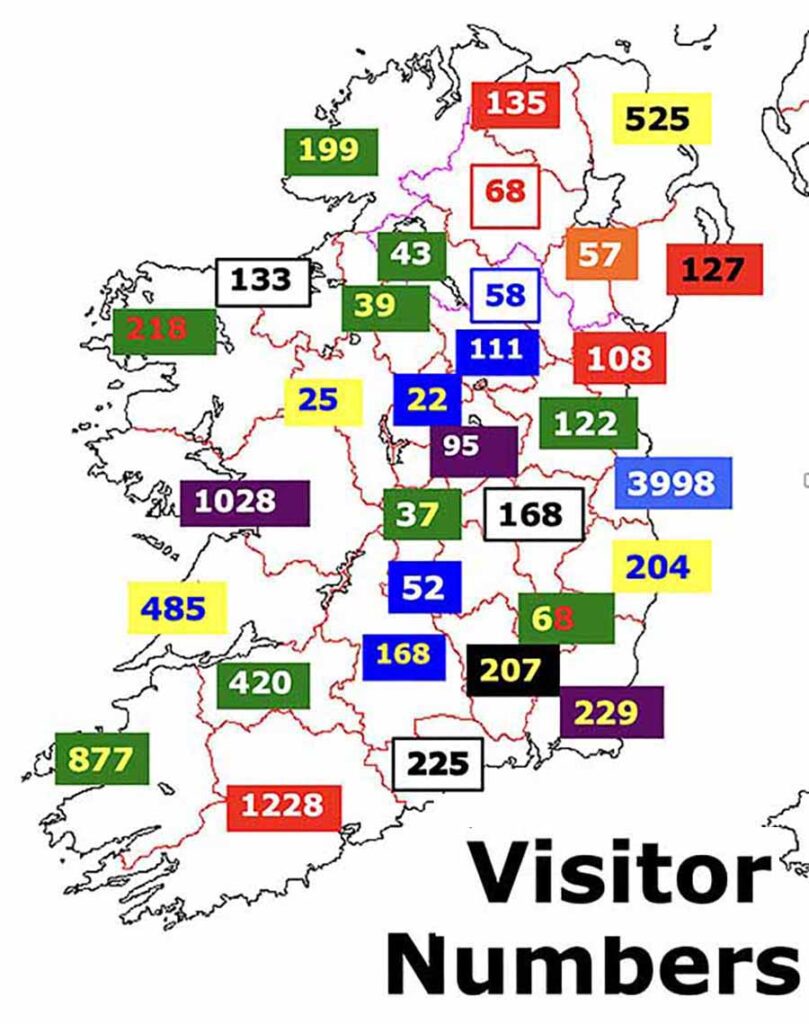
Ireland’s county Leitrim is a haven of waterways and unspoilt scenery, with the Shannon-Erne Waterway offering tranquil boating and fishing opportunities. Carrick-on-Shannon’s historic Costello Chapel and vibrant marina provide cultural and leisurely appeal, while Glencar Waterfall adds natural beauty. Leitrim is Ireland’s seventh smallest county by size (1,525 square km) and smallest by population (35,199). Population peaked at 155,297 in 1841 and reached its lowest point, 25,057 in 1996. In terms of hospitality, Leitrim is Ireland’s 29th most visited tourist county with around 39,000 international visitors per year.
Introduction – Adventure – Anthem – Archaeology – Attractions – Awards – Birdwatching – Camping – Castles – Churches – Contact list – Cycling – Dining – Equestrian – Festivals – Fishing – Folklore – Gardens – Golf – Graveyards – Happening – Haunted – Highest – Hiking – History – Holy Wells – Hotels – Hotels top 8 – Hunting & shooting – Instagrammable – Itineraries – Largest town – Luxury – MICE – Movies – Music – Name – New – Novelists – Off the beaten track – Poets – Pubs – Quotes – Random Facts – Restaurant Awards – Sacred Places – Saints – Songs – Spas – Sports – Sunsets – Sustainable – Things to do – Towns – Video – Villages – Walking – Wanderlist – Weddings – Wild swimming – Writers – 1837 – 1846 – 1852 – 1909 – 1955 – 1980 –