Pre-1000 The Gaelic Nation
County Leitrim’s pre-1000 history is rooted in its role within the kingdom of Breifne, encompassing modern Leitrim and Cavan, under the Breifne branch fo the House of Briún dynasty. Archaeological evidence, such as the crannógs on Lough Scur and the Fenagh ringforts, indicates settlement from the Bronze and Iron Ages. The O’Rourke (Ó Ruairc) clan, who would dominate later, began to emerge. Christianity arrived by the 6th century, with Saint Caillín founding a monastery at Fenagh, a key religious site. The Annals of Ulster (record monastic activities, but Viking raids, primarily along the Shannon, had minimal impact on inland Leitrim. Leitrim’s isolation preserved Gaelic culture, but ecclesiastical sources dominate, potentially exaggerating Christian influence while marginalising pre-Christian traditions.
1000–1100: Gaelic Breifne and Limited External Influence
In the 11th century, Leitrim remained part of Breifne, under the O’Rourkes, with figures like Aedh O’Rourke (d. c. 1087) consolidating local power. Fenagh’s monastery grew as a centre of learning, producing the Book of Fenagh (compiled later but rooted here). Leitrim’s inland lakes and bogs limited Viking incursions, preserving Gaelic autonomy. Ecclesiastical sources dominate, potentially overshadowing secular Gaelic life.
1100–1200: Norman Incursions and O’Rourke Resistance
The Norman invasion (1169–1171) had little direct impact on Leitrim due to its remote, western location. Breifne, under Tigernán O’Rourke (d. 1172), resisted Norman expansion, with Tigernán’s assassination by the Normans destabilising the region. The Annals of the Four Masters (record his conflicts with Dermot MacMurrough. The Normans reached nearby Sligo, but Leitrim remained Gaelic. Fenagh and other monasteries aligned with Roman reforms post-Synod of Cashel (1172). Norman sources, like the “Song of Dermot and the Earl”, focus on eastern conquests, requiring Gaelic sources for local context.
1200–1300: O’Rourke Dominance and Gaelic Continuity
In the 13th century, Leitrim was the heart of West Breifne, under O’Rourke control, with their seat at Dromahair. The county’s boundaries were not yet formalised, but Leitrim corresponded to Breifne’s western half. The O’Rourkes resisted Norman influence, maintaining alliances with Connacht’s O’Conors. The Annals of Loch Cé (mention O’Rourke conflicts with Normans and rival Gaels. Fenagh remained a religious hub, with the O’Rourkes patronising bards and churches. Leitrim’s lakelands supported fishing and small-scale farming, preserving Gaelic autonomy. Norman records marginalise Gaelic achievements, and ecclesiastical sources overemphasise monastic roles.
1300–1400: Breifne Division and O’Rourke Power
The 14th century saw Breifne divided into West Breifne (Leitrim, under O’Rourke) and East Breifne (Cavan, under O’Reilly). The O’Rourkes, under leaders like Ualgarg O’Rourke (d. 1349), strengthened West Breifne’s autonomy. The Black Death (1348–1350) had a limited impact due to Leitrim’s isolation, and the Statute of Kilkenny (1366) was irrelevant, as English authority barely reached the region. The Annals of the Four Masters (record O’Rourke campaigns. English sources portray Gaelic lords as fractious, necessitating critical interpretation.
1400–1500: O’Rourke Autonomy and Cultural Patronage
The 15th century saw Leitrim under strong O’Rourke leadership, with figures like Tadhg O’Rourke (d. 1468) asserting regional power. The Wars of the Roses (1460–1485) distracted English authorities, allowing Gaelic autonomy. The O’Rourkes patronised Fenagh’s monastery, where the Book of Fenagh began compilation, preserving Gaelic genealogies and lore. Dromahair and Carrigallen emerged as small centres, though Leitrim remained rural. Leitrim’s isolation preserved its Gaelic culture, but the lack of secular records limits insights, with ecclesiastical sources dominating.
1500–1600: Tudor Reconquest and O’Rourke Resistance
The 16th century brought Tudor efforts to subdue Leitrim. The O’Rourkes, under Brian Ballach O’Rourke (d. 1591), resisted fiercely, allying with Hugh O’Neill during the Nine Years’ War (1594–1603). Brian was executed by the English for harbouring Spanish Armada survivors. Leitrim Castle (near Carrick-on-Shannon) was a key stronghold. The Ulster Plantation (1609) confiscated O’Rourke lands, with English and Scottish settlers arriving in east Leitrim. The annals document Gaelic resistance, while English records portray the O’Rourkes as rebels, requiring balance. Leitrim remained Catholic, resisting Reformation.
1600–1700: Ulster Plantation and Confederate Wars
The 17th century transformed Leitrim through the Ulster Plantation. O’Rourke lands were granted to settlers, particularly in east Leitrim, with Carrick-on-Shannon developing as a plantation town. The 1641 Rebellion saw Catholic forces, including O’Rourke remnants, resist, briefly capturing Leitrim Castle. The Cromwellian conquest (1649–1653) led to further confiscations, marginalising Catholic landowners. The Williamite War (1689–1691) saw Leitrim loyal to William III, with no major battles. The Annals of the Four Masters document Gaelic losses. English sources vilify Catholic rebels, necessitating critical interpretation.
1700–1800: Protestant Ascendancy and Economic Stagnation
The 18th century saw Leitrim under the Colonial/Protestant Ascendancy, with Anglo-Irish landlords dominating. The Penal Laws marginalised Catholics, who formed the majority in rural Leitrim. The county’s economy relied on agriculture and fishing, with Carrick-on-Shannon as a market centre. The 1798 Rebellion saw minimal United Irishmen activity in Leitrim, with local unrest subdued. The Act of Union (1800) strengthened English control. Leitrim’s bogs and lakes limited development, keeping it one of Ireland’s poorest counties. The English narratives tend to downplay Catholic grievances.
1800–1900: Famine, Emigration, and Nationalist Stirrings
The 19th century brought severe hardship to Leitrim. The Great Famine (1845–1849) devastated the county, reducing its population from 155,000 in 1841 to 112,000 in 1851 due to starvation, disease, and emigration, particularly from rural areas. Leitrim’s reliance on smallholdings exacerbated the crisis. Railways (1860s) and Carrick-on-Shannon’s markets aided recovery. The Gaelic Revival saw the Gaelic League promote Irish culture, with limited traction in Leitrim. The GAA, founded in 1884, established football clubs. The Home Rule movement gained Catholic support, with figures like John Redmond, though not Leitrim-born, influential. English famine records tend to understate suffering.
1900–2025: Independence, Rural Decline, and Tourism
The 20th and 21st centuries saw Leitrim navigate Ireland’s independence. The War of Independence (1919–1921) saw limited IRA activity in Leitrim due to its sparse population, though border ambushes occurred. The Civil War (1922–1923) saw minor fighting, with anti-treaty forces active. Post-independence, Leitrim remained rural, with agriculture and fishing dominating. The county’s GAA tradition grew, with Leitrim winning Connacht football titles. Tourism developed around Lough Allen, Glencar Waterfall, and literary connections to writers like John McGahern, born in Leitrim. Population decline continued, with Leitrim among Ireland’s least populous counties. Official narratives tend to overemphasise progress, overlooking rural depopulation. Leitrim is one of 24 Irish counties that still has a smaller population than it did in 1841.
History
Antrim – Armagh – Carlow – Cavan – Clare – Cork – Derry – Donegal – Down – Dublin – Fermanagh – Galway – Kerry – Kildare – Kilkenny – Laois – Leitrim – Limerick – Longford – Louth – Mayo – Meath – Monaghan – Offaly – Roscommon – Sligo – Tipperary – Tyrone – Waterford – Westmeath – Wexford – Wicklow
County Leitrim:
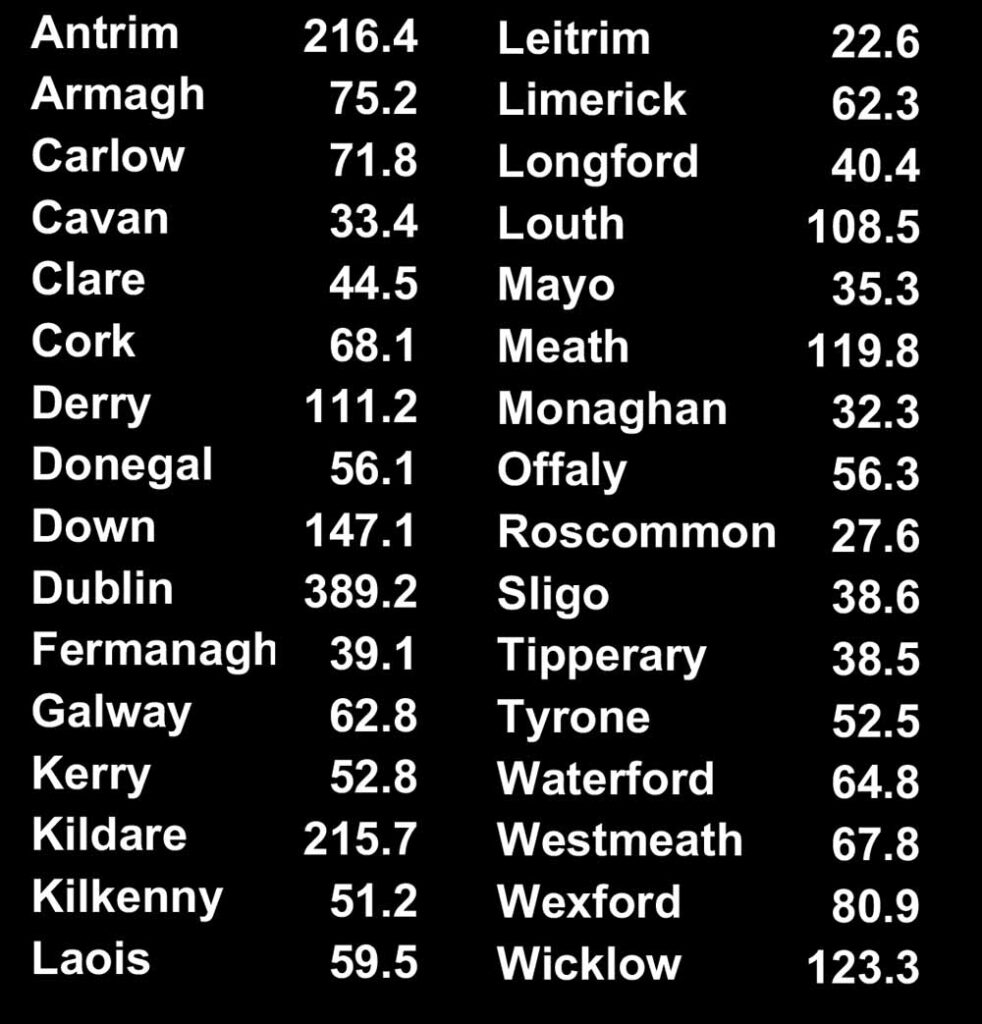
Ireland’s county Leitrim is a haven of waterways and unspoilt scenery, with the Shannon-Erne Waterway offering tranquil boating and fishing opportunities. Carrick-on-Shannon’s historic Costello Chapel and vibrant marina provide cultural and leisurely appeal, while Glencar Waterfall adds natural beauty. Leitrim is Ireland’s seventh smallest county by size (1,525 square km) and smallest by population (35,199). Population peaked at 155,297 in 1841 and reached its lowest point, 25,057 in 1996. In terms of hospitality, Leitrim is Ireland’s 29th most visited tourist county with around 39,000 international visitors per year.
Introduction – Adventure – Anthem – Archaeology – Attractions – Awards – Birdwatching – Camping – Castles – Churches – Contact list – Cycling – Dining – Equestrian – Festivals – Fishing – Folklore – Gardens – Golf – Graveyards – Happening – Haunted – Highest – Hiking – History – Holy Wells – Hotels – Hotels top 8 – Hunting & shooting – Instagrammable – Itineraries – Largest town – Luxury – MICE – Movies – Music – Name – New – Novelists – Off the beaten track – Poets – Pubs – Quotes – Random Facts – Restaurant Awards – Sacred Places – Saints – Songs – Spas – Sports – Sunsets – Sustainable – Things to do – Towns – Video – Villages – Walking – Wanderlist – Weddings – Wild swimming – Writers – 1837 – 1846 – 1852 – 1909 – 1955 – 1980 –