- Saint Patrick’s Well (Tobair Phadhraig), Tullaghan: Pattern day: March 17 (Saint Patrick’s Day), with public stations and sermons. On the hills of Bunduff in Tullaghan, this well is blessed by Saint Patrick and known for healing sore eyes, sore throats, toothaches, headaches, and cattle ailments like murrain or milk fever. Pilgrims perform rounds, recite the Rosary, and leave clooties, with private stations for specific intentions. A 1938 account notes its use for animal cures by applying water to affected parts. The well remains a focal point for local devotion, especially on Saint Patrick’s Day. Tullaghan, near Kinlough, Co. Leitrim.
- Tobair na Bheartha (Well of the Shaving), Tullaghan: Pattern day: March 17 (Saint Patrick’s Day), alongside Saint Patrick’s Well. Also in Tullaghan, this well is where Saint Patrick and his companions reportedly stopped to shave. Linked to the nearby Saint Patrick’s Well, it shares similar curative properties for ailments like sore eyes and livestock diseases. The 1938 Schools Manuscript Collection details rituals starting at a statue east of the well, with pilgrims performing rounds. Less prominent than its counterpart, it remains significant in local folklore. Tullaghan, near Kinlough, Co. Leitrim.
- Saint Brigid’s Well (Tobar Mhuire), Killargue: Pattern day: August 15 (Feast of the Assumption), with annual pilgrimage and Mass. Near Killargue, also known as Mary’s Well, this well is dedicated to Saint Brigid and famed for its peaceful setting. Pilgrims drink the water, pray, and leave clooties on a rag tree, believing in cures for various ailments. The well’s annual pilgrimage includes Rosary and Mass, with locals like Catherine Harte, a 74-year visitor, affirming its spiritual power. Its Celtic origins highlight its pre-Christian sanctity. Killargue, Co. Leitrim.
- Saint Molaise’s Well (Tobar Molaise), Rossinver: Pattern day: August 15 (Saint Molaise’s Day), historically significant. Near Lough Melvin in Rossinver, this well is linked to Saint Molaise, who founded a 6th-century abbey nearby. Legend says Molaise created the well by piercing a rock to quench his thirsty followers. Used for healing various diseases, pilgrims performed Stations of the Cross and left offerings under a whitethorn bush. Though devotion has waned, the well’s small stone edifice remains venerated. Rossinver, Co. Leitrim.
- Saint Patrick’s Well, Miskaun Glebe (Shaver’s Well), Aughnasheelin: Pattern day: Unknown, possibly March 17 (Saint Patrick’s Day). In Miskaun Glebe near Aughnasheelin, this well, also called Shaver’s Well, is dedicated to Saint Patrick. Known for healing, it features a rag tree for clooties and has been a site of local protest (e.g., anti-fracking signs). Pilgrims historically performed rounds, but specific cures are not well-documented. Its rural setting preserves its sanctity, though patterns are minimal today. Miskaun Glebe, near Aughnasheelin, Co. Leitrim.
- Saint Mogue’s Well, Rossinver: Pattern day: January 31 (Saint Mogue’s Day), though patterns have lapsed. Near Saint Mogue’s ruined abbey by Lough Melvin, this well is dedicated to Saint Mogue (Aidan). Once a major pilgrimage site, it was used for curing various ailments, with pilgrims performing rounds and leaving clooties. Its low-lying location is considered miraculous, but devotion has faded, leaving the well largely forgotten in recent times. Rossinver, Co. Leitrim.
- Saint Hugh’s Well, Ballinagleragh: Pattern day: Unknown, possibly tied to Saint Hugh’s Day (April 1). In Ballinagleragh, this well’s water is stained red from iron-rich content, adding to its mystique. Dedicated to Saint Hugh, it was used for general healing, with pilgrims performing rounds and leaving offerings. Its rural setting and unique appearance make it notable, though it’s now obscure with no active patterns recorded. Ballinagleragh, Co. Leitrim.
- Tobar na Súl, Near Drumshanbo: Pattern day: Unknown, possibly Lughnasa (August 1). Known as the “Eye Well,” this well near Drumshanbo was famed for curing eye ailments. Pilgrims bathed their eyes with the water and tied clooties to nearby bushes, believing ailments would fade as the rags decayed. Its rural location keeps it hidden, with minimal modern use but lingering folklore significance. Near Drumshanbo, Co. Leitrim.
- Tobar na nGealt, Near Carrigallen: Pattern day: Unknown, possibly summer festivals. The “Well of the Insane” near Carrigallen was believed to cure mental illnesses, reflecting pre-Christian Otherworldly beliefs. Pilgrims performed rounds, recited prayers, and left clooties. Its secluded setting and specialized healing focus make it obscure, with no modern devotion but strong ties to ancient traditions. Near Carrigallen, Co. Leitrim.
- Saint John’s Well, Near Mohill: Pattern day: June 24 (Saint John the Baptist’s Day), historically observed. Dedicated to Saint John the Baptist, this well near Mohill was used for healing children’s ailments and baptisms. Pilgrims performed rounds, used the water for purification, and left coins or small tokens. Its rural setting near a historic church adds context, but it’s now neglected with patterns long ceased. Near Mohill, Co. Leitrim.
- Tobar na Plaighe, Near Ballinamore: Pattern day: Unknown, possibly linked to plague-related rituals. The “Well of the Plague” near Ballinamore was visited during disease outbreaks for protection or healing. Pilgrims performed rounds and left clooties, believing the water held curative powers. Its historical role in community survival makes it significant, though it’s now overgrown and rarely visited. Near Ballinamore, Co. Leitrim.
- Holy Well, Mount Prospect, Kinlough: Pattern day: Unknown, possibly tied to a local saint’s day or March 17. In a field called George’s Field, about 100 yards from the road in Mount Prospect, this well is one of three in Kinlough parish. Likely blessed by Saint Patrick, it was used for healing, with pilgrims performing rounds for ailments like toothache or cattle diseases. Its obscurity reflects the decline of smaller wells, but it remains part of local tradition. Mount Prospect, Kinlough, Co. Leitrim.
Practical Notes:
- Access and Condition: Many Leitrim wells are on private land (e.g., Mount Prospect) or remote (e.g., Miskaun Glebe); seek permission where needed (check www.leitrimcoco.ie or local heritage groups). Saint Brigid’s and Saint Patrick’s (Tullaghan) are maintained, while others, like Tobar na Plaighe, are neglected or overgrown.
- Visiting Tips: Use a map or GPS (www.ihwcbc.omeka.net) (www.ihwcbc.omeka.net), as signage is often minimal. Wear waterproof boots for boggy sites, and respect offerings like clooties or statues. For Saint Brigid’s Well, attend the August 15 pilgrimage for a communal experience; for Tullaghan wells, visit on March 17.
- Pattern Days: Where unknown, visits likely peaked in summer (May-August), tied to saints’ feast days or Lughnasa. Most patterns declined post-19th century due to church disapproval, Famine, and social changes, but Saint Brigid’s and Saint Patrick’s (Tullaghan) remain active.
- Cultural Context: Leitrim’s wells were Mass sites during Penal Times, with sunwise rounds (deiseal), Rosary prayers, and clooties to transfer ailments. Specialized cures (e.g., eyes, mental illness) reflect pre-Christian beliefs, often enhanced by sacred trees or stones.
Holy Wells
Antrim – Armagh – Carlow – Cavan – Clare – Cork – Derry – Donegal – Down – Dublin – Fermanagh – Galway – Kerry – Kildare – Kilkenny – Laois – Leitrim – Limerick – Longford – Louth – Mayo – Meath – Monaghan – Offaly – Roscommon – Sligo – Tipperary – Tyrone – Waterford – Westmeath – Wexford – Wicklow
Sacred Places
Antrim – Armagh – Carlow – Cavan – Clare – Cork – Derry – Donegal – Down – Dublin – Fermanagh – Galway – Kerry – Kildare – Kilkenny – Laois – Leitrim – Limerick – Longford – Louth – Mayo – Meath – Monaghan – Offaly – Roscommon – Sligo – Tipperary – Tyrone – Waterford – Westmeath – Wexford – Wicklow
County Leitrim:
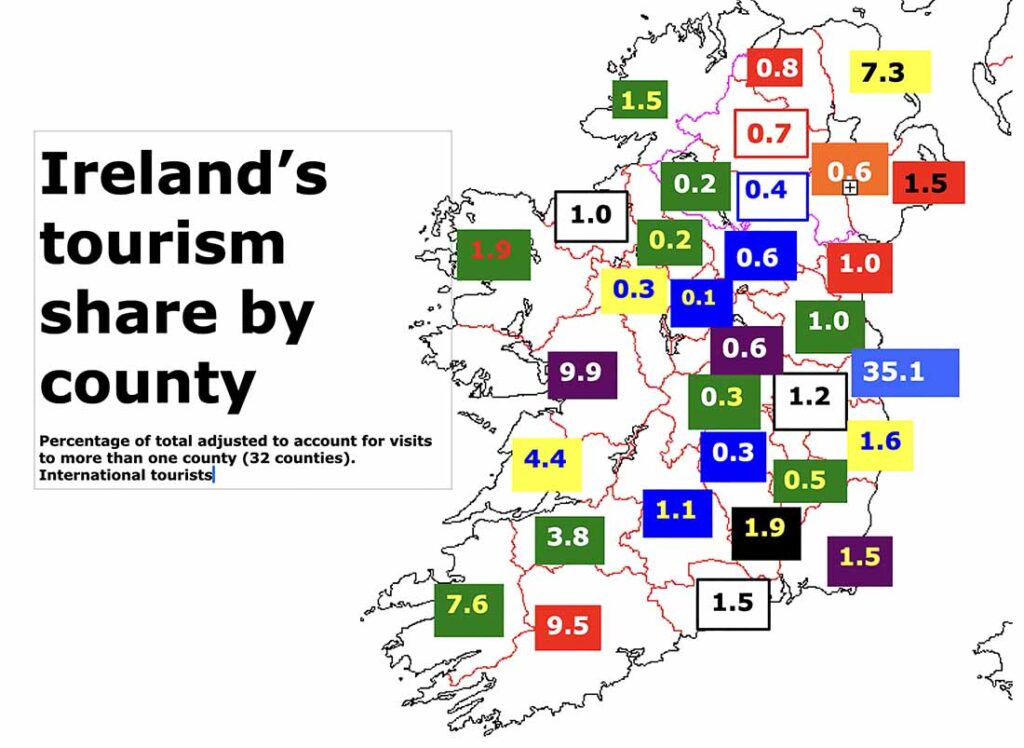
Ireland’s county Leitrim is a haven of waterways and unspoilt scenery, with the Shannon-Erne Waterway offering tranquil boating and fishing opportunities. Carrick-on-Shannon’s historic Costello Chapel and vibrant marina provide cultural and leisurely appeal, while Glencar Waterfall adds natural beauty. Leitrim is Ireland’s seventh smallest county by size (1,525 square km) and smallest by population (35,199). Population peaked at 155,297 in 1841 and reached its lowest point, 25,057 in 1996. In terms of hospitality, Leitrim is Ireland’s 29th most visited tourist county with around 39,000 international visitors per year.
Introduction – Adventure – Anthem – Archaeology – Attractions – Awards – Birdwatching – Camping – Castles – Churches – Contact list – Cycling – Dining – Equestrian – Festivals – Fishing – Folklore – Gardens – Golf – Graveyards – Happening – Haunted – Highest – Hiking – History – Holy Wells – Hotels – Hotels top 8 – Hunting & shooting – Instagrammable – Itineraries – Largest town – Luxury – MICE – Movies – Music – Name – New – Novelists – Off the beaten track – Poets – Pubs – Quotes – Random Facts – Restaurant Awards – Sacred Places – Saints – Songs – Spas – Sports – Sunsets – Sustainable – Things to do – Towns – Video – Villages – Walking – Wanderlist – Weddings – Wild swimming – Writers – 1837 – 1846 – 1852 – 1909 – 1955 – 1980 –