An inland county in the province of Ulster. It is bounded, on the north, by the county of Tyrone and Donegal; on the east, by the counties of Tyrone and Monaghan; on the south, by the county of Cavan; and on the west, by the counties of Leitrim and Donegal. Its greatest length, from north to south, is about 40 miles; its greatest breadth, from east to west, about 30 miles; and its area is computed at 457,000 acres, of which about 57,000 are under water.
The surface is much diversified with lakes, hills, and mountains. The principal chain is the Cuilcagh mountains, which run along the southern and western boundaries, and attain in Cuilcagh an elevation of 2,188 feet above the sea. The northern and eastern parts are less elevated, but hilly; and the whole county presents a pleasing variety of hill and dale. The principal lake is Lough Erne, a magnificent expanse divided into the Upper and Lower Loughs, and studded with numerous islands; its total extent is about 40,000 acres. Other lakes are Lough Melvin, Lough Macnean, and several smaller ones. The chief river is the Erne, which flows through Lough Erne, and is navigable for large vessels to Ballyshannon, and for smaller craft to Enniskillen and Belturbet. Its principal tributaries are the Finn, Sillees, Arney, and Clodagh.
The soil is various: in the valleys and lower grounds, a rich loam well adapted for tillage and pasture; on the hills, lighter and gravelly; and in the mountainous districts, poor and boggy. Agriculture is in a fair state of improvement. Oats, potatoes, and flax are the chief crops; wheat and barley are also grown in the more fertile parts. The dairy system prevails extensively, and large quantities of butter are exported. Flax is cultivated for the linen manufacture, which is carried on to a considerable extent, particularly in the spinning and weaving of coarse linens. The fisheries of Lough Erne and the coast are valuable, yielding salmon, trout, eels, and pike in abundance.
The minerals include limestone, which is quarried for building and burning; freestone and slate; and some indications of coal and iron, but not worked.
The county is divided into the baronies of Clanawley, Coole, Knockninny, Lurg, Magheraboy, Magherastephana, and Tirkennedy. The principal towns are Enniskillen (the county town), Lisnaskea, Irvinestown (Lowtherstown), Newtownbutler, and Roslea. The chief seats are Castle Coole (Earl of Belmore), Florence Court (Earl of Enniskillen), Crom Castle (Earl of Erne), Ely Lodge (Marquess of Ely), and many others.
The county is traversed by good roads, and has canal navigation by the Ulster Canal, connecting Lough Erne with Lough Neagh, and thence to Belfast and Newry.
The population, by the census of 1841, was 156,481; showing an increase since 1831 of about 17 per cent. The number of houses was 25,106. Of the families, 19,045 were chiefly employed in agriculture, 4,684 in manufactures and trade, and 2,377 in other pursuits.
Education is advancing; there are numerous national schools, and others under various societies. The county is in the dioceses of Clogher and Kilmore. The Established Church has about 30 parishes; the Roman Catholics have numerous chapels; and there are Presbyterian and Methodist meeting-houses.
The Poor-Law unions are Enniskillen, Lisnaskea, Lowtherstown, and parts of Clones and Ballyshannon. The workhouses are well managed.
The county returns one member to Parliament. The assizes are held at Enniskillen; and petty sessions are held in various places.
This county, though inland, possesses great advantages from its extensive water communication by Lough Erne and the Erne river, which afford cheap transport for its agricultural produce and linens to the ports of Ballyshannon and Sligo. The scenery is highly picturesque, particularly around Lough Erne, which attracts numerous visitors.
Ireland in 1846
Antrim – Armagh – Carlow – Cavan – Clare – Cork – Derry – Donegal – Down – Dublin – Fermanagh – Galway – Kerry – Kildare – Kilkenny – Laois – Leitrim – Limerick – Longford – Louth – Mayo – Meath – Monaghan – Offaly – Roscommon – Sligo – Tipperary – Tyrone – Waterford – Westmeath – Wexford – Wicklow
County Fermanagh:
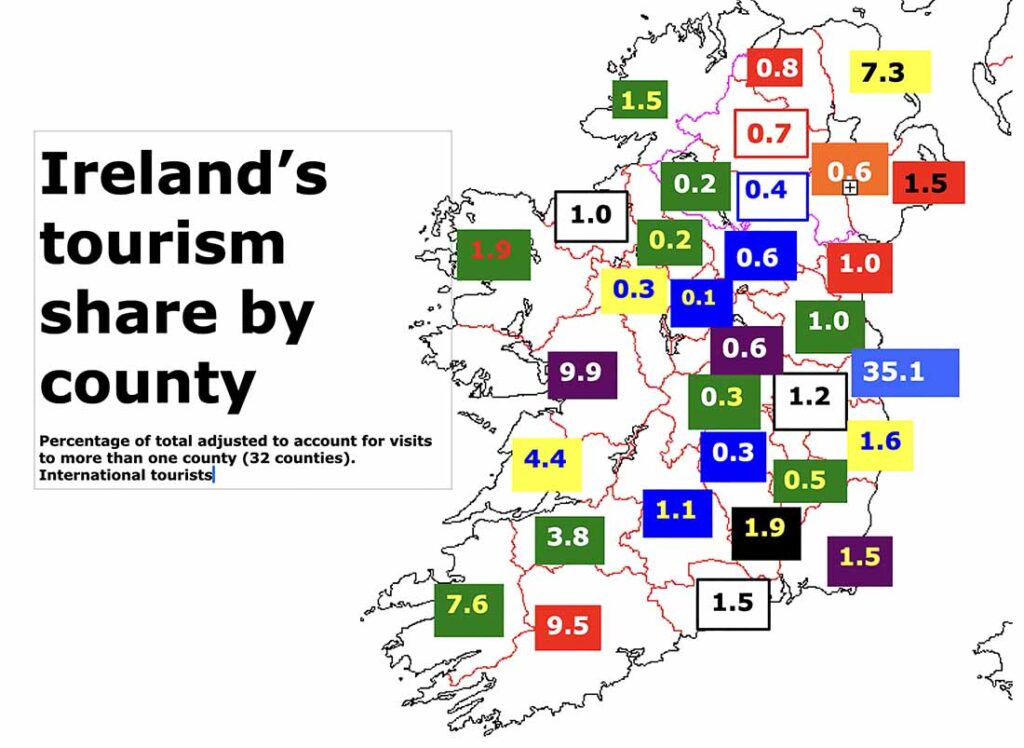
Ireland’s county Fermanagh is a county of lakes and historic charm, with Lough Erne’s waterways offering boating and fishing amidst serene islands. Enniskillen Castle and its museums explore local history, while the Marble Arch Caves, part of a UNESCO Geopark, showcase stunning underground caverns. Other attractions include the historic Florence Court estate and its gardens. Fermanagh is Ireland’s 20th largest county by size (1,876 square km) and fourth smallest by population (63,585). Population peaked at 156,481 in 1841 and reached its lowest point, 49,886 in 1966. In terms of hospitality, Fermanagh is Ireland’s 28th most visited tourist county with around 43,000 international visitors per year.
Introduction – Adventure – Anthem – Archaeology – Attractions – Awards – Birdwatching – Camping – Castles – Churches – Contact list – Cycling – Dining – Equestrian – Festivals – Fishing – Folklore – Gardens – Golf – Graveyards – Happening – Haunted – Highest – Hiking – History – Holy Wells – Hotels – Hotels top 8 – Hunting & shooting – Instagrammable – Itineraries – Largest town – Luxury – MICE – Movies – Music – Name – New – Novelists – Off the beaten track – Poets – Pubs – Quotes – Random Facts – Restaurant Awards – Sacred Places – Saints – Songs – Spas – Sports – Sunsets – Sustainable – Things to do – Towns – Video – Villages – Walking – Wanderlist – Weddings – Wild swimming – Writers – 1837 – 1846 – 1852 – 1909 – 1955 – 1980 –