A maritime county of the province of Leinster, is bounded, on the north, by Cavan, Monaghan, and Louth; on the east, by Louth and the Irish Sea; on the south, by Dublin, Kildare, and Offaly; and on the west, by Westmeath, Longford, and Cavan. Its greatest length, from north to south, is about 42 miles; its greatest breadth, from east to west, is about 38 miles; and its area is 904,117 statute acres, or about 1,413 square miles, of which about 700,000 acres are arable or under cultivation, 100,000 bog and waste, 30,000 woodland, and the rest towns, villages, roads, and water (including portions of bays and estuaries).
POPULATION, In 1831, 176,826; in 1841, 200,732, showing an increase of 23,906, or about 13.5 per cent. Houses in 1841, 33,614. Families chiefly employed in agriculture, 25,614; in manufactures and trade, 5,614; in other pursuits, 2,386. Families dependent chiefly on property and professions, 1,614; on the direction of labour, 10,614; on their own manual labour, 20,614; on means not specified, small number.
The county is divided into 5 baronies: Duleek Lower, Duleek Upper, Kells Lower, Kells Upper, Moyergallen (Morgallion), Navan Lower, Navan Upper, Ratoath, Skryne, and Slane Lower, Slane Upper (often grouped as 5 main: Lower and Upper Duleek, Lower and Upper Kells, Lower and Upper Navan, Lower and Upper Slane, Morgallion, Moyergallen, Ratoath, Skryne). It contains 146 civil parishes, and parts of others; about 1,800 townlands. Poor Law Unions: Drogheda (part), Dunshaughlin, Kells, Navan, Oldcastle, Trim. The Poor-Law valuation is about £350,000 to £400,000.
SURFACE AND TOPOGRAPHY, The surface is chiefly level or gently undulating champaign, forming part of the great eastern limestone plain; diversified with low hills, ridges, and shallow valleys; mean elevation about 200-300 feet above sea-level. The north-west has some higher ground with the Loughcrew Hills (up to 800-900 feet); the Boyne valley is picturesque with wooded slopes; bogs extensive in low tracts (reclaimable, part of great central bog system); limestone prevails, with fertile soil in valleys; coast low and sandy in parts, with Drogheda harbour at Boyne mouth.
RIVERS AND BAYS, The chief river is the Boyne (principal, rises in Offaly, traverses centre eastward, navigable to Navan/Trim and beyond to Drogheda; celebrated for scenery, fisheries, and historical associations). Tributaries: Blackwater (navigable in lower), Mattock, Nanny Water, Dee (part), Enfield Water, etc. Smaller streams: Tolka (southern), Delvin (northern boundary). Bays: none large; Boyne estuary forms good harbour at Drogheda; fisheries moderate (salmon, herring).
SOIL AND AGRICULTURE, The soil is generally fertile: rich deep loam and clay in valleys and east (excellent for wheat, barley, oats); gravelly loam in hills; lighter sandy in parts. Limestone abundant for manure. Crops: wheat (high quality), barley, oats (chief), potatoes, turnips (increasing), flax. Pasture supports superior dairy cattle (butter noted), sheep, pigs. Tillage improving with liming, rotation, drainage; farms medium; husbandry advanced, especially near Dublin influence.
CLIMATE, Mild, moist, equable; influenced by sea proximity; rainfall moderate; salubrious, suitable for agriculture.
MINERALS, Limestone chief (building stone, manure); sandstone, slate; some coal traces (not worked); no extensive metals.
TRADE AND MANUFACTURES, Chiefly agricultural; trade at Drogheda (seaport, exports grain, butter, cattle, provisions), Navan, Trim, Kells (markets for produce to Dublin). Manufactures limited: linen, brewing, distilling, milling.
TOWNS, Trim (county town, ancient, pop. about 4,000); Navan (market town, pop. about 4,500); Kells (ecclesiastical, pop. about 3,500); Drogheda (large borough and port, pop. about 12,000, shared with Louth); Slane, Dunshaughlin, Oldcastle, Athboy, Ratoath, etc.
ECCLESIASTICAL, Diocese of Meath (province of Armagh; cathedral at Trim ruins, but see at Navan historically; extensive parishes). Roman Catholic diocese of Meath; numerous chapels. Protestant churches in towns. Tithes commuted.
ANTIQUITIES, Extremely rich and celebrated: Newgrange (great passage tomb, Knowth, Dowth nearby); Tara Hill (ancient royal seat, earthworks, Lia Fail); Slane (St. Patrick’s legend); Kells (high crosses, round tower, book of Kells origin); Trim Castle (largest Norman in Ireland); Mellifont Abbey ruins (nearby); Navan motte; round towers (Kells, Donaghmore); raths, forts, cromlechs, ancient churches abundant; Boyne battlefield sites (1690).
Ireland in 1846
Antrim – Armagh – Carlow – Cavan – Clare – Cork – Derry – Donegal – Down – Dublin – Fermanagh – Galway – Kerry – Kildare – Kilkenny – Laois – Leitrim – Limerick – Longford – Louth – Mayo – Meath – Monaghan – Offaly – Roscommon – Sligo – Tipperary – Tyrone – Waterford – Westmeath – Wexford – Wicklow
County Meath:
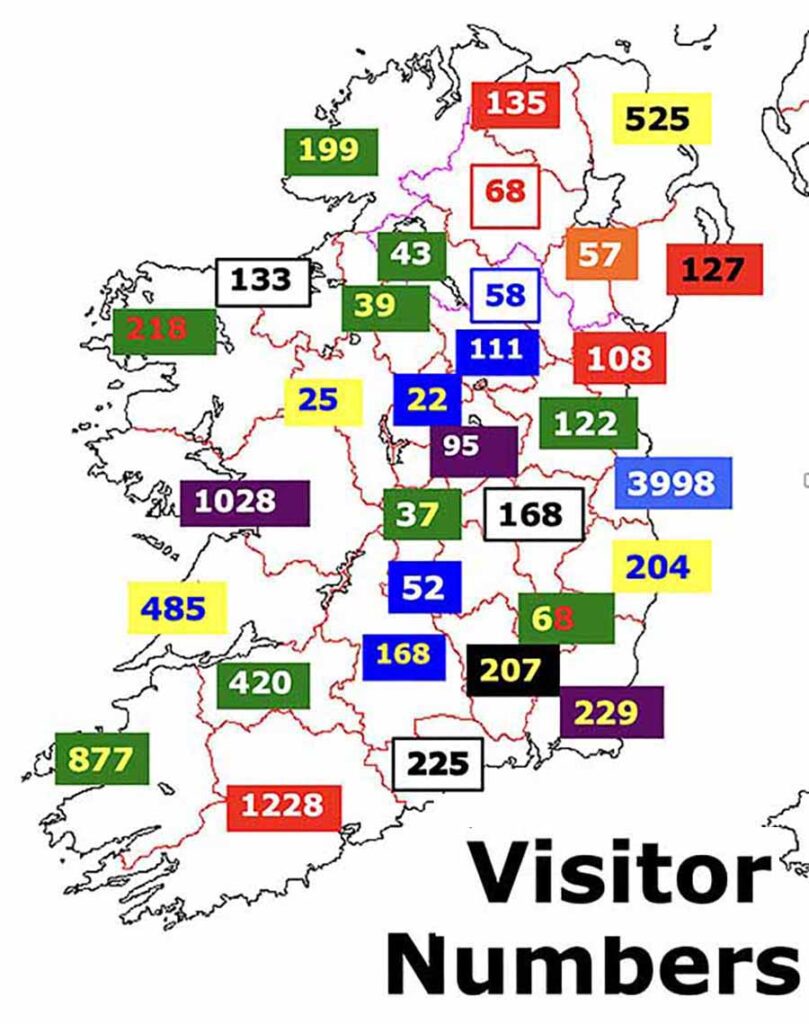
Ireland’s county Meath is steeped in Ireland’s ancient past, with the Hill of Tara offering a glimpse into royal history and panoramic views. The UNESCO-listed Brú na Bóinne complex, including Newgrange and Knowth, showcases intricate Neolithic tombs, while Trim Castle provides medieval grandeur. Other attractions include the Boyne River’s scenic walks and historic Slane Castle. Meath is Ireland’s 14th largest county by size (2,336 square km) and eighth largest by population (220,826). Population previously peaked at 183,828 in 1841 and reached its lowest point, 62,969 in 1926. In terms of hospitality, Meath is Ireland’s 19th most visited tourist county with around 122,000 international visitors per year.
Introduction – Adventure – Anthem – Archaeology – Attractions – Awards – Birdwatching – Camping – Castles – Churches – Contact list – Cycling – Dining – Equestrian – Festivals – Fishing – Folklore – Gardens – Golf – Graveyards – Happening – Haunted – Highest – Hiking – History – Holy Wells – Hotels – Hotels top 8 – Hunting & shooting – Instagrammable – Itineraries – Largest town – Luxury – MICE – Movies – Music – Name – New – Novelists – Off the beaten track – Poets – Pubs – Quotes – Random Facts – Restaurant Awards – Sacred Places – Saints – Songs – Spas – Sports – Sunsets – Sustainable – Things to do – Towns – Video – Villages – Walking – Wanderlist – Weddings – Wild swimming – Writers – 1837 – 1846 – 1852 – 1909 – 1955 – 1980 –