- Aer Lingus recorded an operating loss of €103 million in Q1 2026 compared with €55 million in Q1 2025.
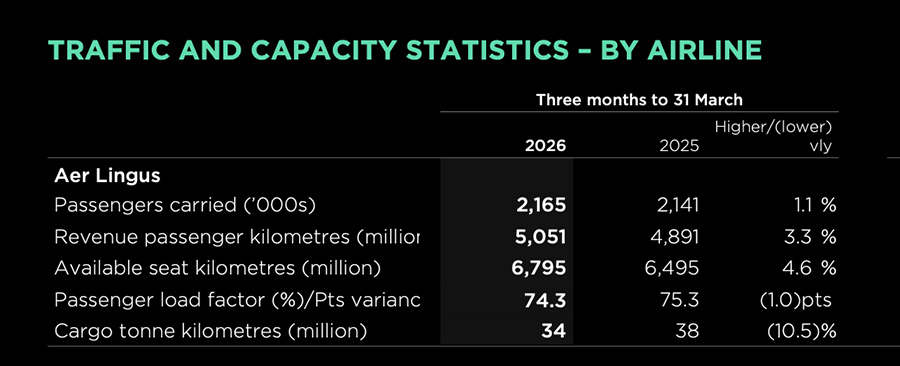
- Passenger numbers increased by 1.1 pc in the first quarter supported by new long haul and short haul routes.
- The airline launched Dublin to Raleigh-Durham in April and starts Pittsburgh services on 25 May.
- Starlink Wi-Fi installation began in March on the first aircraft with full long-haul rollout by Q1 2027.
- Aer Lingus maintains confidence in jet fuel supply for the complete summer 2026 schedule.
Aer Lingus has reported an operating loss of €103 million for the first quarter of 2026. The airline experienced higher fuel prices and increased carbon costs alongside the impact of additional competitive capacity on transatlantic routes and the closure of its Manchester transatlantic base. Passenger numbers rose by 1.1 pc compared with the same period in 2025.
Overall, International Airlines Group (IAG), the parent company of Aer Lingus, British Airways and Iberia lowered its full-year profit outlook despite strong revenue growth, due to soaring jet fuel prices linked to geopolitical disruptions. Revenue rose 1.9pc to €7.18 billion, with operating profit surging 77.3pc to €351 million. Operating margin improved to 4.9pc, and PRASK increased by 3.5pc with near-flat capacity growth.
Due to high fuel prices (estimated $150–$200/barrel), the full-year profit outlook was lowered, and free cash flow is now expected to fall short of the previous €3 billion goal. IAG is scaling back capacity growth to 1pc and 2pc for Q2 and Q3, while aiming to recover 60pc of higher fuel costs through ticket price increases. The company remains committed to €1 billion in remaining cash returns by early 2027, despite shares falling 11pc to roughly 397 GBX following the announcement
IAG reported: “We have seen some long-haul yield pressure at Aer Lingus, due to the high levels of competition, as well as some softer demand in the Eastern Mediterranean. The €48 million increase in the operating loss for Aer Lingus mainly reflected additional fuel costs and lower passenger revenues linked to competition on North Atlantic routes. IAG Loyalty’s operating profit growth of £28 million mainly reflected growth in the loyalty business driven by non-airline partnerships, with the holidays business flat year-on-year.“
Aer Lingus new routes launched including Dublin to Cancún, Tromsø, Turin and a temporary Dublin to Barbados service supported the growth in passenger numbers. Aer Lingus launched a direct Dublin to Raleigh-Durham service in April and plans to start Dublin to Pittsburgh on 25 May with its expanding fleet of A321 XLR aircraft. The carrier equipped its first aircraft with Starlink in March and continues the phased rollout of ultrafast Wi-Fi across the fleet with full long-haul availability expected by the first quarter of 2027.
Aer Lingus says it has reviewed its cost base and schedule in response to the macro-economic conditions. The airline confirmed no interruptions to jet fuel supply and expressed confidence in its ability to operate the full summer 2026 schedule. It delivered the sixth A321 XLR aircraft in January 2026. Passenger load factor was 74.3, sompared with 91.5 for Level, 90.9 for Vueling, 88.6 for Iberia and 81.9 for BA.
Lynne Embleton CEO of Aer LIngus shared ““The more challenging macro-economic environment is reflected in our Q1 2026 financial performance. While we are not seeing interruptions to jet fuel supply and we are confident of supply to operate our summer schedule, we are not immune to the impacts of sharp rises in fuel prices. In the context of a potentially longer-term change in fuel prices and a more uncertain global environment, we are actively reviewing our cost base and our schedule beyond the summer to ensure that we operate as efficiently as possible and are positioned well for the future.”
Luis Gallego, IAG Chief Executive Officer, shared: “We are pleased to report a strong first quarter, in which revenue grew by 1.9pc and profit grew by 77.3pc to €351 million, reflecting continued strong demand for our networks and airline brands. IAG is uniquely positioned to navigate the current headwinds created by the Middle East conflict thanks to our leading positions across diverse markets, strong brands, structurally high margins and strong balance sheet, as well as a strong track record of execution. “We are actively managing the uncertainty created by the fuel price increase and its impact, taking the necessary action on yields, costs and capacity. We currently see no issues with fuel availability in our main markets, particularly as we benefit from our investment in fuel self-supply at our hubs. “Whilst the impact of the higher fuel price will inevitably lead to lower profit this year than we originally anticipated, we are confident in our business model and strategy, which has made us one of the best-performing airline groups in the world, and which gives us the opportunity to prove our resilience. This confidence means we are on track to continue with the remaining €1 billion return of excess cash.”