- Dún Aonghasa: Inishmore, Aran Islands, Co. Galway, H91 YX20. An Iron Age promontory fort, dating to c. 1000-500 BC, dramatically perched on a 100m cliff. Its three concentric stone walls and chevaux-de-frise suggest defensive and ceremonial roles. Likely a royal or tribal centre, it’s a UNESCO World Heritage nominee. Managed by the OPW, it’s accessible via ferry and a visitor centre, showcasing Galway’s prehistoric coastal heritage.
- Dunguaire Castle: Kinvara, Co. Galway, H91 Y9C6. A 16th-century tower house built c. 1520 by the O’Hynes clan, strategically located on Galway Bay. Restored in the 20th century, it hosted literary figures like W.B. Yeats during its time as a cultural hub. Managed privately, it offers tours and medieval banquets, reflecting Galway’s Gaelic and literary history.
- Aughnanure Castle: Oughterard, Co. Galway, H91 PX20. A 16th-century tower house built by the O’Flaherty clan, featuring six storeys and a double bawn. It withstood sieges during the Cromwellian conquest. Set by Lough Corrib, it reflects Gaelic lordship. Managed by the OPW, it’s accessible with guided tours, showcasing medieval architecture and clan history.
- Cahercommaun Fort: Carron, The Burren (shared with Co. Clare, accessible via Galway), Co. Galway, H91 K5V7. An early medieval ringfort, c. 6th-9th century, with three concentric stone walls on a limestone cliff. Excavations revealed domestic structures and artefacts, indicating a high-status community. Accessible via public trails, it’s a state-care monument, offering insight into Galway’s early medieval life, linked to the Burren’s heritage.
- Kilmacduagh Monastic Site: Near Gort, Co. Galway, H91 K2R3. Founded in the 7th century by St. Colman MacDuagh, this site includes a 34m round tower, cathedral, and five churches, dating from the 10th-13th centuries. A key ecclesiastical centre, it reflects early Christian Ireland. Managed by the OPW, it’s freely accessible, showcasing Galway’s monastic legacy.
- Menlo Castle (Archaeological Context): Menlo, Galway City, Co. Galway, H91 E2NW. A 16th-century castle ruin, built by the Blake family, with earlier archaeological features like a possible ringfort nearby (c. 500-1000 AD). Burned in 1910, its ivy-covered ruins are atmospheric. Accessible via public paths along the River Corrib, it’s on private land but open to careful visitors, reflecting Galway’s medieval and prehistoric past.
- Rathcroghan (Crúachan): Near Oranmore, Co. Galway (shared with Co. Roscommon, accessible via Galway), F45 XF76. An Iron Age royal complex, c. 500 BC-400 AD, linked to Queen Medb in the Ulster Cycle. Features include a ceremonial mound, ringforts, and a cave (Oweynagat). A key mythological site, it’s accessible via public paths with a visitor centre in Tulsk, offering insight into Galway’s ancient royal heritage.
- Carrownaglogh Stone Circle: Near Athenry, Co. Galway, H65 VY29. A Bronze Age stone circle, c. 2000-1500 BC, with standing stones possibly used for ritual or astronomical purposes. Set in a rural landscape, it reflects prehistoric ceremonial practices. A state-care monument, it’s accessible on private land with permission, showcasing Galway’s megalithic tradition.
- Oranmore Castle: Oranmore, Co. Galway, H91 R2K7. A 15th-century tower house built by the Clanricarde Burkes, strategically located on Galway Bay. Restored in the 20th century, it reflects Gaelic maritime power. Privately owned but open for limited tours, it offers a glimpse into medieval Galway’s defensive architecture.
- Inishbofin Ecclesiastical Site: Inishbofin Island, Co. Galway, F91 YK28. An early Christian monastery, founded c. 7th century by St. Colman, with church ruins, a high cross, and holy wells. The island also has Iron Age promontory forts (c. 500 BC). Accessible by ferry from Cleggan, it’s managed by local heritage groups, reflecting Galway’s insular monastic and prehistoric heritage.
Archaeological sites
Antrim – Armagh – Carlow – Cavan – Clare – Cork – Derry – Donegal – Down – Dublin – Fermanagh – Galway – Kerry – Kildare – Kilkenny – Laois – Leitrim – Limerick – Longford – Louth – Mayo – Meath – Monaghan – Offaly – Roscommon – Sligo – Tipperary – Tyrone – Waterford – Westmeath – Wexford – Wicklow
County Galway:
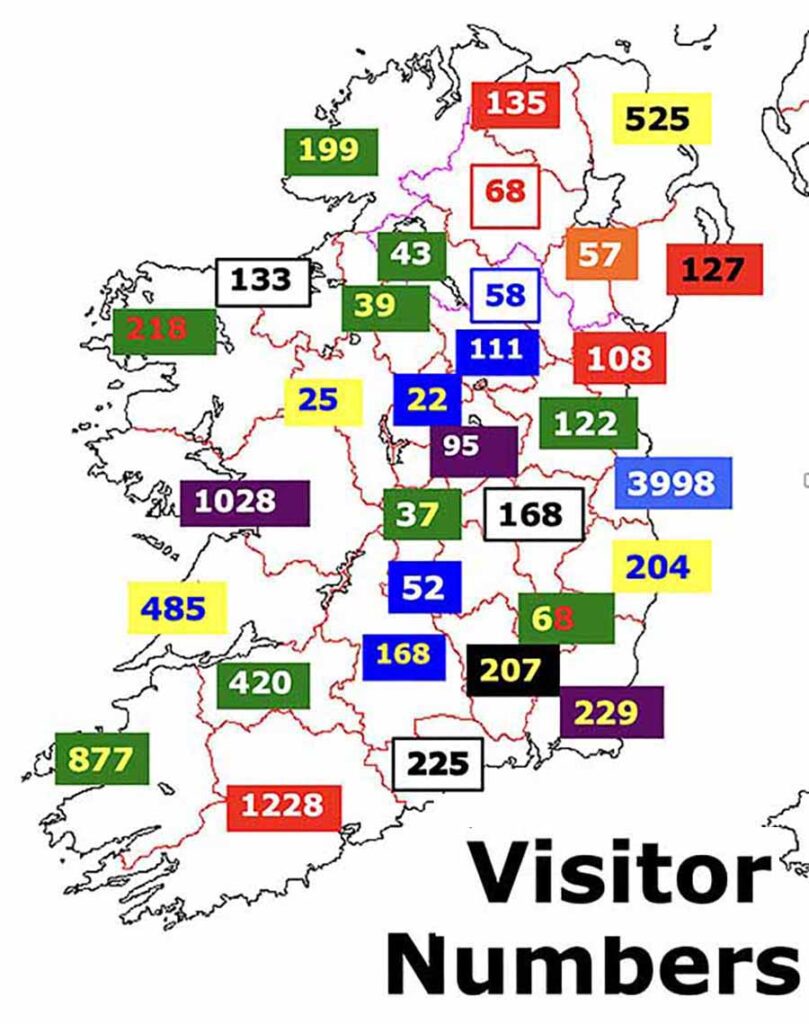
Ireland’s county Galway offers a delightful mix of cultural heritage and coastal beauty, with Galway City’s Latin Quarter showcasing historic streets and traditional music venues. The Connemara National Park provides hiking trails through rugged mountains and bogs, while the Aran Islands offer ancient stone forts like Dún Aonghasa. Other favourite stop is ithe Kylemore Abbey’s Victorian gardens and coastal cliffs. Galway is Ireland’s second largest county by size (5,939 sq km) and fifth largest by population (277,737). Population peaked at 440,198 in 1841 and reached its lowest point, 148,340 in 1966. In terms of hospitality, Galway is Ireland’s third most visited tourist county with around 1,028,000 international visitors per year.
Introduction – Adventure – Anthem – Archaeology – Attractions – Awards – Birdwatching – Camping – Castles – Churches – Contact list – Cycling – Dining – Equestrian – Festivals – Fishing – Folklore – Gardens – Golf – Graveyards – Happening – Haunted – Highest – Hiking – History – Holy Wells – Hotels – Hotels top 8 – Hunting & shooting – Instagrammable – Itineraries – Largest town – Luxury – MICE – Movies – Music – Name – New – Novelists – Off the beaten track – Poets – Pubs – Quotes – Random Facts – Restaurant Awards – Sacred Places – Saints – Songs – Spas – Sports – Sunsets – Sustainable – Things to do – Towns – Video – Villages – Walking – Wanderlist – Weddings – Wild swimming – Writers – 1837 – 1846 – 1852 – 1909 – 1955 – 1980 –