The highest point in County Galway is Mweelrea (Binn Mhór), standing at 814 meters (2,671 feet). Mweelrea is located in the Mweelrea Mountains, on the border of County Galway and County Mayo, near the village of Leenane and Killary Harbour, Ireland’s only fjord. It lies within the Wild Atlantic Way region, known for its dramatic coastal and mountain scenery.
- Elevation: At 814 meters, Mweelrea is the highest peak in Connacht, shared by Galway and Mayo, and one of Ireland’s most imposing mountains due to its rugged terrain and proximity to the Atlantic.
- Terrain: The mountain features steep, rocky slopes, grassy ridges, and boggy lower sections. The summit is a broad, rocky plateau with a cairn, offering stunning views but requiring careful navigation due to its exposure and complex terrain.
Starting Point and Access:
- Driving Route: The most common trailhead is at Doolough Valley, accessible via the R335 from Leenane (15 minutes, 10 km) or the N59 from Westport (30 minutes, ~25 km). The trailhead is near Delphi Adventure Centre or Doolough Pass, where limited parking is available along the road or at nearby lay-bys. From Galway city, the drive takes about 1.5 hours (80 km). The route offers scenic views of Killary Harbour and the Twelve Bens.
- Alternative Access: Another approach starts from Silver Strand near Louisburgh (Mayo), ascending via the western slopes. This coastal route is longer but includes stunning Atlantic views. A third option is from Leenane village, incorporating parts of the Western Way trail.
- Public Transport: Public transport is limited. Leenane is served by buses from Galway or Westport (e.g., Bus Éireann 423), but reaching the trailhead typically requires a car or taxi. Guided hikes, such as those offered by Connemara Adventure Tours or Hillwalk Ireland, include transport from Galway or Clifden.
Doolough Valley Route:
- Distance: Approximately 10–12 km round trip.
- Duration: 5–7 hours, depending on pace and conditions.
- Description: This is the most popular route, starting at Doolough Valley near the Delphi Adventure Centre. The trail crosses boggy ground to reach the base of Mweelrea, then ascends steeply via a grassy ramp known as “The Ramp” to the ridge. Hikers follow the ridge to the summit, navigating rocky and exposed terrain. The descent retraces the route, with care needed on steep and slippery sections.
- Difficulty: Strenuous, suitable for experienced hikers. The steep ascent, boggy lower slopes, and exposed ridge require good fitness, sure footing, and navigation skills.
Silver Strand Route:
- Distance: 12–15 km round trip.
- Duration: 6–8 hours.
- Description: Starting at Silver Strand beach, this route ascends Mweelrea’s western slopes, passing coastal cliffs and offering Atlantic views. The trail joins the main ridge to the summit. It’s scenic but challenging due to its length and exposure to coastal winds.
- Difficulty: Strenuous, best for experienced hikers comfortable with navigation and variable terrain.
Western Way Loop:
- Distance: 15–20 km round trip.
- Duration: 7–9 hours.
- Description: This route starts from Leenane, following parts of the Western Way long-distance trail before ascending Mweelrea via its eastern slopes. It includes views of Killary Harbour and the Twelve Bens, making it a longer but rewarding circuit.
- Difficulty: Very strenuous, requiring excellent navigation and stamina.
Navigation Tips:
- Use an Ordnance Survey map (Discovery Series Sheet 37) or apps like HiiKER, AllTrails, or PeakVisor for navigation, as the summit plateau and ridges can be disorienting in fog.
- Bring a compass or GPS device, as the mountain lacks clear waymarking, and weather can change rapidly.
- Wear sturdy, waterproof hiking boots with good grip, as the terrain includes boggy ground, loose rocks, and steep slopes. Trekking poles are highly recommended.
Scenery and Views:
- Summit Views: On clear days, Mweelrea offers breathtaking 360-degree views of Killary Harbour, the Twelve Bens, the Maumturks, and the Atlantic Ocean. Notable sights include Croagh Patrick, Clare Island, and the Mayo coastline. On exceptional days, views extend to the Aran Islands and Galway Bay. The summit’s dramatic cliffs and fjord backdrop make it one of Ireland’s most scenic peaks.
- Landscape: The lower slopes are boggy with heather and grass, transitioning to steep, rocky ridges and a broad summit plateau. The surrounding area features glacial valleys, lakes (e.g., Doolough), and the fjord-like Killary Harbour, creating a wild, elemental landscape.
- Unique Features: Mweelrea’s position between the ocean and mountains gives it a unique character. Its cliffs and corries, like those in the Coumshingaun corrie, are geologically significant, formed by glacial activity.
Hiking Experience:
- Duration: The Doolough Valley route takes 5–7 hours, Silver Strand 6–8 hours, and the Western Way loop 7–9 hours, including summit time.
- Conditions: The terrain is challenging, with wet, boggy ground at lower levels and steep, rocky ascents. The summit is highly exposed, with strong winds and frequent mist. Spring and summer (April–September) are ideal for milder weather and longer daylight, with August showcasing vibrant heather. Winter hikes are possible but risky due to snow, ice, and shorter days.
- Cultural Significance: Mweelrea is part of the Connemara Gaeltacht, an Irish-speaking region, and is steeped in local folklore. Its proximity to Killary Harbour and Leenane, featured in films like The Field, adds cultural depth.
- Weather: The summit is extremely exposed, with rapid weather changes, strong winds, and frequent fog. Check forecasts (e.g., Met Éireann) and avoid hiking in severe conditions.
- Terrain: The boggy lower slopes, steep ramps, and loose rocks require careful footing. The summit ridge can be hazardous in high winds or low visibility.
- Safety: Inform someone of your plans, as there are no rangers. Bring water, snacks, and warm clothing, as temperatures drop significantly. Solo hikers should be highly confident in navigation or opt for guided tours.
- Wildlife: Expect to see birds like peregrine falcons, ravens, or skylarks, and possibly red deer or hares. The bogs support unique flora, including sundews and bog asphodel.
Highest point in county
Antrim – Armagh – Carlow – Cavan – Clare – Cork – Derry – Donegal – Down – Dublin – Fermanagh – Galway] – Kerry – Kildare – Kilkenny – Laois – Leitrim – Limerick – Longford – Louth – Mayo – Meath – Monaghan – Offaly – Roscommon – Sligo – Tipperary – Tyrone – Waterford – Westmeath – Wexford – Wicklow
County Galway:
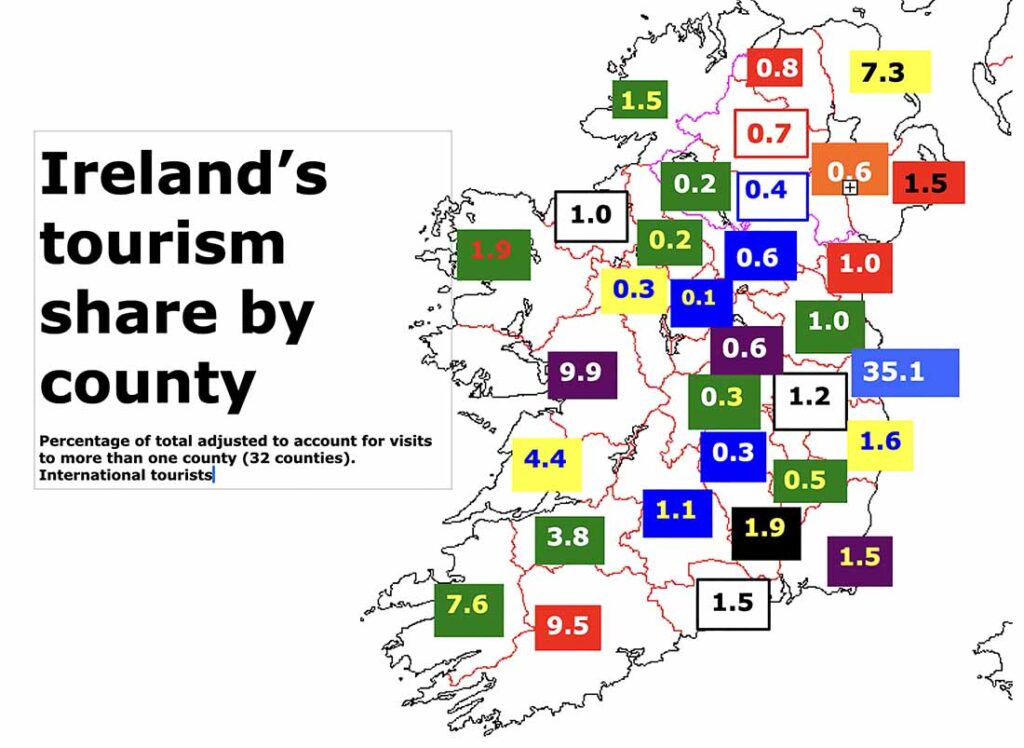
Ireland’s county Galway offers a delightful mix of cultural heritage and coastal beauty, with Galway City’s Latin Quarter showcasing historic streets and traditional music venues. The Connemara National Park provides hiking trails through rugged mountains and bogs, while the Aran Islands offer ancient stone forts like Dún Aonghasa. Other favourite stop is ithe Kylemore Abbey’s Victorian gardens and coastal cliffs. Galway is Ireland’s second largest county by size (5,939 sq km) and fifth largest by population (277,737). Population peaked at 440,198 in 1841 and reached its lowest point, 148,340 in 1966. In terms of hospitality, Galway is Ireland’s third most visited tourist county with around 1,028,000 international visitors per year.
Introduction – Adventure – Anthem – Archaeology – Attractions – Awards – Birdwatching – Camping – Castles – Churches – Contact list – Cycling – Dining – Equestrian – Festivals – Fishing – Folklore – Gardens – Golf – Graveyards – Happening – Haunted – Highest – Hiking – History – Holy Wells – Hotels – Hotels top 8 – Hunting & shooting – Instagrammable – Itineraries – Largest town – Luxury – MICE – Movies – Music – Name – New – Novelists – Off the beaten track – Poets – Pubs – Quotes – Random Facts – Restaurant Awards – Sacred Places – Saints – Songs – Spas – Sports – Sunsets – Sustainable – Things to do – Towns – Video – Villages – Walking – Wanderlist – Weddings – Wild swimming – Writers – 1837 – 1846 – 1852 – 1909 – 1955 – 1980 –