Pre-1000 The Gaelic Nation
County Galway’s pre-1000 history is rooted in its role within the Connachta kingdoms, particularly the house of Fiachra and the house of Maine. Archaeological sites, such as the ringforts at Roscam and the Dunguaire Castle site (a later structure but with Iron Age origins), indicate settlement from the Bronze Age. The region was controlled by Gaelic clans, with the O’Flahertys (Ó Flaithbheartaigh) emerging in Iar Connacht (west Galway). Christianity arrived by the 5th century, with Saint Enda founding a monastery on Inishmore (Aran Islands) around 480 CE, and Saint Brendan associated with Clonfert. The Annals of Inisfallen (record Viking raids on Galway’s coast, particularly the Aran Islands, from the 9th century, targeting monastic wealth. Galway’s strategic position on the Atlantic made it a trade hub, but ecclesiastical sources dominate, potentially exaggerating Christian influence while marginalising pre-Christian Gaelic culture.
1000–1100: Gaelic Connacht and Viking Influence
In the 11th century, Galway remained under Gaelic control, with the house of Briún dynasty, led by the O’Conor (Ó Conchobhair) dynasty, dominating Connacht. The Annals of Inisfallen mention conflicts between the O’Conors and rival kingdoms. Vikings established a presence at Galway city by the 10th century, creating a trading post at the mouth of the River Corrib. Monastic centres like Clonfert and Tuam grew in significance, with Tuam emerging as an ecclesiastical hub. The Battle of Clontarf (1014) weakened Viking influence, but Galway’s port maintained Norse trade links. Norse and ecclesiastical sources dominate, potentially overshadowing Gaelic secular life.
1100–1200: Norman Incursions and Gaelic Resilience
The Norman invasion (1169–1171) had limited direct impact on Galway due to its western location. Connacht, including Galway, remained under O’Conor control, with Rory O’Conor (d. 1198) resisting Norman expansion. The Annals of the Four Masters (record O’Conor’s campaigns, notably his role as High King. The Normans reached east Galway, with figures like William de Burgh granted lands by 1200. The establishment of Cistercian monasteries, such as Knockmoy Abbey (c. 1190), introduced European influences. Galway city began to develop as a port under Anglo-Norman influence. The “Song of Dermot and the Earl” focuses on eastern conquests. Gaelic sources provide local context but are limited.
1200–1300: Anglo-Norman Settlement and Galway’s Urban Growth
In the 13th century, Galway was formally shired, with boundaries close to modern definitions. The Anglo-Norman de Burgh family, under Richard de Burgh (d. 1243), established control in east Galway, building castles like Athenry. Galway city was chartered in 1230, becoming a walled port under Anglo-Norman merchants, known as the “Tribes of Galway” (e.g., Lynch, Blake). The O’Flahertys and O’Conors retained power in west Galway, resisting Norman dominance. The Annals of Loch Cé mention de Burgh conflicts with Gaelic lords. The city’s trade with Spain and France grew, but Norman records overemphasise their control, requiring balance with Gaelic sources.
1300–1400: Gaelic Revival and de Burgh Decline
The 14th century saw a Gaelic revival in Galway, as Anglo-Norman power weakened post-Black Death (1348–1350). The O’Conors and O’Flahertys regained influence in rural Galway, with the O’Flahertys dominating Iar Connacht. The de Burghs, Gaelicised as Burkes, split into rival factions, weakening their hold. The Statute of Kilkenny (1366) had little impact in Galway, where Gaelic law prevailed outside the city. Galway city remained an Anglo-Norman hub, with its walls completed by 1360. The Annals of the Four Masters (record O’Conor and O’Flaherty campaigns. English sources portray Gaelic lords as chaotic, necessitating critical interpretation.
1400–1500: Gaelic Autonomy and Tribes of Galway
The 15th century saw Galway’s rural areas under Gaelic control, with the O’Flahertys and O’Conors dominant. The Burkes, now fully Gaelicised, ruled east Galway. Galway city thrived as a semi-autonomous port, governed by the Tribes (14 merchant families), with figures like the Lynch family prominent. The Wars of the Roses (1460–1485) distracted English authorities, allowing local autonomy. Tuam and Clonfert remained ecclesiastical centres, with the O’Conors patronising churches. Galway’s isolation preserved its Gaelic culture, but urban records dominate, marginalising rural Gaelic perspectives.
1500–1600: Tudor Reconquest and O’Flaherty Resistance
The 16th century brought Tudor efforts to control Galway. The O’Flahertys, under leaders like Donal O’Flaherty (d. 1564), resisted, while the Burkes accepted English titles via surrender and regrant. Galway city, loyal to the crown, received a royal charter in 1579, strengthening its merchant elite. The Reformation had limited impact, as Galway remained Catholic. The Nine Years’ War (1594–1603) saw minor O’Flaherty involvement, with Galway city a supply base for English forces. Early plantations targeted east Galway. The annals document Gaelic resistance, while English records portray Gaels as rebels, requiring balance.
1600–1700: Plantations and Confederate Wars
The 17th century saw Galway transformed by English colonisation. The Munster and Connacht plantations confiscated O’Flaherty and Burke lands, particularly in east Galway, granting them to English settlers. The 1641 Rebellion saw Galway join the Catholic Confederacy, with Galway city briefly besieged. The Cromwellian conquest (1649–1653) led to massive land redistributions, with Catholics transplanted to west Galway under the “to Hell or to Connacht” policy. The Williamite War (1689–1691) saw Galway city surrender to Williamite forces in 1691. The Annals of the Four Masters document Catholic losses. English sources vilify rebels, necessitating critical interpretation.
1700–1800: Protestant Ascendancy and Trade Decline
The 18th century saw Galway under the Colonial/Protestant Ascendancy, with Anglo-Irish landlords dominating. The Penal Laws marginalized Catholics, who formed the majority outside Galway city. The city’s trade declined due to competition from Dublin and Cork, though the Tribes retained influence. The 1798 Rebellion saw minimal activity in Galway, with local discontent subdued. The Act of Union (1800) strengthened English control. Rural Galway relied on agriculture, with fishing in the Aran Islands. English and colonial narratives tend to downplay native Irish or Catholic grievances.
1800–1900: Famine, Revival, and Nationalism
The 19th century was marked by hardship in Galway. The Great Famine (1845–1849) devastated the county, reducing its population from 422,000 in 1841 to 321,000 in 1851 due to starvation, disease, and emigration, particularly from west Galway’s Gaeltacht. Galway city’s port facilitated emigration. The railway (1851) and Clifden’s growth aided recovery. The Gaelic Revival saw the Gaelic League thrive in Galway’s Gaeltacht, with figures like Patrick Pearse visiting the Aran Islands. The GAA, founded in 1884, established strong hurling clubs, with Galway winning titles. The Land League and Home Rule movement, led locally by figures like Matthew Harris, gained traction. English famine records tend to understate suffering.
1900–2025: Independence, Gaeltacht, and Tourism
The 20th and 21st centuries saw Galway play a key role in Ireland’s independence. The War of Independence (1919–1921) saw IRA activity, particularly in rural Galway, with figures like Liam Mellows prominent. The Civil War (1922–1923) saw fighting in Galway, with anti-treaty forces active. Post-independence, Galway’s Gaeltacht preserved Irish language, with Údarás na Gaeltachta supporting development. Galway city became a cultural hub, with festivals like the Galway Arts Festival. The county’s GAA tradition flourished, with All-Ireland hurling titles in 1923, 1980, 1987, 1988, and 2017. Tourism grew around the Aran Islands, Connemara, and Galway city. Official narratives tend to overemphasise progress, overlooking rural challenges. Galway is one of 24 Irish counties that still has a smaller population than it did in 1841.
History
Antrim – Armagh – Carlow – Cavan – Clare – Cork – Derry – Donegal – Down – Dublin – Fermanagh – Galway – Kerry – Kildare – Kilkenny – Laois – Leitrim – Limerick – Longford – Louth – Mayo – Meath – Monaghan – Offaly – Roscommon – Sligo – Tipperary – Tyrone – Waterford – Westmeath – Wexford – Wicklow
County Galway:
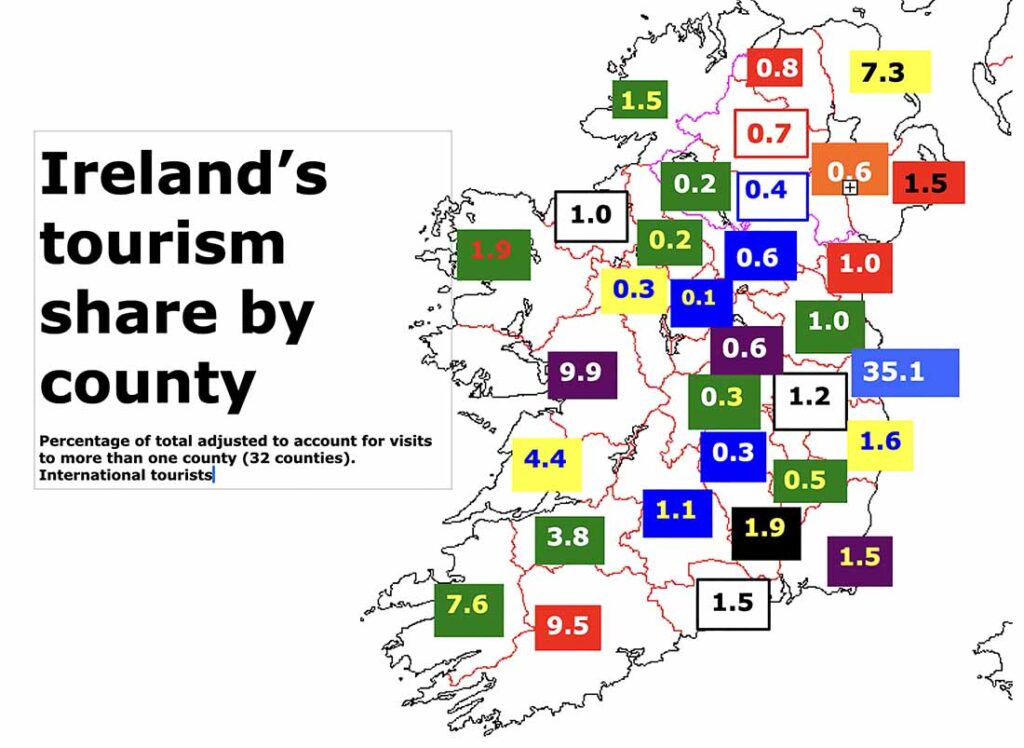
Ireland’s county Galway offers a delightful mix of cultural heritage and coastal beauty, with Galway City’s Latin Quarter showcasing historic streets and traditional music venues. The Connemara National Park provides hiking trails through rugged mountains and bogs, while the Aran Islands offer ancient stone forts like Dún Aonghasa. Other favourite stop is ithe Kylemore Abbey’s Victorian gardens and coastal cliffs. Galway is Ireland’s second largest county by size (5,939 sq km) and fifth largest by population (277,737). Population peaked at 440,198 in 1841 and reached its lowest point, 148,340 in 1966. In terms of hospitality, Galway is Ireland’s third most visited tourist county with around 1,028,000 international visitors per year.
Introduction – Adventure – Anthem – Archaeology – Attractions – Awards – Birdwatching – Camping – Castles – Churches – Contact list – Cycling – Dining – Equestrian – Festivals – Fishing – Folklore – Gardens – Golf – Graveyards – Happening – Haunted – Highest – Hiking – History – Holy Wells – Hotels – Hotels top 8 – Hunting & shooting – Instagrammable – Itineraries – Largest town – Luxury – MICE – Movies – Music – Name – New – Novelists – Off the beaten track – Poets – Pubs – Quotes – Random Facts – Restaurant Awards – Sacred Places – Saints – Songs – Spas – Sports – Sunsets – Sustainable – Things to do – Towns – Video – Villages – Walking – Wanderlist – Weddings – Wild swimming – Writers – 1837 – 1846 – 1852 – 1909 – 1955 – 1980 –