- Céide Fields: Ballycastle, North Mayo, approximately 8 km west of Ballycastle (Coordinates: 54.305°N, 9.456°W).. The Céide Fields, dating to c. 3500–3000 BC, is the world’s oldest known field system, a vast Neolithic landscape preserved beneath blanket bog. Discovered in the 1930s by local schoolteacher Patrick Caulfield and excavated by his son Seamus, the site includes stone-walled fields, houses, and megalithic tombs, covering over 12 square kilometres. It reveals a sophisticated farming community with a complex social structure, predating the pyramids of Egypt. The visitor centre, opened in 1993, offers exhibits on the site’s archaeology, geology, and bog ecology, with guided tours of the exposed field systems. Managed by Heritage Ireland, the visitor centre is open seasonally (typically March–November) with admission fees and guided tours. Check www.heritageireland.ie for hours and tickets.
- Rockfleet Castle (Carrickahowley Castle): Near Newport, County Mayo, approximately 8 km west of Newport (Coordinates: 53.896°N, 9.628°W).. Built in the mid-16th century, Rockfleet Castle is a four-storey tower house associated with Grace O’Malley (Granuaile), the legendary pirate queen. Strategically located on Clew Bay, it served as a defensive stronghold and base for O’Malley’s maritime activities. The castle reflects the Gaelic lordship of the O’Malley clan during a period of resistance against English rule. Archaeological surveys indicate minimal alteration since its construction, preserving its medieval character. Managed by the OPW, the castle is accessible year-round with free entry, though interior access may be limited. Check www.heritageireland.ie for details.
- Boheh Stone (St. Patrick’s Chair): Boheh, near Westport, County Mayo, approximately 6 km southeast of Westport (Coordinates: 53.775°N, 9.467°W).. The Boheh Stone, a rock outcrop with Neolithic rock art (c. 3000–2000 BC), features over 250 cup-and-ring carvings, one of Ireland’s finest examples of prehistoric petroglyphs. Known locally as St. Patrick’s Chair, it is linked to early Christian traditions and offers a view of Croagh Patrick, suggesting a ritual connection. The site’s alignment with the “Rolling Sun” phenomenon, where the sun appears to roll down Croagh Patrick’s slope at specific times, indicates possible astronomical significance. It reflects Mayo’s rich prehistoric ritual landscape. Located on public land, the site is freely accessible via a short walk. No formal facilities; check www.archaeology.ie or www.discoverireland.ie for directions.
- Ballintubber Abbey: Ballintubber, near Claremorris, County Mayo, approximately 13 km south of Castlebar (Coordinates: 53.742°N, 9.286°W).. Founded in 1216 by Cathal Crobhdearg O’Connor, King of Connacht, Ballintubber Abbey is a rare example of a church in continuous use for over 800 years despite periods of suppression. Built in the Romanesque style, it features a nave, chancel, and later medieval additions. The abbey survived destruction during the Cromwellian conquest and penal laws, reflecting its resilience as a spiritual and cultural centre. Archaeological excavations have uncovered medieval artefacts, including a 13th-century font. Open year-round with guided tours and a visitor centre. Donations are suggested; check www.ballintubberabbey.ie for hours and events.
- Rathcroghan (Cruachan Aí): Near Tulsk, County Roscommon, but closely associated with Mayo’s archaeological landscape, approximately 40 km east of Castlebar (Coordinates: 53.806°N, 8.302°W).. Although primarily in Roscommon, Rathcroghan’s influence extends into Mayo due to its role as the mythical capital of Connacht in the Ulster Cycle, including the Táin Bó Cúailnge. This Iron Age complex (c. 500 BC–AD 500) includes over 240 archaeological sites, such as ring forts, barrows, and the Oweynagat Cave, a ritual site linked to the goddess Morrígan. The site was a royal and ceremonial centre for the Connachta dynasty. Mayo’s proximity makes it a key destination for visitors exploring the region’s mythology. The Rathcroghan Visitor Centre in Tulsk offers guided tours and exhibits. Open year-round; check www.rathcroghan.ie for details. Note: Some monuments are on private land, requiring permission.
- Carrowmore Megalithic Cemetery: Near Sligo, County Sligo, but relevant to Mayo’s archaeological context, approximately 50 km north of Ballina (Coordinates: 54.251°N, 8.519°W).. Included due to its proximity and shared cultural landscape with Mayo, Carrowmore is one of Ireland’s largest and oldest megalithic cemeteries, dating to c. 3700–3000 BC. Over 30 tombs, including dolmens and passage tombs, have been excavated, revealing cremated remains and artefacts. The site predates Newgrange and reflects early Neolithic burial practices. Its visitor centre connects it to Mayo’s prehistoric sites like Céide Fields, forming part of the northwest’s megalithic tradition. Managed by Heritage Ireland, the visitor centre is open seasonally (April–October) with guided tours. Check www.heritageireland.ie for tickets.
- Doona Castle: Near Ballycroy, County Mayo, approximately 20 km northwest of Newport (Coordinates: 54.027°N, 9.884°W).. A 15th-century tower house on the Erris coast, Doona Castle is another stronghold linked to Grace O’Malley. Built by the O’Malley clan, it overlooks Blacksod Bay and served as a defensive and maritime base. The castle’s remote location reflects the clan’s control over Mayo’s western seaboard. It fell into ruin after the 17th century, but its dramatic coastal setting and historical significance make it a notable site. Archaeological surveys highlight its intact medieval features. Accessible year-round with free entry, though the interior is not open due to safety concerns. Check www.discoverireland.ie for access details
Archaeological sites
Antrim – Armagh – Carlow – Cavan – Clare – Cork – Derry – Donegal – Down – Dublin – Fermanagh – Galway – Kerry – Kildare – Kilkenny – Laois – Leitrim – Limerick – Longford – Louth – Mayo – Meath – Monaghan – Offaly – Roscommon – Sligo – Tipperary – Tyrone – Waterford – Westmeath – Wexford – Wicklow
County Mayo:
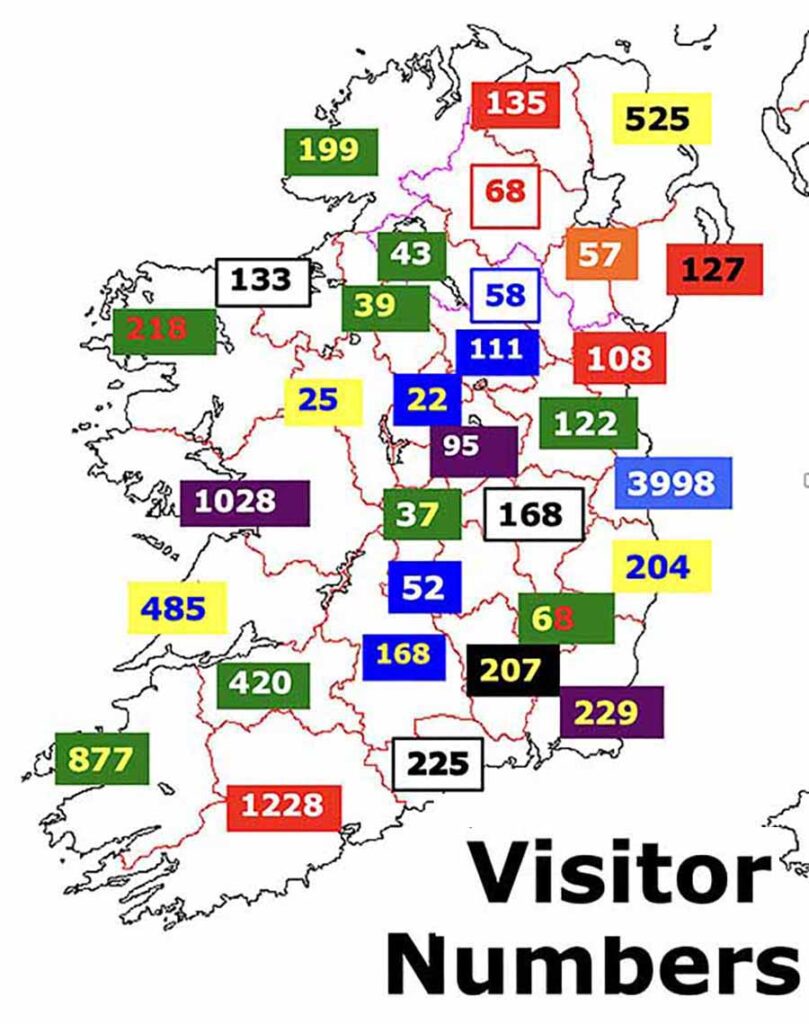
Ireland’s county Mayo offers dramatic scenery and ancient heritage, with the Cliffs of Moher’s rugged beauty and Croagh Patrick’s pilgrimage trail providing stunning vistas. The town of Westport features Georgian architecture and access to Clew Bay’s islands, while the Ceide Fields showcase a prehistoric farming landscape. Other attractions include the celebrity beaches of Achill Island. Mayo is Ireland’s third largest county by size (5,398 square km) and 18th largest by population (137,970). Population peaked at 388,887 in 1841 and reached its lowest point, 109,525 in 1971. In terms of hospitality, Mayo is Ireland’s tenth most visited tourist county with around 218,000 international visitors per year.
Introduction – Adventure – Anthem – Archaeology – Attractions – Awards – Birdwatching – Camping – Castles – Churches – Contact list – Cycling – Dining – Equestrian – Festivals – Fishing – Folklore – Gardens – Golf – Graveyards – Happening – Haunted – Highest – Hiking – History – Holy Wells – Hotels – Hotels top 8 – Hunting & shooting – Instagrammable – Itineraries – Largest town – Luxury – MICE – Movies – Music – Name – New – Novelists – Off the beaten track – Poets – Pubs – Quotes – Random Facts – Restaurant Awards – Sacred Places – Saints – Songs – Spas – Sports – Sunsets – Sustainable – Things to do – Towns – Video – Villages – Walking – Wanderlist – Weddings – Wild swimming – Writers – 1837 – 1846 – 1852 – 1909 – 1955 – 1980 –