- Ferns Castle: Ferns, County Wexford, approximately 16 km north of Enniscorthy (Coordinates: 52.589°N, 6.498°W).. Built in the early 13th century (c. 1200) by William Marshal, Earl of Pembroke, Ferns Castle is a well-preserved Anglo-Norman fortress, replacing an earlier fortification of Dermot MacMurrough, King of Leinster. The castle features a square keep with cylindrical corner towers, a rare design in Ireland, and remnants of curtain walls. It served as a stronghold during the Norman conquest of Leinster and was linked to the MacMurrough-Kavanagh dynasty. Archaeological excavations have uncovered medieval artefacts, including pottery and coins, highlighting its role as an administrative centre. Ferns was also a significant ecclesiastical site, with St. Mary’s Augustinian Abbey nearby, founded in the 12th century. Managed by the Office of Public Works (OPW), open seasonally (May–September) with free entry and a small visitor centre. Guided tours are available; check www.heritageireland.ie for details.
- Tintern Abbey: Saltmills, near New Ross, County Wexford, approximately 20 km southwest of Wexford Town (Coordinates: 52.237°N, 6.837°W).. Founded in 1200 by William Marshal for Cistercian monks from Tintern Abbey in Wales, Tintern Abbey in Wexford is a well-preserved medieval monastery. The abbey includes a nave-and-chancel church, a tower, and cloister remnants, reflecting Cistercian architectural simplicity. It was a key religious and economic centre until its suppression in 1536 during the Dissolution of the Monasteries, later becoming a residence for the Colclough family. Archaeological surveys have revealed medieval tiles and burials, underscoring its monastic wealth. The abbey’s coastal location on the Hook Peninsula ties it to Norman maritime influence. Managed by Heritage Ireland, open seasonally (April–October) with a visitor centre and guided tours. Admission fees apply; check www.heritageireland.ie for hours and tickets.
- Irish National Heritage Park: Ferrycarrig, near Wexford Town, County Wexford, approximately 5 km northwest of Wexford Town (Coordinates: 52.349°N, 6.509°W).. The Irish National Heritage Park is an open-air museum reconstructing Ireland’s archaeological past from the Mesolithic (c. 7000 BC) to the Norman period (c. 1200 AD). While not an in-situ archaeological site, it features accurate replicas of a Mesolithic camp, Neolithic farmstead, portal tomb, ringfort, crannog, Viking house, and Norman castle, based on excavations across Ireland, including Wexford. The park’s location near a Viking-era crannog and medieval castle site at Ferrycarrig adds context. It provides an immersive experience of Wexford’s archaeological heritage, particularly its Norse and Norman history, given the county’s role as a Viking entry point. Open year-round with guided tours, interactive exhibits, and a visitor centre. Admission fees apply; check www.irishheritage.ie for details.
- Dunbrody Abbey: Campile, near New Ross, County Wexford, approximately 25 km southwest of Wexford Town (Coordinates: 52.283°N, 6.960°W).. Founded in 1170 by Hervey de Montmorency for Cistercian monks, Dunbrody Abbey is one of Ireland’s largest Cistercian monasteries, endowed by the MacMurrough family. The abbey features a 13th-century church with a 60-metre-long nave, cloister, and a fortified crossing tower, reflecting its dual role as a spiritual and defensive site. It thrived until the Dissolution in 1536, later becoming a ruin. Archaeological excavations have uncovered medieval artefacts, including effigy tombs, highlighting its economic importance. The abbey’s setting near the Barrow River underscores its trade connections. Open seasonally (April–October) with a visitor centre, guided tours, and a maze. Admission fees apply; check www.dunbrodyabbey.com or www.heritageireland.ie for details.
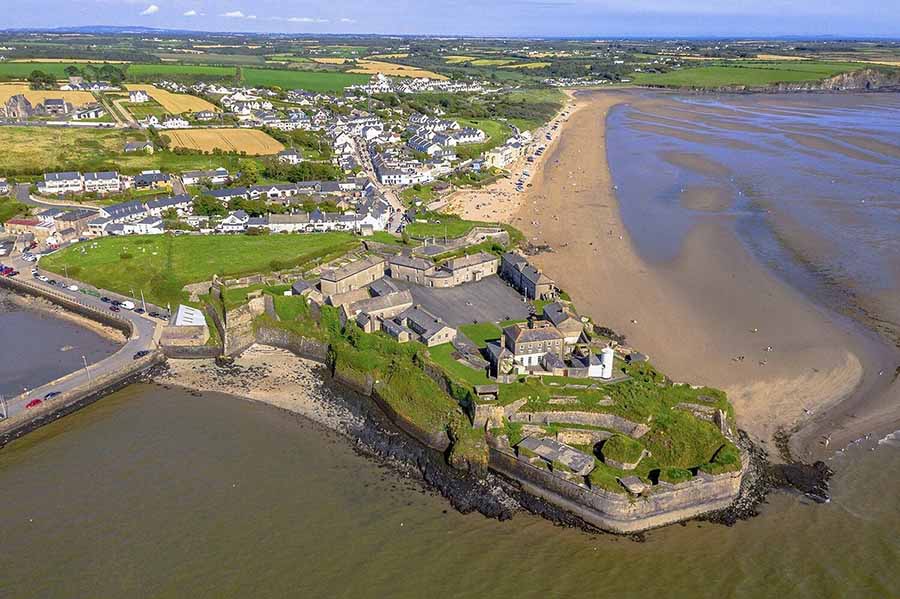
- Ballyhack Castle: Ballyhack, near Arthurstown, County Wexford, approximately 30 km southwest of Wexford Town (Coordinates: 52.245°N, 6.966°W).. Built in the late 15th century (c. 1450) by the Knights Hospitaller, Ballyhack Castle is a five-storey tower house overlooking Waterford Harbour. It served as a defensive stronghold and toll collection point for maritime trade, reflecting the strategic importance of the Hook Peninsula. The castle’s intact spiral staircase and vaulted chambers are notable. Archaeological evidence suggests a surrounding bawn and medieval settlement. The site highlights Wexford’s Anglo-Norman and maritime history, particularly its control over shipping routes. Managed by the OPW, open seasonally (June–August) with free entry and guided tours. Check www.heritageireland.ie for access details.
Archaeological sites
Antrim – Armagh – Carlow – Cavan – Clare – Cork – Derry – Donegal – Down – Dublin – Fermanagh – Galway – Kerry – Kildare – Kilkenny – Laois – Leitrim – Limerick – Longford – Louth – Mayo – Meath – Monaghan – Offaly – Roscommon – Sligo – Tipperary – Tyrone – Waterford – Westmeath – Wexford – Wicklow
County Wexford:
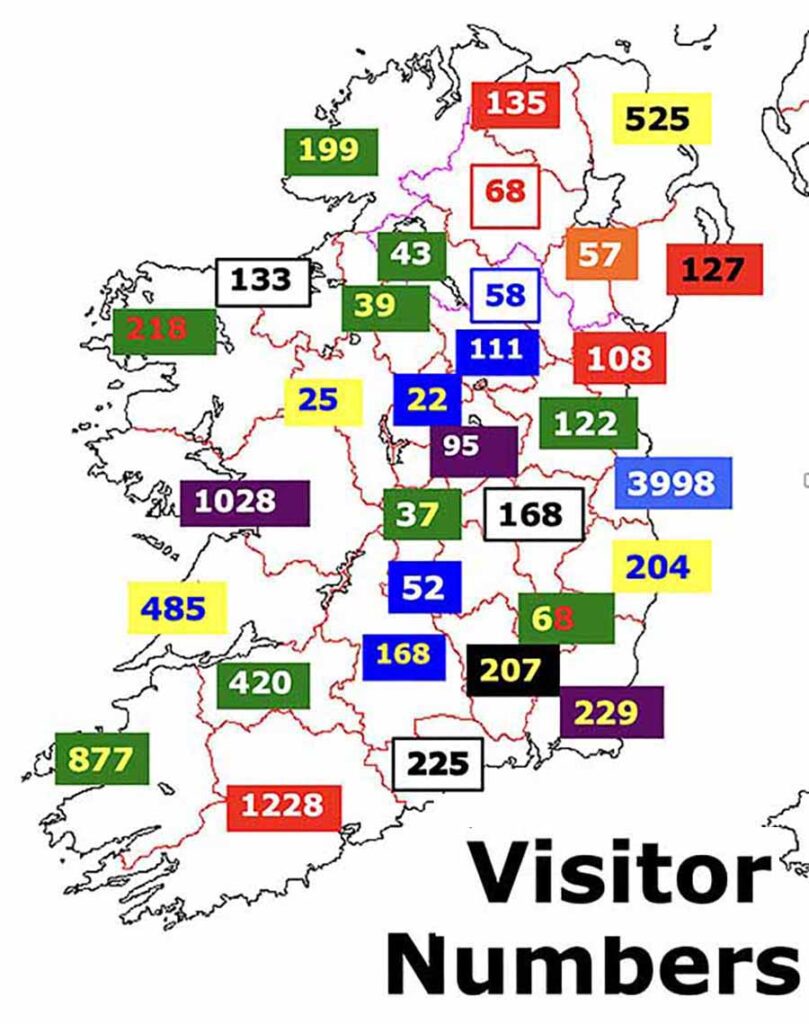
Ireland’s county Wexford combines coastal beauty with historic sites, with the Hook Lighthouse, one of the world’s oldest, offering scenic coastal views. The Irish National Heritage Park recreates ancient and medieval settlements, while Wexford’s beaches, like Curracloe, provide sandy shores for walking. Other attractions include the historic town of Enniscorthy and its castle. Wexford is Ireland’s 13th largest county by size (2,351 square km) and 14th largest by population (163,919). Population peaked at 202,033 in 1841 and reached its lowest point, 83,308 in 1961. In terms of hospitality, Wexford is Ireland’s eighth most visited tourist county with around 229,000 international visitors per year.
Introduction – Adventure – Anthem – Archaeology – Attractions – Awards – Birdwatching – Camping – Castles – Churches – Contact list – Cycling – Dining – Equestrian – Festivals – Fishing – Folklore – Gardens – Golf – Graveyards – Happening – Haunted – Highest – Hiking – History – Holy Wells – Hotels – Hotels top 8 – Hunting & shooting – Instagrammable – Itineraries – Largest town – Luxury – MICE – Movies – Music – Name – New – Novelists – Off the beaten track – Poets – Pubs – Quotes – Random Facts – Restaurant Awards – Sacred Places – Saints – Songs – Spas – Sports – Sunsets – Sustainable – Things to do – Towns – Video – Villages – Walking – Wanderlist – Weddings– Wild swimming – Writers – 1837 – 1846– 1852 – 1909 – 1955 – 1980 –