The highest point in County Wexford is Mount Leinster (Sliabh Laighean), standing at 794 meters (2,605 feet). Mount Leinster is located in the Blackstairs Mountains, straddling the border of County Wexford and County Carlow, near the village of Borris (Carlow) and Kiltealy (Wexford). It lies within Ireland’s Ancient East, a region known for its rolling hills, historic sites, and lush landscapes.
- Elevation: At 794 meters, Mount Leinster is the highest peak in Wexford and Carlow, and the fifth highest in the Leinster province, offering a prominent and accessible climb with expansive views.
- Terrain: The mountain features grassy slopes, heather-covered moorland, and rocky paths, with a broad summit plateau marked by a trig pillar, a large cairn, and a transmission mast. The terrain is generally moderate but can be boggy and exposed, especially near the summit.
Starting Point and Access:
- Driving Route: The most common trailhead is at the Nine Stones car park, located on the saddle between Mount Leinster and Blackstairs Mountain, accessible via the R702 from Borris (15 minutes, 10 km) or the R703 from Enniscorthy (25 minutes, ~20 km). The car park is well-marked, offering space for vehicles and panoramic views. From Wexford town, the drive takes about 45 minutes (40 km), and from Dublin, it’s about 1.5 hours (~100 km). An alternative trailhead is at Corrabut Gap, slightly further east, used for longer routes.
- Alternative Access: Another approach is from Kiltealy (Wexford), following local paths or the Blackstairs Way toward the summit. A more challenging route starts from Bunclody (Carlow/Wexford border), incorporating the full Blackstairs ridge. The presence of a service road to the transmission mast allows for a less strenuous ascent from the Nine Stones.
- Public Transport: Public transport is limited. Enniscorthy or Bunclody are served by buses from Wexford or Dublin (e.g., Bus Éireann 132 or Wexford Bus), but reaching the Nine Stones requires a car or taxi. Guided hikes, such as those offered by Blackstairs Eco Trails or Ireland Walk Hike Bike, include transport from Enniscorthy or Carlow.
Nine Stones Route:
- Distance: Approximately 5–7 km round trip.
- Duration: 2–3.5 hours, depending on pace and conditions.
- Description: This is the most popular and direct route, starting at the Nine Stones car park (named for nine stones commemorating fallen soldiers). The trail follows a gravel service road or grassy path, ascending steadily to the summit plateau. The summit is marked by a trig pillar, a cairn, and a transmission mast. The descent retraces the path, offering clear views of the Blackstairs range. The route is well-trodden and straightforward.
- Difficulty: Easy to moderate, suitable for hikers with basic fitness. The gradual ascent and clear path make it accessible, though boggy patches and exposure require sturdy footwear.
Kiltealy Route:
- Distance: 8–10 km round trip.
- Duration: 3.5–5 hours.
- Description: Starting from Kiltealy, this route follows local paths or sections of the Blackstairs Way, ascending Mount Leinster’s eastern slopes. It offers scenic views of the Wexford countryside but involves steeper climbs and boggy terrain, requiring more navigation.
- Difficulty: Moderate to strenuous, best for hikers comfortable with navigation and uneven terrain.
Blackstairs Ridge Walk:
- Distance: 12–15 km round trip.
- Duration: 5–7 hours.
- Description: This challenging route starts at Bunclody or Corrabut Gap, following the Blackstairs ridge to include Mount Leinster and other peaks like Blackstairs Mountain (735 meters). It offers a full exploration of the range with stunning views but requires stamina and navigation skills.
- Difficulty: Strenuous, suitable for experienced hikers confident in open moorland navigation.
Navigation Tips:
- Use an Ordnance Survey map (Discovery Series Sheet 68) or apps like HiiKER, AllTrails, or PeakVisor for navigation, as fog can reduce visibility on the summit.
- Bring a compass or GPS device for the Kiltealy or Blackstairs Ridge routes, as paths may be faint in open areas.
- Wear waterproof hiking boots with good grip, as the terrain includes boggy patches and rocky sections. Trekking poles are useful for stability.
Scenery and Views:
- Summit Views: On clear days, Mount Leinster offers spectacular 360-degree views of the Wexford and Carlow countryside, the Wicklow Mountains, the Irish Sea, and the Blackstairs range. Notable sights include the Slaney Valley, the Comeragh Mountains, and, on exceptional days, parts of Wales. The Nine Stones viewpoint and summit provide stunning vistas.
- Landscape: The lower slopes feature grassy fields and some forestry, transitioning to heather moorland and rocky paths. The summit is a broad plateau with a trig pillar, cairn, and transmission mast, offering a commanding yet open landscape.
- Unique Features: Mount Leinster is a hub for hang-gliding and paragliding due to its strong updrafts, adding a dynamic element to the area. The mountain is steeped in local folklore, with its name linked to the ancient province of Leinster, and the Nine Stones add historical intrigue.
Hiking Experience:
- Duration: The Nine Stones route takes 2–3.5 hours, Kiltealy 3.5–5 hours, and the Blackstairs Ridge Walk 5–7 hours, including summit time.
- Conditions: The Nine Stones route is well-maintained and clear, but boggy patches and rocky sections occur higher up. The summit is exposed to wind and mist. Spring and summer (April–September) offer the best conditions, with vibrant heather in August. Autumn (September–October) provides colorful landscapes, while winter hikes are wetter and colder but manageable.
- Cultural Significance: Mount Leinster is tied to the heritage of Ireland’s Ancient East, with nearby Borris and Bunclody offering historic estates (e.g., Borris House) and medieval sites. The Blackstairs Mountains are known for their quiet, rural charm and traditional farming communities.
- Weather: The summit is exposed, with frequent mist and strong winds. Check forecasts (e.g., Met Éireann) and avoid hiking in severe conditions.
- Terrain: The Nine Stones route is straightforward, but boggy patches and rocky sections require care. The Kiltealy and Blackstairs Ridge routes involve steeper climbs and navigation challenges.
- Safety: Inform someone of your plans, as there are no rangers. Bring water, snacks, and layered clothing, as temperatures can drop. Solo hikers should be confident in navigation for longer routes or opt for guided tours.
- Wildlife: Expect to see birds like kestrels, skylarks, or buzzards, and possibly hares or foxes. The moorland supports heather, gorse, and wildflowers.
Highest point in county
Antrim – Armagh – Carlow – Cavan – Clare – Cork – Derry – Donegal – Down – Dublin – Fermanagh – Galway] – Kerry – Kildare – Kilkenny – Laois – Leitrim – Limerick – Longford – Louth – Mayo – Meath – Monaghan – Offaly – Roscommon – Sligo – Tipperary – Tyrone – Waterford – Westmeath – Wexford – Wicklow
County Wexford:
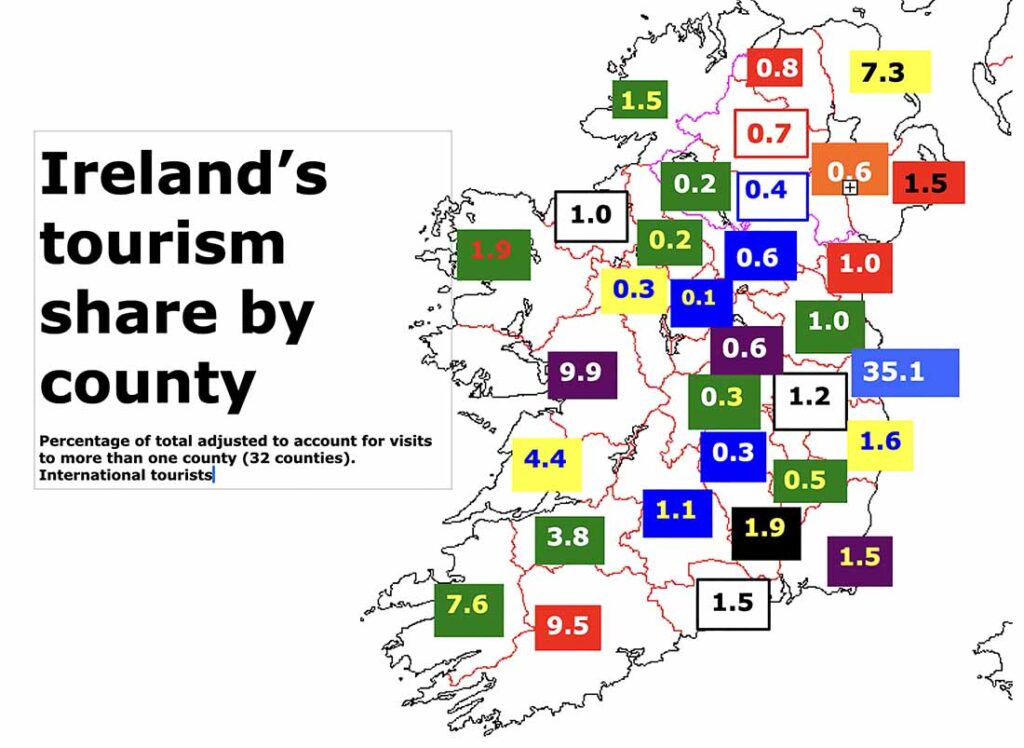
Ireland’s county Wexford combines coastal beauty with historic sites, with the Hook Lighthouse, one of the world’s oldest, offering scenic coastal views. The Irish National Heritage Park recreates ancient and medieval settlements, while Wexford’s beaches, like Curracloe, provide sandy shores for walking. Other attractions include the historic town of Enniscorthy and its castle. Wexford is Ireland’s 13th largest county by size (2,351 square km) and 14th largest by population (163,919). Population peaked at 202,033 in 1841 and reached its lowest point, 83,308 in 1961. In terms of hospitality, Wexford is Ireland’s eighth most visited tourist county with around 229,000 international visitors per year.
Introduction – Adventure – Anthem – Archaeology – Attractions – Awards – Birdwatching – Camping – Castles – Churches – Contact list – Cycling – Dining – Equestrian – Festivals – Fishing – Folklore – Gardens – Golf – Graveyards – Happening – Haunted – Highest – Hiking – History – Holy Wells – Hotels – Hotels top 8 – Hunting & shooting – Instagrammable – Itineraries – Largest town – Luxury – MICE – Movies – Music – Name – New – Novelists – Off the beaten track – Poets – Pubs – Quotes – Random Facts – Restaurant Awards – Sacred Places – Saints – Songs – Spas – Sports – Sunsets – Sustainable – Things to do – Towns – Video – Villages – Walking – Wanderlist – Weddings– Wild swimming – Writers – 1837 – 1846– 1852 – 1909 – 1955 – 1980 –