Saint Patrick (Padraig or Patricius) of Armagh (Ard Mhacha), has had dozens of placenames associated with him through the retelling of his core story which was, uniquely among the saints of Ireland, written by himself. It tells of his background, captivity, escape, recall to Ireland by way of dreams, and subsequent preparation for his mission. Unhelpfully, it mentions just two place names, his birthplace. Bannavem Taberniae and the place of captivity, Silva Focluti. Neither have been conclusively identified.
The geography of the saint was expanded dramatically from Patrick’s own sparse account in the Confessio by two lives of Patrick written two centuries later. Tírechán (c664) placed the core of his mission in Connacht and had the saint undertake a circuit before returning to Meath, mentioning 200 locations along the way. Muirchú (c668)) placed the events in the Confessio and mission in south Ulster and first asserted the significant claim, accepted unanimously since then, that he was saint-founder of Armagh,
Both had a similar mission and may have been commissioned by the same Abbott of Armagh,likely Ségéne (610-688), himself venerated as a saint.. Muirchú was likely based in Armagh and commissioned by the Abbot there to establish a link with Patrick. The scribe’s approach was simple but amazingly effective, even more than a millennium later.
Armagh was one of a series of half a dozen ecclesiastical sites competing for supremacy and funds from affiliate churches, without the benefit of a founder saint unlike its main rival, Kildare, Clonmacnoise, Glendalough, Kells, Clonard, Ardmore or Emly (which was more important than Cashel at the time). Muirchú was effectively declaring Armagh overlord of all when he affirmed the mission of Patrick into the South Ulster region and attributed to him the foundation of the site where two cathedrals now bear the saint’s name. Many of the myths that Muirchú promulgated are still central to the Patrick story today.
For his part, Tírechán wrote If an heir of Patrick were to investigate his supremacy he could vindicate for him almost the whole island as his domain,because God gave him the whole island with its people and all the primitive churches of Ireland are his.”
These manuscripts had a political dimension. Patrick’ status as High Saint of Ireland was promulgated by the House of Niall, a dynasty that controlled three of the five provincial kingships of ancient Ireland including the High Kingship at Tara and the ecclesiastical site at Armagh. Gradually, their and Patrick’s influence was extended nationwide. This was initially evident in the notes and additions to Muirchú and Tírechán’s text in the Book of Armagh (c807) which asserted the site’s supremacy by having Patrick visit Ireland’s most prominent saints and having them pledge affection or allegiance, and eventually in an anonymous hodge-podge of stories known as the Tripartite Life, written c900 or c1100 according to what scholarly evidence we chose to follow.
It brought Patrick to all four provinces, including Munster, which had previously been accorded a bare mention. The Liber Angeli, an important section of the Book of Armagh, has Patrick meeting Brigid of Kildare and mutually agreeing to have two spheres of influence, hers over the southern half of Ireland and his over the northern half, conveniently glossing over the fact that their lifespans did not overlap. Patrick’s Law, effectively control over church finances, was proclaimed in 799 over Connacht, over Ulster in 806, over Munster in 823 and again over Connacht in 811.
Geographical and narrative gaps were filled by further biographies written in the 12th century such as that by Jocelin of Furness (c1185, commissioned by Archbishop Tomaltach of Armagh) and the lives of regional saints which competed to accord Patrick a place in the narrative. These extended Patrick’s mission, about which so little was documented, to new terrain, reflecting Armagh’s growing influence and the filling of narrative gaps to bolster ecclesiastical claims. Jocelin introduced the tale that Saint Patrick banished the snakes from ireland.
From such unpromising beginnings an enormous body of literature has grown around Ireland’s patron saint. The widely read biography of Patrick by John Healy, Archbishop of Tuam, in 1905 accorded, with great certainty, a huge, cumulative travelogue to the saint, a far cry from the two bare placenames in the Confessio.
- Bannavem Taberniae (or Taburniae). From the saint himself, documented in Patrick’s own lifetime in the Confessio, Patrick’s autobiography. Scholarly consensus holds that Patrick’s family village/origin place was likely near Boulogne-sur-Mer, France, situated on the coast between Le Havre and Calais and known in Roman times as Bononia. Jocelin of Furness (c1185) transported it to north west England, and bestowed an elaborate genealogy reflecting local power struggles there. The saint himself just names two people: his father (Calpornius) and grandfather (Potitus).
- Neamhthor (Nemthur) From the Tripartite Life (c1100). Birthplace or early home in later legendary genealogy linked to Old Kilpatrick, Scotland but also sometimes identified as a tower in the suburbs of Boulogne. First mentioned in the Tripartite Life with a hymn attributed to Fiac of Sleaty.
- Other contenders for Patrick’s birthplace: Some researchers suggest the name refers to a location in South Wales, with “Banwen” in the mountains of West Wales being a key candidate. This area was known for its Roman road and a possible early site known as “Tafarn y Banwen”. The Roman fort Banna (modern Birdoswald) in Cumbria is sometimes considered a strong candidate.Inscribed stones were found associated with graves on a recent claimaint, Lundy Island (off the coast of Devon) dating to the 5th/6th century. One of these stones bears the name Potiti, regarded as highly significant as Saint Patrick stated his grandfather was named Potitus.
- Silva Focluti (Wood of Foclut|); From the saint himself, the only Irish place-name in Patrick’s writings; linked to his divine call to return.
- Caille Fochladh. From Tírechán (c664), who referenced Patrick placenames in Mayo, Silva Focluti is identifiable with the district of Caille Fochladh near Killala, also home to the famous Céide Fields.
- Slemish (County Antrim): From Muirchú (c668). Decisively, Silva Focluti was linked by Muirchú to the area near Sliabh Mis, Slemish in English. Muirchú’s emphasis on south-east Ulster meant that this location of Patrick’s captivity/slavery is preferred over Mayo. Manuscripts commissioned by Armagh each in turn affirmed this as the location.
- Croagh Patrick: From Tírechán (c664). Christianised Lughnasadh pilgrimage mountain associated with Patrick’s fasting and vision in later medieval tradition with an annual pilgrimage, on the pre-Lughanasad Garland Sunday (last Sunday in July), that endures to this day.
- Armagh (Ard Mhacha): From Muirchú (c668). The principal church foundation and metropolitan see; self proclaimed heirs to Patrick’s mission. It is mentioned in Muirchú’s Life, where he gives a lengthy founding account. Later annals dated the foundation to 444.
- Tara: From Muirchú (c668). Site of the famous paschal fire contest with druids at Easter; the symbolic royal centre of Ireland and inauguration headquarters of the House of Niall, a branch of whom were patrons of Armagh. First mentioned in Muirchú’s Life, where several chapters are devoted to the episode, and probably invented by him. The shamrock was a later addition in the 1640s, the story that he used the shamrock to explain the trinity an English language tradition first published in 1727.
- Saul (Sabhall): From Muirchú (c668). Allegedly Patrick’s first church foundation in Ireland in a barn given by Diocha; scene of early preaching and return. Late 7th century. An invention in Muirchú’s life bringing the focus of Patrick’s mission to south-east Ulster). Muirchú claims the last rites were given to Patrick on his deathbed by Tasach, patron of Raholp in Ballyculter, in another adjoining parish adjacent to Downpatrick and Saul.
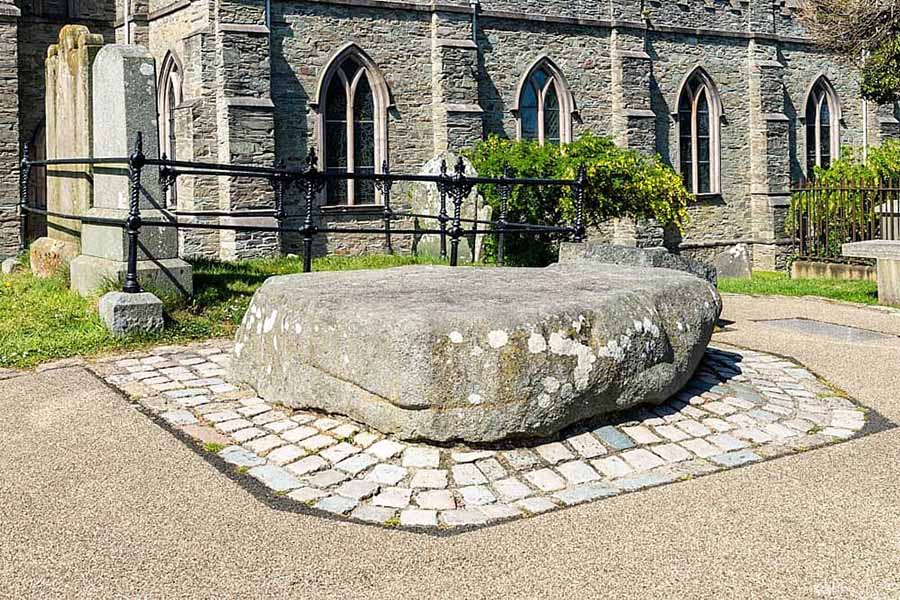
- Downpatrick (Dún Da Leathghlaise) From Muirchú (c668). Traditional burial place of Patrick, determined by oxen-drawn cart to resolve a rival claim. The final section of Muirchú’s Life introduces the oxen legend to an unidentified site called Dún Da Leathghlaise. In 1185, seven years after he had seized the kingdom from the Irish, local landowner and conquistador John de Courcy miraculously ‘discovered’ the body and had it reinterred alongside saints Brigid and Colmcille, also miraculously transported there. An accomplished propagandist, John de Courcy claimed his triumph had been prophesied by the saint. Academic Pádraig O Riain says the fact that no alternative claim is documented lends some authority to this tradition., making it a significant pilgrimage site for those honouring the patron saint of Ireland. The stone clab is a 19th century addition, to prevent pilgrims removing soil from the grave.
- Lough Derg: Tripartite Life (c1100). Loch Geirg, site of Patrick’s Purgatory on a lake island in Donegal, is the home of a hardship pilgrimage that persists into modern times. Patrick displaced another saint Dobheóg here c1140, securing much needed credibility for the site after the Augustinian canons established a house there in 1160. It became well known throughout Europe, largely through the Tractatus de Purgatorio Sancti Patrici written in 1180, describing how the knight Owen in 1153 encountered terrifying figures, including demons and serpents, and experienced horrific sufferings to purge their souls, effectively “dying” to the world before returning. The sites appears on dozens of documents such as Martin Behaim’s 1492 world map.
- Dublin: From Jocelin (1185). Sojourn and visit; recalled by wells and cathedral church (among “Norwegians”, though Patrick lived four centuries ahead of the Viking establishment. First mentioned in two twelfth century texts, Leabhar na gCeart (Book of Rights) and Jocelin’s Vita Patricii (c. 1185). Dublin’s reputational transition from a pagan Scandinavian city to a Christian site became an important strategic aim of the Cambro-Norman conquest. The connection with Dublin was likely a response to clerical politics in 1074 when the bishops of Dublin, by then consecrated at Canterbury, began to challenge. Armagh’s claims to primacy. It is no coincidence that Jocelyn’s biography which established Patrick’s presence at the site, was commissioned by Archbishop Tomaltach of Armagh.
- St Patrick’s Well (near Clonmel,,county Tipperary): From Life of Deaglán (c1150). Marks a land grant from meeting with Deaglán of Ardmore in Munster, first recorded in the Life of Deaglán, written in the 12th century to support Ardmore’s claim to be a bishopric. Texts needed to compensate for the fact that Patrick’s cult did not extend into Munster until relatively late. In the Book of Lismore, for instance, much more space is given to the saint’s sojourn in Munster than in other versions. Contact with Deaglán of Ardmore had been missed in the Tripartite life. Thus the saint’s biography set out to fill in some Munster geographical details which were not in the Tripartite Life.
FOOTSTEPS: Visit ten beautiful places associated with Saint Patrick
Saint Patrick’s Day county by county in Ireland
Antrim – Armagh – Carlow – Cavan – Clare – Cork – Derry – Donegal – Down – Dublin – Fermanagh – Galway – Kerry – Kildare – Kilkenny – Laois – Leitrim – Limerick – Longford – Louth – Mayo – Meath – Monaghan – Offaly – Roscommon – Sligo – Tipperary – Tyrone – Waterford – Westmeath – Wexford – Wicklow
Saint Patrick’s Day state by state in the USA
Alabama – Alaska – Arizona – Arkansas – California – Colorado – Connecticut – Delaware – Florida – Georgia – Hawaii – Idaho – Illinois –Indiana – Iowa – Kansas – Kentucky – Louisiana – Maine – Maryland – Massachusetts – Michigan – Minnesota – Mississippi – Missouri – Montana – Nebraska – Nevada – New Hampshire – New Jersey – New Mexico – New York – North Carolina – North Dakota – Ohio – Oklahoma – Oregon – Pennsylvania – Rhode Island – South Carolina – South Dakota – Tennessee – Texas – Utah – Vermont – Virginia – Washington DC – Washington State – West Virginia – Wisconsin – Wyoming –
Saint Patrick’s Day province by province in Canada
Alberta – British Columbia – Manitoba – New Brunswick – Newfoundland and Labrador – Nova Scotia – Ontario – Prince Edward Island – Quebec – Saskatchewan
Saint Patrick’s Day state by state in Australia
New South Wales – Northern Territory – Queensland – Tasmania – Victoria – Western Australia