- Galway Bay: A nostalgic ballad about an emigrant longing for Galway Bay, capturing the beauty of the Claddagh and the county’s west coast. It reflects Galway’s maritime heritage and the emotional pull of home, with references to local scenery and culture. Written by Dr. Arthur Colahan, written in 1947 in Leicester; popularized by Bing Crosby, who altered “English” to “strangers” to reduce political undertones. Also recorded by Dolores Keane and others.
- The Fields of Athenry: A folk ballad set during the Great Famine (1840s), telling the story of Michael, a man from Athenry, Galway, deported to Australia for stealing food for his family. It captures the county’s historical struggles and is a beloved anthem at Irish sporting events. Written by Pete St. John (pseudonym of Peter Mooney), written in the 1970s; popularized by The Dubliners in 1983.
- Galway Girl: A lively folk song about a man falling in love with a blue-eyed, black-haired girl from Galway, set against the city’s vibrant streets like the Long Walk and Salthill Promenade. It celebrates Galway’s cultural energy and romantic allure. Written by Steve Earle, written in 2000 with contributions from Mundy; recorded with Sharon Shannon.
- The Rocky Road to Dublin: A fast-paced 19th-century song about a Galwayman’s journey from Tuam to Liverpool, detailing adventures, mishaps, and encounters with “Galway boys.” It reflects the county’s rural identity and emigrant experience. Written by D.K. Gavan, “the Galway Poet,” written c. 1863 for Harry Clifton.
- Peigín Leitir Móir: An Irish-language love song from the Lettermore Gaeltacht in Connemara, celebrating a local woman and the region’s rugged beauty. It highlights Galway’s Irish-speaking heritage and community spirit. Traditional; often performed by artists like The Dubliners.
- From Galway to Graceland: A folk ballad about a woman from Galway who travels to Memphis to visit Elvis Presley’s grave, blending themes of obsession and the county’s emigrant spirit. It captures Galway’s connection to global dreams. Written by Richard Thompson, written in 1991.
- The Galway Shawl: A traditional ballad about a wandering musician enchanted by a woman wearing a Galway shawl in Oranmore. It celebrates the county’s rural charm and traditional garments, evoking local romance. Traditional; popularized by various folk artists.
- Gleanntáin Ghlas’ Ghaoth Dobhair: An Irish-language song about emigration, expressing longing for the green glens of Gweedore, though more associated with Donegal, it’s performed by Galway’s Clannad, tying it to the county’s Gaeltacht tradition. Written by Francie Mooney; recorded by Clannad in 1982.
- Les Lacs du Connemara: A French-language song by Michel Sardou, a 1981 hit celebrating the lakes of Connemara, Galway’s wild western region. It captures the area’s rugged beauty and mystique for an international audience. Written by Michel Sardou, Pierre Delanoë, and Jacques Revaux.
- Fisherman’s Blues: A folk-rock song capturing the romantic and free-spirited vibe of Galway, written during The Waterboys’ time in Spiddal. It reflects the county’s musical and coastal culture, with imagery of its landscapes. Written by Mike Scott and Steve Wickham, written in 1988.
Songs
Antrim – Armagh – Carlow – Cavan – Clare – Cork – Derry – Donegal – Down – Dublin – Fermanagh – Galway – Kerry – Kildare – Kilkenny – Laois – Leitrim – Limerick – Longford – Louth – Mayo – Meath – Monaghan – Offaly – Roscommon – Sligo – Tipperary – Tyrone – Waterford – Westmeath – Wexford – Wicklow
County Anthem
Antrim – Armagh – Carlow – Cavan – Clare – Cork – Derry – Donegal – Down – Dublin – Fermanagh – Galway – Kerry – Kildare – Kilkenny – Laois – Leitrim – Limerick – Longford – Louth – Mayo – Meath – Monaghan – Offaly – Roscommon – Sligo – Tipperary – Tyrone – Waterford – Westmeath – Wexford – Wicklow
County Galway:
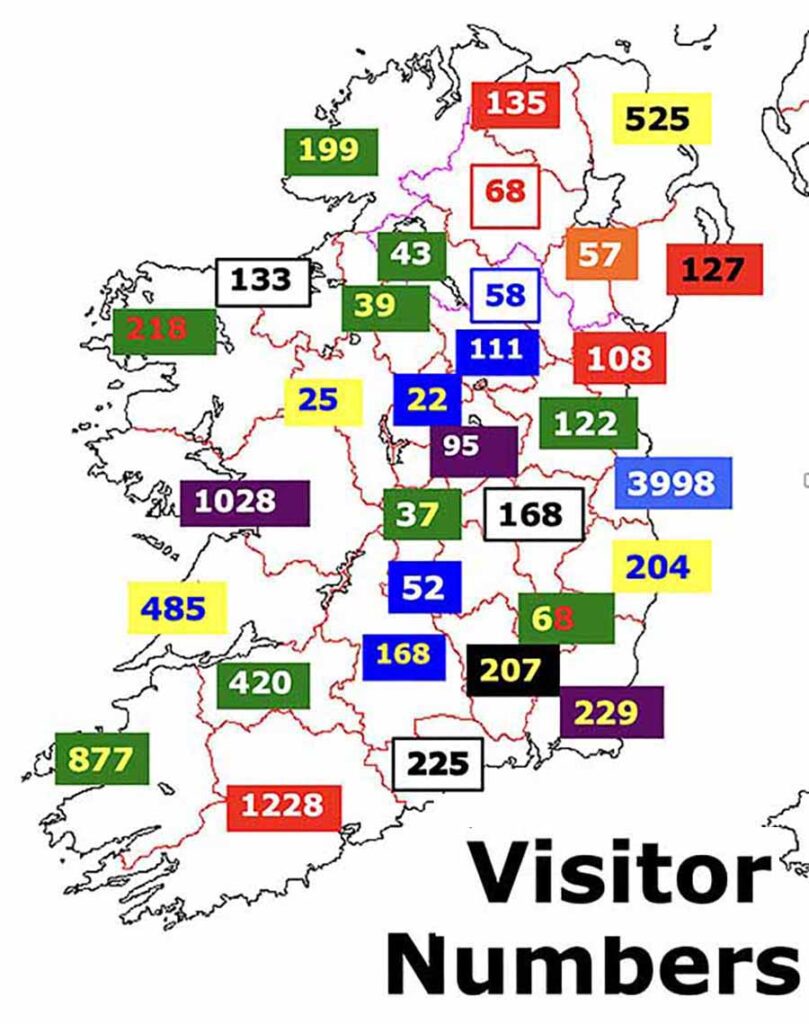
Ireland’s county Galway offers a delightful mix of cultural heritage and coastal beauty, with Galway City’s Latin Quarter showcasing historic streets and traditional music venues. The Connemara National Park provides hiking trails through rugged mountains and bogs, while the Aran Islands offer ancient stone forts like Dún Aonghasa. Other favourite stop is ithe Kylemore Abbey’s Victorian gardens and coastal cliffs. Galway is Ireland’s second largest county by size (5,939 sq km) and fifth largest by population (277,737). Population peaked at 440,198 in 1841 and reached its lowest point, 148,340 in 1966. In terms of hospitality, Galway is Ireland’s third most visited tourist county with around 1,028,000 international visitors per year.
Introduction – Adventure – Anthem – Archaeology – Attractions – Awards – Birdwatching – Camping – Castles – Churches – Contact list – Cycling – Dining – Equestrian – Festivals – Fishing – Folklore – Gardens – Golf – Graveyards – Happening – Haunted – Highest – Hiking – History – Holy Wells – Hotels – Hotels top 8 – Hunting & shooting – Instagrammable – Itineraries – Largest town – Luxury – MICE – Movies – Music – Name – New – Novelists – Off the beaten track – Poets – Pubs – Quotes – Random Facts – Restaurant Awards – Sacred Places – Saints – Songs – Spas – Sports – Sunsets – Sustainable – Things to do – Towns – Video – Villages – Walking – Wanderlist – Weddings – Wild swimming – Writers – 1837 – 1846 – 1852 – 1909 – 1955 – 1980 –