It is bounded, on the north, by Fermanagh; on the east, by Monaghan and Meath; on the south, by Meath and Longford; and on the west, by Leitrim and Fermanagh. Its greatest length, from north-north-east to south-south-west, is about 42 miles; and its greatest breadth, from east to south-west, about 28 miles. Its area is 476,289 acres, or 744 square miles; of which 429,064 acres are arable land, 29,225 are bog, and 17,999 are water. The surface is greatly diversified. In the north-west it is mountainous and wild; in the centre and south it is undulating and comparatively level; and in the east and south-east it is diversified with gentle hills and fertile valleys. The principal mountains are Cuilcagh, which rises to the height of 2,188 feet, and forms part of the boundary with Fermanagh; Slieve Rushen, Slieve Beagh, Slieve Glagh, and the Dartry range. The principal rivers are the Erne, which forms the northern boundary, and is navigable to Belturbet; the Blackwater, which rises in the county, and flows into Lough Erne; the Annalee, which flows into Lough Erne; the Woodford, which forms part of the boundary with Leitrim; and the Inny, which flows into Lough Kinale. The principal lakes are Lough Oughter, an expansion of the Erne, Lough Ramor, Lough Sheelin, Lough Gowna (partly in the county), Lough Macnean (partly), Lough Kinale, and numerous smaller loughs.
The soil is various. In the valleys it is a rich black loam; in other parts it is light sandy loam, heavy clay, gravelly, or stiff clay; and large tracts are bog or moor. The subsoil is limestone in the south and east, granite in the north-west, with patches of coal-measures and mica-slate. Agriculture is the chief employment. The farms are small, and the mode of cultivation is improving. Oats, potatoes, and flax are the principal crops; wheat, barley, and rye are grown to a limited extent. Cattle and sheep are reared, but not in large numbers. Linen manufacture is carried on to some extent in the north.
The county is divided into the baronies of Castlerahan, Clonkee, Coole, Dartree, Loughtee Upper, Loughtee Lower, Tullygarvey, and Tullyhaw.
CAVAN, the county town, is situated on the river Annalee, 60 miles north-west of Dublin. It has a population of about 3,281, and contains a courthouse, jail, barracks, union workhouse, churches, chapels, schools, and some trade. Belturbet, on the Erne, has a population of 2,145, and is a place of some trade. Bailieborough, Virginia, Cootehill, Killeshandra, Arvagh, and other small towns and villages are scattered over the county.
The antiquities include remains of castles at Cavan, Belturbet, Bailieborough, Cloughoughter, etc.; abbeys or churches at Kilmore, Drumlane, Drung, etc.; and some raths and cromlechs.
The county returns two members to parliament.
Ireland in 1846
Antrim – Armagh – Carlow – Cavan – Clare – Cork – Derry – Donegal – Down – Dublin – Fermanagh – Galway – Kerry – Kildare – Kilkenny – Laois – Leitrim – Limerick – Longford – Louth – Mayo – Meath – Monaghan – Offaly – Roscommon – Sligo – Tipperary – Tyrone – Waterford – Westmeath – Wexford – Wicklow
County Cavan:
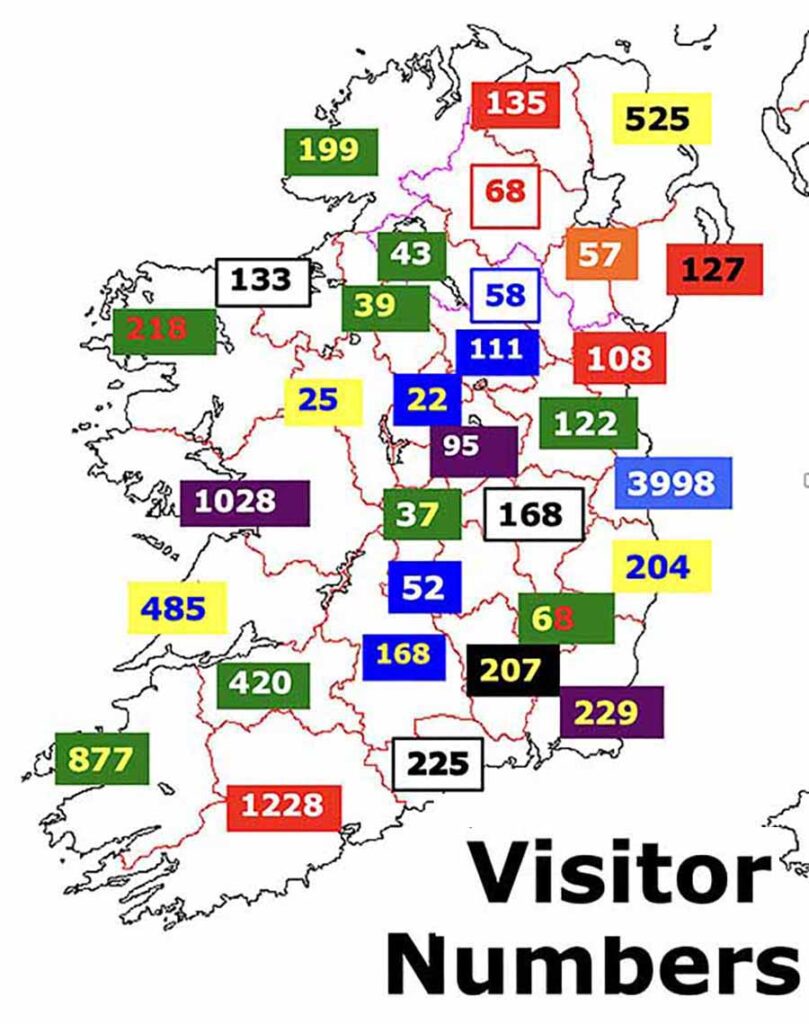
Ireland’s county Cavan is a haven of lakes and rolling hills, with the Shannon-Erne Waterway offering tranquil boating and fishing opportunities. The Cavan County Museum in Ballyjamesduff explores local history, while the Marble Arch Caves, part of a UNESCO Geopark, showcase stunning underground formations. Other attractions include the Killykeen Forest Park’s walking trails. Cavan is Ireland’s 19th largest county by size (1,891 sq km) and eighth smallest by population (81,704). Population peaked at 243,158 in 1841 and reached its lowest point, 52,618 in 1971. In terms of hospitality, Cavan is Ireland’s 20th most visited tourist county with around 111,000 international visitors per year.
IIntroduction – Adventure – Anthem – Archaeology – Attractions – Awards – Birdwatching – Camping – Castles – Churches – Contact list – Cycling – Dining – Equestrian – Festivals – Fishing – Folklore – Gardens – Golf – Graveyards – Happening – Haunted – Highest – Hiking – History – Holy Wells – Hotels – Hotels top 8 – Hunting & shooting – Instagrammable – Itineraries – Largest town – Luxury – MICE – Movies – Music – New – Name – Novelists – Off the beaten track – Poets – Pubs – Quotes – Random Facts – Restaurant Awards – Sacred Places – Saints – Songs – Spas – Sports – Sunsets – Sustainable – Things to do – Towns – Video – Villages – Walking – Wanderlist – Weddings – Wild swimming – Writers – 1837– 1846 – 1852 – 1909 – 1955 – 1980 –