A maritime county in the province of Ulster. It is bounded, on the north, by the Atlantic Ocean and Lough Swilly; on the east, by Lough Foyle and the counties of Tyrone and Antrim; on the south, by the counties of Tyrone and Armagh, and by Lough Neagh; and on the west, by the county of Donegal. Its greatest length, from east to west, is about 50 miles; its greatest breadth, from north to south, about 40 miles; but its average dimensions are considerably less. Its area is computed at 819,200 acres, or about 1,280 square miles, of which a considerable portion is mountain, bog, and water.
The surface is greatly diversified. A chain of mountains, the Sperrins, runs through the southern and central districts, attaining in Sawel an elevation of 2,240 feet, in Mullaghcarn 2,100 feet, and in several other summits from 1,500 to 2,000 feet. Toward the north and north-east, the surface shelves gradually to the sea, forming extensive plains and fertile valleys; but the coast is in general bold and rocky, indented with numerous bays and inlets, and presenting some magnificent scenery, particularly at the Giant’s Causeway (though chiefly in Antrim, its influence extends), Magilligan Point, and the basaltic cliffs of Benevenagh. The principal rivers are the Foyle, which forms the greater part of the eastern boundary, and is navigable for vessels of large burden to the city of Derry; the Roe, which flows northward to Lough Foyle; the Bann, which skirts the south-eastern extremity, issuing from Lough Neagh; the Mourne, which forms part of the southern boundary; and various smaller streams, such as the Strule, Derg, Moyola, and Faughan, which afford water-power for mills and machinery.
The soil is various. In the valleys and lower districts, it is a rich loam or clay, highly productive; on the hills, lighter and better adapted for pasture; and on the mountains, rocky, heathy, or boggy. Agriculture is in a progressive state. Oats, barley, wheat, potatoes, and flax are the principal crops; the dairy system is extensively pursued, particularly in the neighbourhood of the larger towns; and large quantities of butter, pork, and grain are exported. The linen manufacture, though not so prominent as in other Ulster counties, employs many hands; and there are several distilleries, breweries, and flour-mills. The fisheries on the coast and in the loughs, particularly herrings and salmon, are productive. Minerals include limestone (abundantly quarried for building and agricultural purposes), coal (in small quantities and of inferior quality), slate, marble, basalt (extensive but little worked), and sandstone.
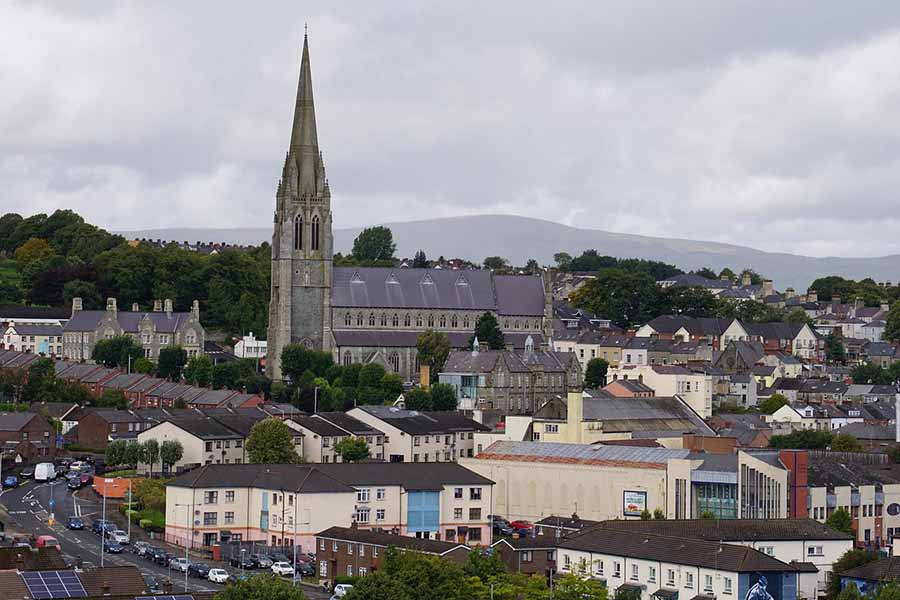
The county is divided into the baronies of Tirkeeran, Keenaght, Loughinsholin, Coleraine, Tirhugh (part), North-West Liberties of Derry, and South-West Liberties of Derry. The principal towns are Derry (the county town and chief seaport), Coleraine, Magherafelt, Limavady (Newtownlimavady), Strabane (partly in Tyrone), Maghera, Kilrea, and Moneymore. Derry is a city of great antiquity, with venerable walls, a noble cathedral, extensive quays, and considerable trade in linen, provisions, and emigrants.
The population, by the census of 1841, was 233,480; showing a decrease since 1831, when it was about 255,000, occasioned chiefly by emigration. The number of houses was 40,512. Of the families, a large proportion were engaged in agriculture, with a considerable number in manufactures, trade, and labour.Education has advanced, particularly through the National Board schools. There are numerous parochial, Presbyterian, and other schools; and in the city of Derry, excellent diocesan and free schools.
Ecclesiastically, the county is chiefly in the diocese of Derry (consolidated with Raphoe), with a small portion in Armagh. The Established Church has many parishes and churches; the Presbyterians numerous meeting-houses (being very strong in the county); the Roman Catholics have chapels in most districts; and other Dissenters places of worship.
The Poor-Law unions are Derry, Coleraine, Magherafelt, Limavady, and parts of others. The workhouses are established and operative.The county, conjointly with the city, returns two members to Parliament. Assizes are held in Derry; and petty sessions courts are distributed over the county.
This county possesses great natural advantages from its navigable rivers, extensive coast, fertile valleys, and proximity to Scotland. The linen trade, agriculture, and commerce, particularly through the port of Derry, give it importance; and improvements in roads, drainage, and liming have materially advanced its condition.
Ireland in 1846
Antrim – Armagh – Carlow – Cavan – Clare – Cork – Derry – Donegal – Down – Dublin – Fermanagh – Galway – Kerry – Kildare – Kilkenny – Laois – Leitrim – Limerick – Longford – Louth – Mayo – Meath – Monaghan – Offaly – Roscommon – Sligo – Tipperary – Tyrone – Waterford – Westmeath – Wexford – Wicklow
County Derry:
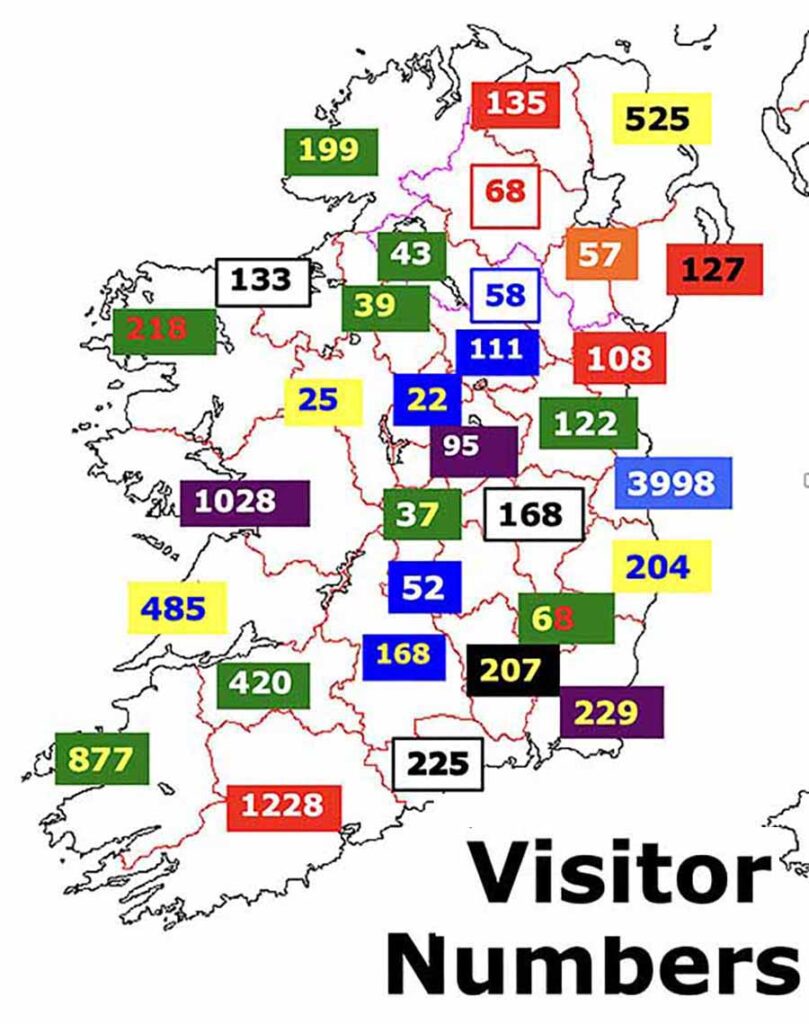
Ireland’s county Derry offers a rich historical tapestry, with the city’s 17th-century walls providing a walkable journey through its past. The Guildhall and Tower Museum explore Derry’s maritime and political history, while the Peace Bridge offers scenic views over the River Foyle. Derry is Ireland’s 15th largest county by size (2,067 square km) and sixth largest by population (252,231). Population previously peaked at 222,174 in 1841 and reached its lowest point, 139,693 in 1926. In terms of hospitality, Derry is Ireland’s 16th most visited tourist county with around 135,000 international visitors per year.
Introduction – Adventure – Anthem – Archaeology – Attractions – Awards – Birdwatching – Camping – Castles – Churches – Contact list – Cycling – Dining – Equestrian – Festivals – Fishing – Folklore – Gardens – Golf – Graveyards – Happening – Haunted – Highest – Hiking – History – Holy Wells – Hotels – Hotels top 8 – Hunting & shooting – Instagrammable – Itineraries – Largest town – Luxury – MICE – Movies – Music – New – Name – Novelists – Off the beaten track – Poets – Pubs – Quotes – Random Facts – Restaurant Awards– Sacred Places – Saints – Songs – Spas – Sports – Sunsets – Sustainable – Things to do – Towns – Video – Villages – Walking – Wanderlist – Weddings – Wild swimming – Writers – 1837 – 1846 – 1852 – 1909 – 1955 – 1980 –