County DownA maritime county of Ulster, the most southerly in that province, bounded on the north by the county of Antrim, on the east by the Irish Sea and the North Channel, on the south by the Irish Sea and Carlingford Lough, and on the west by the counties of Armagh and Louth. Its greatest length, from Donaghadee on the east to Newry on the southwest, is about 50 English miles; and its greatest breadth, from the vicinity of Bangor to that of Rathfriland, is about 35 miles. Its area is computed at 608,862 acres, or 951 square miles; of which about 480,000 acres are arable land. Its outline is very irregular, deeply indented on the east by numerous bays and inlets; and its surface is beautifully diversified with lofty mountains, extensive plains, fertile valleys, and numerous lakes. The principal elevations are the Mourne mountains on the southern frontier, including Slieve Donard, rising to 2,796 feet; Slieve Commedagh, 2,515 feet; Slieve Bernagh, 2,394 feet; and several others exceeding 2,000 feet; the hills of Lecale and Ards, rising to about 800 feet; and the Castlereagh hills in the north, attaining an altitude of about 600 feet. The general aspect of the county is eminently picturesque; the southern districts are wild and mountainous, but in many places fertile; the eastern districts are richly cultivated and well wooded; and the northern districts, though hilly, are in general highly productive.The principal rivers are the Newry river, the Clanrye, the Bann, the Lagan, and the Quoile. The Newry river rises in the Mourne mountains, flows northward past Newry, and falls into Carlingford Lough. It is navigable for vessels of considerable burden as far as Newry, and is connected with Lough Neagh by the Newry canal. The Clanrye rises near Poyntzpass, flows southward past Newry, and falls into the Newry river. The Bann rises in the Mourne mountains, flows northward past Rathfriland and Banbridge, receives the Cusher and the Upper Bann, and falls into Lough Neagh near Portadown. The Lagan rises near Lisburn, flows eastward past Belfast, and falls into Belfast Lough. It is navigable for vessels of large burden to Belfast. The Quoile rises near Downpatrick, and falls into Strangford Lough. The county is intersected by the Newry canal, which connects Carlingford Lough with Lough Neagh, and is navigable for vessels of considerable burden; and by the Lagan navigation, which connects Lough Neagh with Belfast Lough.The soils are exceedingly various, but in general highly fertile. The northern and eastern districts consist chiefly of a rich loam and clay, well adapted to tillage and pasturage; the central districts are a mixture of loam, clay, and gravel; and the southern districts exhibit a strong clay and moorish soils, with large tracts of mountain land. Limestone is abundant in the north and northeast; freestone and granite occur in the Mourne mountains; slate is found near Newry; and coal exists in small quantities near Lough Neagh. The agriculture is in a very advanced state; the farms are in general of moderate size, and well cultivated; and the system of green-cropping, stall-feeding, and irrigation is extensively practised. The principal crops are oats, wheat, barley, potatoes, turnips, and flax; and large quantities of excellent butter, pork, and beef are produced for exportation. The linen manufacture is the staple of the county, and is carried on to a very great extent, particularly in the northern and central districts; and there are numerous bleach-greens and beetling-mills. The fisheries on the eastern coast are productive; and considerable quantities of herrings, cod, and haddock are caught and cured for exportation.The population in 1841 was 361,877; of whom 177,258 were males, and 184,619 females; 248,654 were returned as living in rural districts, and 113,223 in towns and villages. The principal towns are Downpatrick, the county town, Newry (partly in Down), Banbridge, Lisburn (partly in Down), Holywood, Bangor, Portaferry, Donaghadee, and Castlewellan. The county contains 58 parishes, and parts of 10 others; and is divided into the baronies of Ards Lower, Ards Upper, Castlereagh Lower, Castlereagh Upper, Dufferin, Iveagh Lower (Lower Half), Iveagh Lower (Upper Half), Iveagh Upper (Lower Half), Iveagh Upper (Upper Half), Kinelarty, Lecale Lower, Lecale Upper, Lordship of Newry, and Mourne. The estates are in general of moderate size; and several are well managed. The Grand Jury presentments for 1843 amounted to £28,456 14s. 7d. The assizes are held at Downpatrick; and quarter-sessions at Downpatrick, Newry, Banbridge, and Lisburn. The county returns two members to parliament for the county at large, and two for the borough of Newry. The navigation of Carlingford Lough is safe and commodious.
Ireland in 1846
Antrim – Armagh – Carlow – Cavan – Clare – Cork – Derry – Donegal – Down – Dublin – Fermanagh – Galway – Kerry – Kildare – Kilkenny – Laois – Leitrim – Limerick – Longford – Louth – Mayo – Meath – Monaghan – Offaly – Roscommon – Sligo – Tipperary – Tyrone – Waterford – Westmeath – Wexford – Wicklow
County Down:
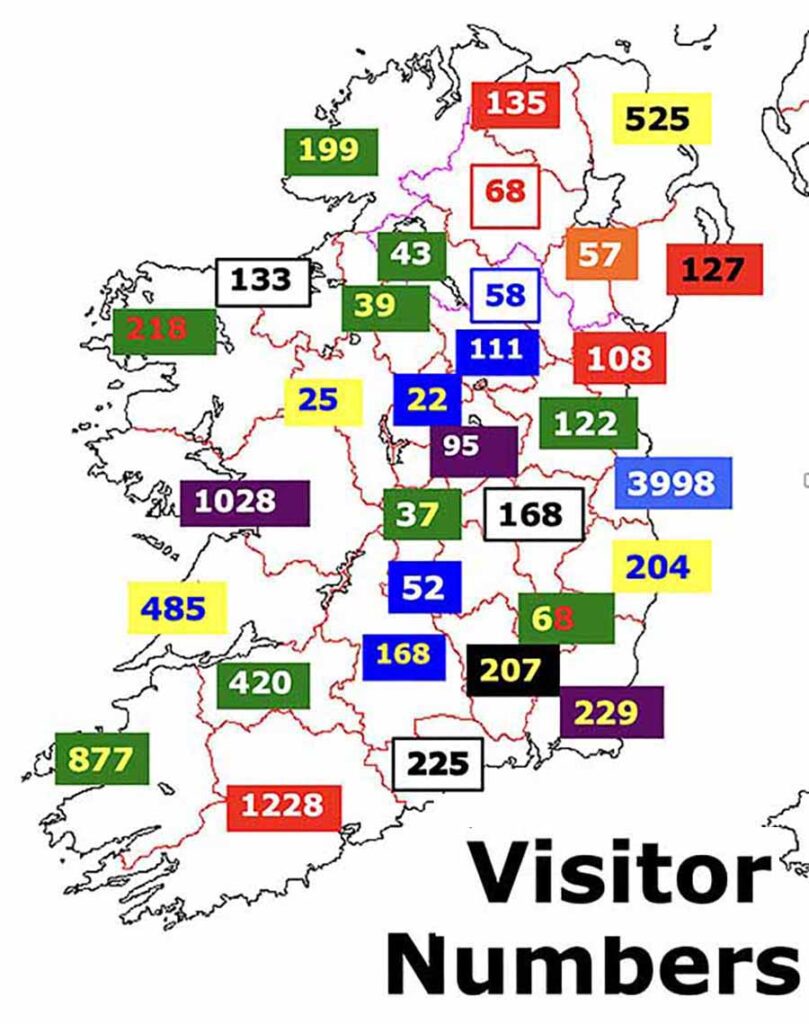
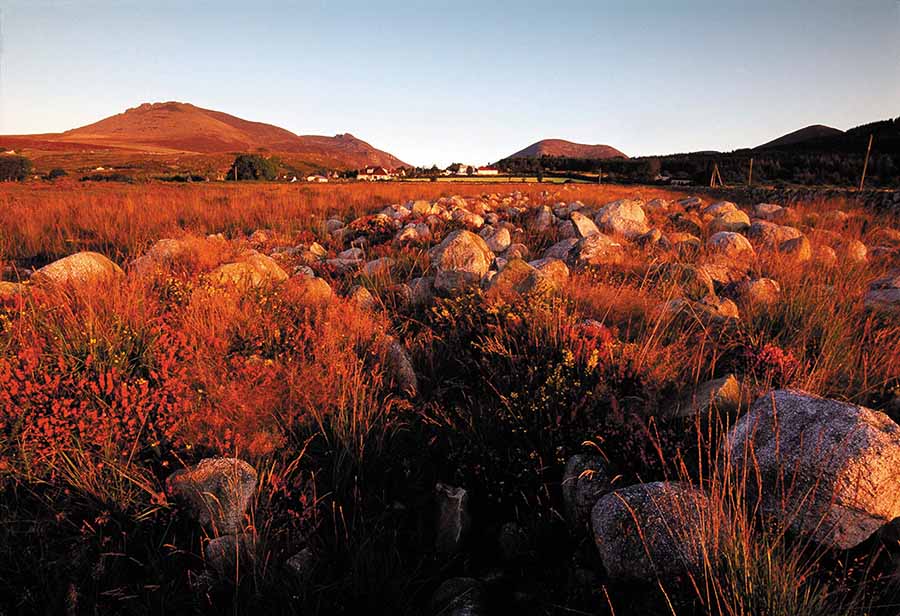
Ireland’s county Down offers a mix of historic sites and scenic landscapes, with Downpatrick’s Saint Patrick Centre and cathedral providing insights into Ireland’s patron saint. The Mourne Mountains offer hiking trails with sweeping views, while Strangford Lough provides kayaking and wildlife spotting. Other attractions include the historic Tollymore Forest Park. Down is Ireland’s 12th largest county by size (2,447 square km) and fourth largest by population (553,261). Population peaked at 361,446 in 1841 and reached its lowest point, 204,303, in 1911. In terms of hospitality, Down is Ireland’s 18th most visited tourist county with around 127,000 international visitors per year.
Introduction – Adventure – Anthem – Archaeology – Attractions – Awards – Birdwatching – Camping – Castles – Churches – Contact list – Cycling – Dining – Equestrian – Festivals – Fishing – Folklore – Gardens – Golf – Graveyards – Happening – Haunted – Highest – Hiking – History – Holy Wells – Hotels – Hotels top 8 – Hunting & shooting – Instagrammable – Itineraries – Largest town – Luxury – MICE – Movies – Music – New – Name – Novelists – Off the beaten track – Poets – Pubs – Quotes – Random Facts – Restaurant Awards – Sacred Places – Saints – Songs – Spas – Sports – Sunsets – Sustainable – Things to do – Towns – Video – Villages – Walking – Wanderlist – Weddings – Wild swimming – Writers – 1837 – 1846 – 1852 – 1909 – 1955 – 1980 –