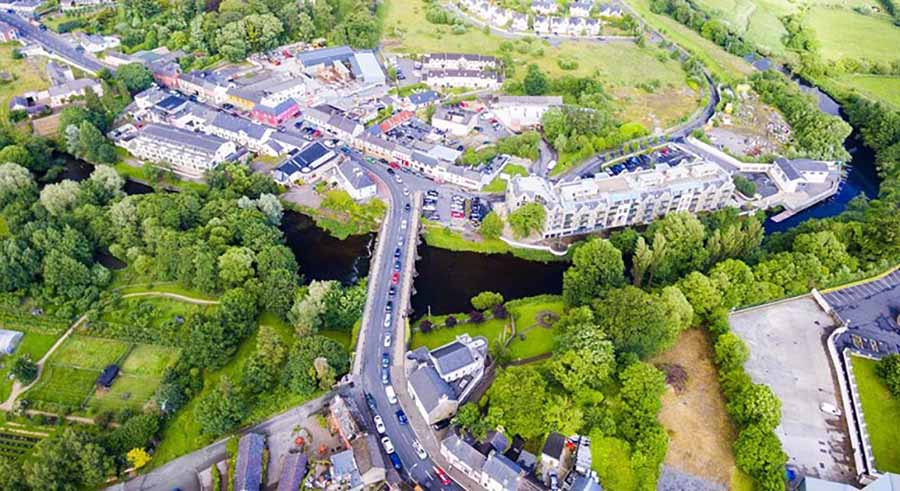
Start your walking tour of Kilcullen in Ireland’s county Kildare on the approach from the south along the old Athy road from Calverstown, where the Hill of Knockaulin comes into view with the ancient royal site of Dún Ailinne visible on its summit. The site consists of a large circular ditch that encloses about 13 hectares and ranks as one of the four main royal sites of Ireland together with Tara, Eamhain Macha and Rathcroghan.
Dún Ailinne appears on the tentative list for World Heritage status and counts among the principal archaeological locations in the county. The site reached its peak around 3000 years ago and served mainly for ceremonies. Excavations from the 1960s onwards have revealed the presence of large amphitheatre-style timber structures on the hilltop.
The hill functions as a working farm at present and remains closed to the public. Upon entry to the town a replica of the hill stands on the left side of the road. Local sculptor Noel Scullion created the piece based on an Iron Age spearhead discovered at Dún Áilinne. The sculpture aligns with the sunrise during the equinoxes. On the opposite side of the old Athy road the round tower of Old Kilcullen appears.
Saint Iserninus established the first church there around 438 AD after he had studied with Saint Patrick in France and accompanied him to Ireland. Monasteries from that period often located near centres of power and the proximity to Dún Ailinne made the spot suitable. A monastery, centre of learning and settlement developed around the church. The name Kilcullen means the church of the holly.
Seven roads led up the hill to the town. The monastery lasted for about 600 years and the settlement persisted into the 1800s. Decline occurred for two reasons. A bridge over the River Liffey opened in 1319 and led to the growth of a new settlement called Kilcullen Bridge.
Stagecoach travel increased later and horses struggled on the steep hill so bypass roads formed on either side one to Carlow and one to Athy. The original hilltop location became known as Old Kilcullen while the bridge area took the name Kilcullen. The modern town traces its start to the 1319 bridge and the community marked the 700th anniversary in 2019.
As the route enters the town from the southern end a campus appears on the left with facilities that include the community centre, GAA grounds, soccer club, boxing club, scouts, playground, preschool, primary school and secondary school. The Sisters of the Cross and Passion arrived in Kilcullen in 1878 at the request of parish priest Canon Langan. In 1887 they opened Cross and Passion College which has taught generations of local people. The sisters donated land for the present facilities. Proceed to the sole set of traffic lights and turn right to reach the Church of the Sacred Heart and Saint Brigid. Canon Langan oversaw its construction in 1872. The building displays stained glass windows produced in the studios of Joshua Clarke father of artist Harry Clarke.
Continue past the church along the route followed by Queen Elizabeth II during her 2011 visit to Ireland when she called at Gilltown Stud owned by her friend the Aga Khan home to valuable racehorses including Sea The Stars.
Along this path Saint Brigid’s Well stands beside Valley Riverside Park laid out by the community in the 1970s. The route passes New Abbey where the FitzEustace family founded a Franciscan monastery in the 1400s. New Abbey now belongs to Judmonte Farms as part of its worldwide thoroughbred breeding operation. Return from Gilltown through the traffic lights towards Newbridge to view Leinster Mart which marked its 50th anniversary in 2017 and operates as the only active cattle mart in Kildare. Next door Castle Martin House stands formerly a home of the Aga Khan. The property passed through owners until Lord Gowrie inherited it and rented the mansion to musicians including Mick Jagger and Donovan in 1974.
Agrifood and newspaper magnate Tony O’Reilly purchased Castle Martin in 1972 restored the house estate and ruined 15th-century Saint Mary’s Church to a high standard. In 2008 Castle Martin transferred to American billionaire John Malone who has continued restoration and development. Retrace to the traffic lights and turn left down the Main Street.
Just before the bridge Burden’s pub and restaurant appears. One hundred years ago the premises operated as a hotel where the French team stayed during the Gordon Bennett Cup road race in 1903 the first international motor race held in Great Britain or Ireland which influenced the development of Grand Prix motor racing. The race course passed through Kilcullen.
Cross the bridge to find a monument to local people who died in the 1798 Rebellion. Rebels gathered 300 strong at Old Kilcullen tower but General Dundas from Castle Martin attacked them. The rebels repelled the troops who withdrew to Kilcullen Bridge for reinforcements. A later clash near the bridge resulted in at least 150 rebel deaths. Survivors retreated to Knockaulin Hill where Dundas arranged a peaceful surrender unlike events at Gibbet Rath on the Curragh. A short distance away, Kilcullen Town Hall and Heritage Centre stands built by the community in 1933.
Since 2000 the building contains an intimate theatre fitted with luxury leather Volvo car seats sourced through the efforts of the late Pat Dunlea who persuaded Volvo to supply them from Sweden. Head up the hill on the road to Naas to pass an industrial estate that includes the large Kmed mattress factory. The site’s origins go back to 1939 when the local tennis club ran a weekly non-stop draw to raise funds.
The draw expanded to employ ticket sellers across Leinster and generated substantial income for the town. From this the Kilcullen Development Association formed bought land offered free sites to industrialists and constructed affordable homes in Monread and Bishop Rogan Park.
Kilcullen expanded more than any other town in Kildare during the Celtic Tiger period yet it retains a small town atmosphere and community spirit. The town provides riverside walks public houses restaurants coffee shops and a record of history that invites further exploration.
Ireland county by county
Antrim – Armagh – Carlow – Cavan – Clare – Cork – Derry – Donegal – Down – Dublin – Fermanagh – Galway – Kerry – Kildare – Kilkenny – Laois – Leitrim – Limerick – Longford – Louth – Mayo – Meath – Monaghan – Offaly – Roscommon – Sligo – Tipperary – Tyrone – Waterford – Westmeath – Wexford – Wicklow
Largest town walking tour
Antrim – Armagh – Carlow – Cavan – Clare – Cork – Derry – Donegal – Down – Dublin – Fermanagh – Galway – Kerry – Kildare – Kilkenny – Laois – Leitrim – Limerick – Longford – Louth – Mayo – Meath – Monaghan – Offaly – Roscommon – Sligo – Tipperary – Tyrone – Waterford – Westmeath – Wexford – Wicklow
Towns
Antrim – Armagh – Carlow – Cavan – Clare – Cork – Derry – Donegal – Down – Dublin – Fermanagh – Galway – Kerry – Kildare – Kilkenny – Laois – Leitrim – Limerick – Longford – Louth – Mayo – Meath – Monaghan – Offaly – Roscommon – Sligo – Tipperary – Tyrone – Waterford – Westmeath – Wexford – Wicklow
Villages
Antrim – Armagh – Carlow – Cavan – Clare – Cork – Derry – Donegal – Down – Dublin – Fermanagh – Galway – Kerry – Kildare – Kilkenny – Laois – Leitrim – Limerick – Longford – Louth – Mayo – Meath – Monaghan – Offaly – Roscommon – Sligo – Tipperary – Tyrone – Waterford – Westmeath – Wexford – Wicklow