Approach your walking tour of Straffan, in Ireland’s county Kildare, from either the Kill or Clane direction, sweeping over the dramatic bridge spanning the Liffey, where the vista upstream presents a quintessential postcard scene of Straffan House, now the centrepiece of the renowned K Club, rising elegantly against the skyline. Constructed in the 1830s by Hugh Barton of the famed Bordeaux wine merchant family Barton & Guestier, the house draws inspiration from a French château at Louveciennes near Paris, a nod to the Bartons’ fortunes amassed in French vineyards, a legacy that endures in the well-known wine brand still available today.
The family resided here until the 1930s, after which the property saw a colourful succession of owners, including film producer Kevin McClory, a Dublin-born survivor of a Second World War U-boat attack who drifted for two weeks on a life raft in the Atlantic before rescue; in the 1950s and 1960s, McClory transformed Ian Fleming’s script into the glamorous James Bond phenomenon with Thunderball, amassing wealth amid legal battles, and hosted legendary parties at Straffan House featuring hot air balloons, Duffy’s circus, and celebrity guests such as Shirley MacLaine and Sean Connery. Later owners included Michael Smurfit, who in the early 1990s transformed it into the luxurious K Club resort and golf course, hosting the 2006 Ryder Cup and welcoming figures like Prince Albert of Monaco.
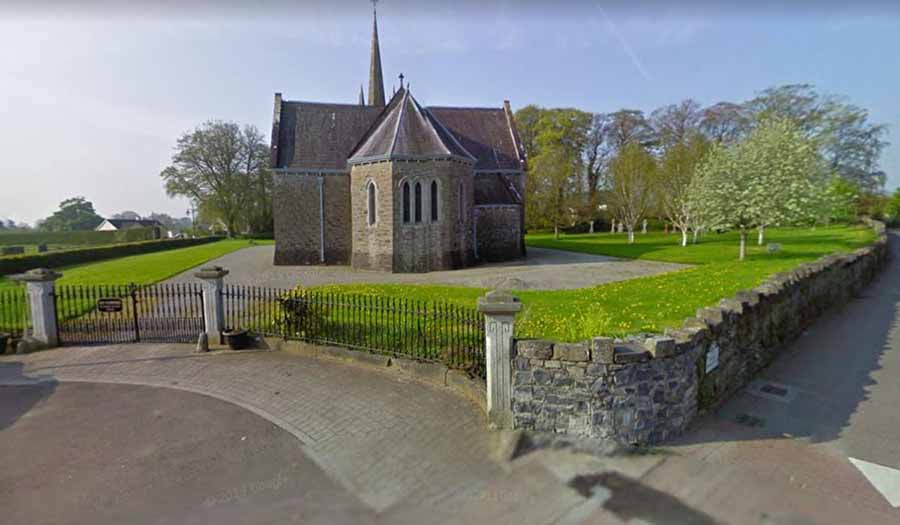
Entering the village proper, the layout reflects its origins as an estate village serving the big house. On the left stands the Church of Ireland, built privately by the Bartons for family and estate workers, while to the right a distinctive green pillar box bearing the cypher of England’s king Edward VII, a rarity given his short reign from 1901 to 1910, stands beside the shop and butcher, a relic of an era when few full-size boxes were produced, even though the English king himself never visited Straffan but passed nearby by train en route to Naas races in 1904.
Further along on the left, a picturesque lychgate, a covered wooden porch traditionally sheltering coffins at cemetery entrances, serves as a unique memorial presented by Mr Shaw to honour local men lost in the First World War, a conflict that claimed over a thousand from Kildare and is remembered through plaques and stained glass across the county.
Step through into the cemetery to view the ruins of an ancient fortified medieval church, echoing Straffan’s early religious foundations, where notable burials include legendary flat-racing trainer Vincent O’Brien, master of Ballydoyle and associated with champions like Nijinsky, who trained at Newhall Stud nearby and spent later years at the Baronrath Stud before his interment here. Back on the main street, pass the Baronial-style former Royal Irish Constabulary station, now a private residence, its design harmonising with the estate village aesthetic.
At the crossroads rises the Catholic church, part of the Archdiocese of Dublin despite the rural setting, linked historically to Celbridge. From here, a brief detour along the small winding road towards Celbridge leads past modern developments like the Hammerstone estate, reflecting recent population growth, and the route soon reaches Barberstown Cross, overlooked by the imposing Barberstown Castle and Hotel.
This 13th-century tower house, with Elizabethan and Victorian additions, boasts a storied past including residents such as a Lord Mayor of Dublin, an admiral who fought alongside Nelson at Trafalgar, and rock legend Eric Clapton, who owned it from 1979 to 1987 before its conversion into a luxurious hotel. Local lore tells of a former occupier whose shrewd wife ensured low rent by having him interred within the castle walls, technically keeping him “above ground” to thwart increases, a tale that adds a macabre twist to its thick stone walls.
Straffan, though small, boasts delightful dualities: two churches, two post boxes including a rare Irish Free State wall box alongside the Edwardian pillar, and even two names, the long-standing Cloncurry from an adjacent townland meaning “little meadows,” recently updated officially to Teach Srafáin, referencing an early Christian saint said to have founded the first church here.
This gentle circuit through village streets, cemetery paths, and crossroads captures Straffan’s essence as a peaceful yet richly layered spot, where wine barons, Hollywood glamour, sporting triumphs, and ancient echoes converge amid the serene flow of the Liffey.
Ireland county by county
Antrim – Armagh – Carlow – Cavan – Clare – Cork – Derry – Donegal – Down – Dublin – Fermanagh – Galway – Kerry – Kildare – Kilkenny – Laois – Leitrim – Limerick – Longford – Louth – Mayo – Meath – Monaghan – Offaly – Roscommon – Sligo – Tipperary – Tyrone – Waterford – Westmeath – Wexford – Wicklow
Largest town walking tour
Antrim – Armagh – Carlow – Cavan – Clare – Cork – Derry – Donegal – Down – Dublin – Fermanagh – Galway – Kerry – Kildare – Kilkenny – Laois – Leitrim – Limerick – Longford – Louth – Mayo – Meath – Monaghan – Offaly – Roscommon – Sligo – Tipperary – Tyrone – Waterford – Westmeath – Wexford – Wicklow
Towns
Antrim – Armagh – Carlow – Cavan – Clare – Cork – Derry – Donegal – Down – Dublin – Fermanagh – Galway – Kerry – Kildare – Kilkenny – Laois – Leitrim – Limerick – Longford – Louth – Mayo – Meath – Monaghan – Offaly – Roscommon – Sligo – Tipperary – Tyrone – Waterford – Westmeath – Wexford – Wicklow
Villages
Antrim – Armagh – Carlow – Cavan – Clare – Cork – Derry – Donegal – Down – Dublin – Fermanagh – Galway – Kerry – Kildare – Kilkenny – Laois – Leitrim – Limerick – Longford – Louth – Mayo – Meath – Monaghan – Offaly – Roscommon – Sligo – Tipperary – Tyrone – Waterford – Westmeath – Wexford – Wicklow