Start your walking tour of salubrious Sallins, as some would have it, at Sallins Railway Station, a striking survivor from the 1840s built by the Great Southern and Western Railway in an imitation Tudor style featuring steep gables, pinnacles, and heraldic coats of arms, reflecting an era when aesthetics complemented function; this station has welcomed luminaries over the decades, including Percy French, whoe likely changed trains here en route to performances in Naas or elsewhere in the region.
James Joyce, too, immortalised the spot in his semi-autobiographical A Portrait of the Artist as a Young Man, vividly describing Clongowes Wood College boys joyfully hurling their caps from carriage windows as the train departed Sallins at term’s end, bound for home.
England’s King Edward VII passed through in 1904, switching to the Tullow branch line for Naas races, allegedly impatient to reach a promising tip rather than endure a civic welcome. Though passenger services ceased in 1963, the station was triumphantly revived as a commuter hub in 1992 by Minister Máire Geoghegan-Quinn, who arrived by special train to announce its refurbishment, and it remains a bustling gateway today.
From the station, stroll into the Main Street, pausing at the aptly named Railway Inn, then turn right to behold one of Kildare’s hidden architectural treasures: the Church of Our Lady and the Guardian Angels, a remarkable tin-and-timber structure erected in 1924.
Conceived as a prefabricated “kit” church ordered from a firm in Camberwell, London, much like an early IKEA assembly, it was assembled on site after First World War delays stalled grander plans for what was then part of Naas parish; Father Norris, the long-lived priest who commissioned it, oversaw its opening, and the corrugated iron and timber building looks remarkably fresh more than a century later, its centenary celebrated with special masses in recent years. In the grounds stands an ancient stone font rescued from the ruined Bride’s Church or St Brigid’s Church on the Liffey banks two miles south, symbolising the new parish’s deep roots in local Christian heritage, alongside a curious bell cast by Sheridan of Dublin in 1860, predating the church itself and a cousin to the one that once chimed in Naas Town Hall.
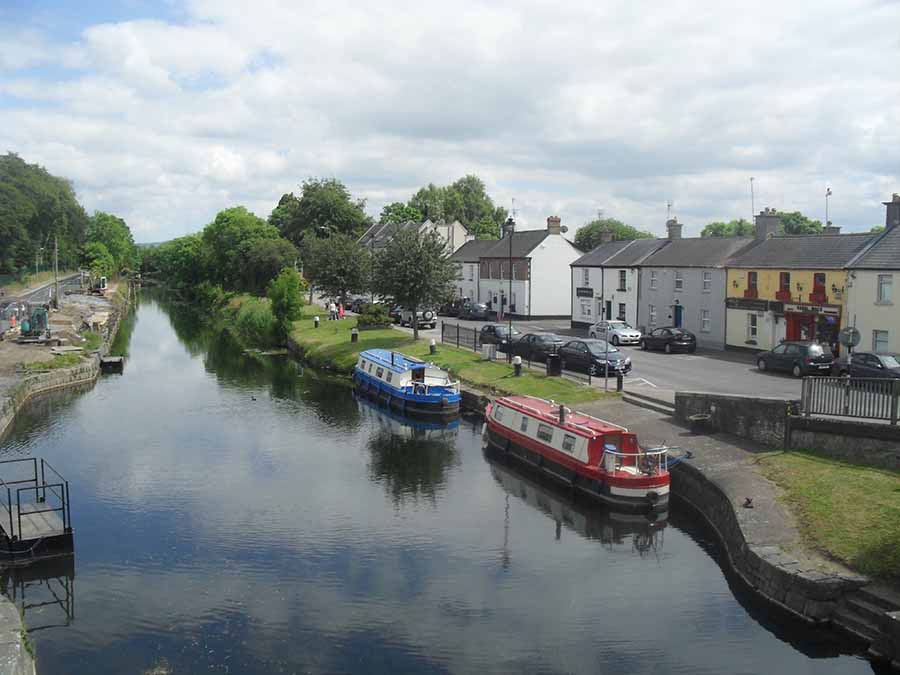
Just a few yards further lies the Grand Canal, where the vista opens to a lively harbour scene with around 60 boats moored along both sides of the bridge, lending Sallins an almost Amsterdam-like charm as Ireland’s premier inland live-aboard community adds colour and character to village life.
From the canal bridge, walkers can choose directions: one path leads towards Bodenstown, burial place of Theobald Wolfe Tone and site of historic pilgrimages that drew 1916 leaders in June each year, while the more scenic towpath, soon to form part of the expanding national Greenway network, stretches invitingly along the water. Follow this appealing route to the Leinster Aqueduct, a masterful 1783 engineering feat where the canal majestically crosses the River Liffey on four stone arches designed by Richard Evans, carrying boats high above the flowing river in a display of Georgian ingenuity.
Nearby, the railway bridge at Osberstown dates from 1883, while the modern bypass motorway bridge, part of the R407 Sallins Bypass scheme incorporating dramatic new crossings over the Liffey and completed with the Osberstown Interchange (Junction 9a on the M7) opening in April 2021, completes a remarkable chronological trio of transport milestones spanning exactly two centuries: canal in 1783, rail in 1883, and road in 1983 (with the latest upgrades enhancing connectivity and easing village congestion).
This gentle loop, perhaps a mile or two along towpath and streets, encapsulates Sallins’ essence as a transport engineering crossroads where water, rail, and road converge, blending literary echoes, ecclesiastical curiosity, and watery tranquillity into a delightful portrait of a village forever shaped by its pioneering arteries of movement.
Ireland county by county
Antrim – Armagh – Carlow – Cavan – Clare – Cork – Derry – Donegal – Down – Dublin – Fermanagh – Galway – Kerry – Kildare – Kilkenny – Laois – Leitrim – Limerick – Longford – Louth – Mayo – Meath – Monaghan – Offaly – Roscommon – Sligo – Tipperary – Tyrone – Waterford – Westmeath – Wexford – Wicklow
Largest town walking tour
Antrim – Armagh – Carlow – Cavan – Clare – Cork – Derry – Donegal – Down – Dublin – Fermanagh – Galway – Kerry – Kildare – Kilkenny – Laois – Leitrim – Limerick – Longford – Louth – Mayo – Meath – Monaghan – Offaly – Roscommon – Sligo – Tipperary – Tyrone – Waterford – Westmeath – Wexford – Wicklow
Towns
Antrim – Armagh – Carlow – Cavan – Clare – Cork – Derry – Donegal – Down – Dublin – Fermanagh – Galway – Kerry – Kildare – Kilkenny – Laois – Leitrim – Limerick – Longford – Louth – Mayo – Meath – Monaghan – Offaly – Roscommon – Sligo – Tipperary – Tyrone – Waterford – Westmeath – Wexford – Wicklow
Villages
Antrim – Armagh – Carlow – Cavan – Clare – Cork – Derry – Donegal – Down – Dublin – Fermanagh – Galway – Kerry – Kildare – Kilkenny – Laois – Leitrim – Limerick – Longford – Louth – Mayo – Meath – Monaghan – Offaly – Roscommon – Sligo – Tipperary – Tyrone – Waterford – Westmeath – Wexford – Wicklow