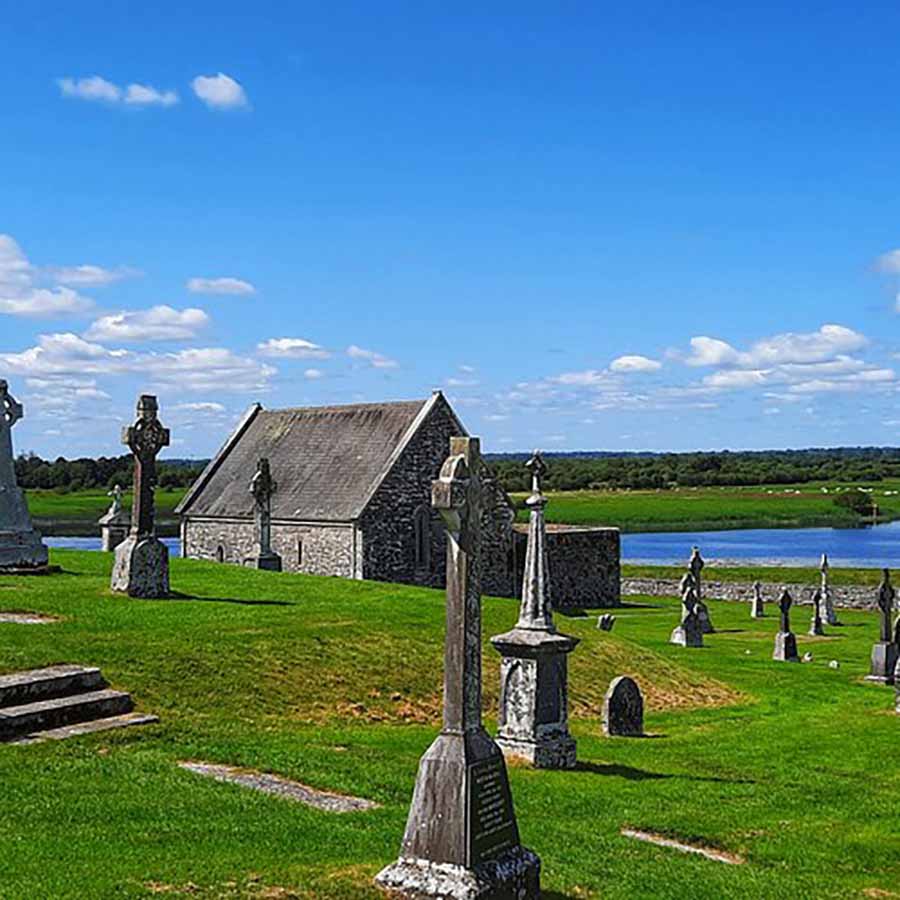
- Clonmacnoise Monastic Site: Near Shannonbridge, County Offaly, approximately 20 km south of Athlone (Coordinates: 53.326°N, 7.986°W).. Founded in 544 AD by St. Ciarán, Clonmacnoise is one of Ireland’s most significant early Christian monastic sites, strategically located on the River Shannon. It became a major centre of learning, art, and religion, attracting scholars across Europe. The site includes three high crosses (notably the Cross of the Scriptures, c. 9th century), a 10th-century round tower, nine churches (including Temple Ciarán), and extensive grave slabs. It was raided by Vikings and later Normans but flourished until the 12th century. Archaeological excavations have uncovered artefacts like croziers and manuscripts, highlighting its cultural wealth. Clonmacnoise is tied to Ireland’s “Golden Age” of monasticism. Managed by Heritage Ireland, the site is open year-round with a visitor centre offering guided tours and exhibits. Admission fees apply; check www.heritageireland.ie for hours and tickets.
- Birr Castle Demesne: Birr, County Offaly, approximately 38 km southwest of Tullamore (Coordinates: 53.096°N, 7.914°W).. While primarily known for its 19th-century Leviathan Telescope, Birr Castle sits on a site with medieval archaeological significance. The castle, built by the O’Carroll clan in the 14th century, was a Gaelic stronghold before being granted to the Parsons family (Earls of Rosse) in the 17th century. The demesne includes remnants of a 12th-century motte-and-bailey and early Christian features, such as a bullaun stone. Archaeological surveys indicate a multi-period landscape, with evidence of prehistoric activity. The castle’s historical layers reflect Offaly’s transition from Gaelic to Anglo-Norman and Plantation eras. The castle itself is private, but the demesne, gardens, and Science Centre (with telescope) are open to visitors year-round. Admission fees apply; check www.birrcastle.com for details.
- Durrow High Cross and Monastic Site: Durrow, near Tullamore, County Offaly, approximately 7 km north of Tullamore (Coordinates: 53.329°N, 7.515°W).. Founded in the 6th century by St. Columba (Colmcille), Durrow was an important monastic centre, famous for the Book of Durrow (c. 7th century), an illuminated manuscript now in Trinity College Dublin. The site features a 9th-century high cross with intricate biblical carvings, a medieval church ruin, and early Christian grave slabs. Archaeological evidence suggests Viking raids and later medieval rebuilding under O’Molloy patronage. The site’s significance lies in its contribution to early Christian art and scholarship. Located on private land within Durrow Abbey estate, the high cross and church are accessible with permission. No formal facilities; check www.archaeology.ie or contact www.offaly.ie for access guidance.
- Rahan Monastic Site: Rahan, near Tullamore, County Offaly, approximately 10 km west of Tullamore (Coordinates: 53.279°N, 7.615°W).. Established in the 6th century by St. Carthage (Mochuda), Rahan was an early Christian monastery with three churches, two of which survive: a 12th-century Romanesque church with ornate doorways and a smaller medieval church. The site includes a holy well and earthworks suggesting a larger monastic enclosure. Archaeological surveys indicate activity from the 6th to 13th centuries, with links to the O’Connor clan. Rahan’s architectural features reflect the transition from early Christian to Romanesque styles in Ireland. Publicly accessible with free entry, managed by the OPW. Limited signage; check www.heritageireland.ie or www.offaly.ie for details.
- Croghan Hill: Near Daingean, County Offaly, approximately 15 km northeast of Tullamore (Coordinates: 53.340°N, 7.283°W).. Croghan Hill, a volcanic outcrop, is a multi-period site with Bronze Age (c. 2000–1000 BC) and Iron Age (c. 500 BC–AD 500) significance. It features a hillfort enclosure and is linked to a Bronze Age burial mound where the Croghan Bog Man, a well-preserved Iron Age body (dated c. 200 BC), was found in 2014. The hill is associated with the mythological figure Ériu, symbolising Ireland, and was a ceremonial or defensive site for the local Fomoire and later Gaelic tribes. Archaeological findings, including bog offerings, suggest ritual use. The hill is publicly accessible with free entry, reachable via a short walk. No formal facilities; check www.archaeology.ie or www.discoverireland.ie for directions. The Croghan Man is displayed at the National Museum of Ireland, Dublin.
Archaeological sites
Antrim – Armagh – Carlow – Cavan – Clare – Cork – Derry – Donegal – Down – Dublin – Fermanagh – Galway – Kerry – Kildare – Kilkenny – Laois – Leitrim – Limerick – Longford – Louth – Mayo – Meath – Monaghan – Offaly – Roscommon – Sligo – Tipperary – Tyrone – Waterford – Westmeath – Wexford – Wicklow
County Offaly:
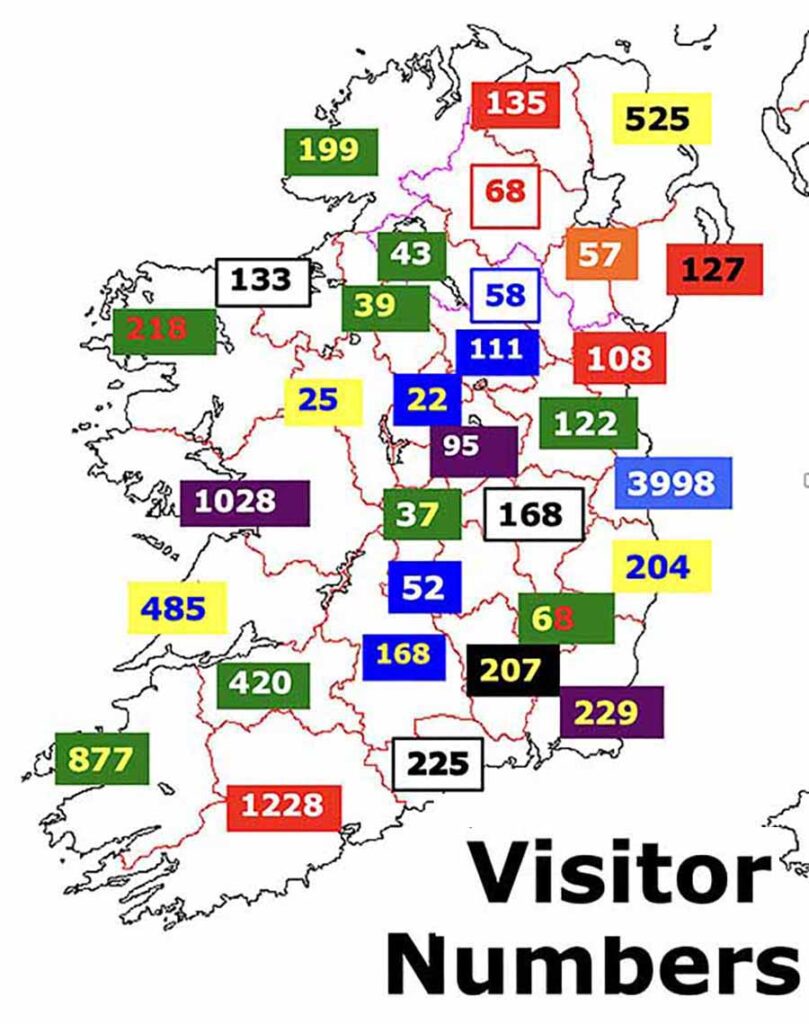
Ireland’s county Offaly is a county of historic depth and natural beauty, with the Clonmacnoise monastic site featuring ancient high crosses and a riverside setting along the Shannon. Tullamore’s historic distillery provides insights into Irish whiskey production, while the Bog of Allen Nature Centre explores the county’s unique peatlands. Other attractions include the Slieve Bloom Mountains’ hiking trails. Offaly is Ireland’s 18th largest county by size (1,998 square km) and ninth smallest by population (83,150). Population peaked at 146,857 in 1841 and reached its lowest point, 51,533 in 1961. In terms of hospitality, Offaly is Ireland’s 30th most visited (and third least visited) tourist county with around 37,000 international visitors per year.
Introduction – Adventure – Anthem – Archaeology – Attractions – Awards – Birdwatching – Camping – Castles – Churches – Contact list – Cycling – Dining – Equestrian – Festivals – Fishing – Folklore – Gardens – Golf – Graveyards – Happening – Haunted – Highest – Hiking – History – Holy Wells – Hotels – Hotels top 8 – Hunting & shooting – Instagrammable – Itineraries – Largest town – Luxury – MICE – Movies – Music – Name – New – Novelists – Off the beaten track – Poets – Pubs – Quotes – Random Facts – Restaurant Awards – Sacred Places – Saints – Songs – Spas – Sports – Sunsets – Sustainable – Things to do – Towns – Video – Villages – Walking – Wanderlist – Weddings – Wild swimming – Writers – 1837 – 1846 – 1852 – 1909 – 1955 – 1980 –