- Rathcroghan (Cruachan Aí): Near Tulsk, County Roscommon, approximately 25 km northeast of Roscommon Town (Coordinates: 53.806°N, 8.302°W).. Rathcroghan is one of Ireland’s most significant archaeological complexes, a Royal Site and the ancient capital of Connacht, dating from the Neolithic to the Iron Age (c. 3500 BC–AD 500). It encompasses over 240 monuments, including the Rathcroghan Mound (a ceremonial hillfort), Oweynagat (Cave of the Cats, known as the “Gate to Hell” in mythology), ring forts, burial mounds, and the La Tène Stone at Castlestrange, a decorated Iron Age stone (c. 200–100 BC). Linked to Queen Medb and the Táin Bó Cúailnge epic, it was a centre for kingship rituals, feasting, and mythology. Archaeological surveys, including geophysical studies, reveal parade ramps and enclosures, indicating large-scale ceremonies. The site reflects Connacht’s pre-Christian power and cultural continuity. The Rathcroghan Visitor Centre in Tulsk offers guided tours, exhibits, and virtual reality experiences, open year-round. Some monuments are on private land, requiring permission. Check www.rathcroghan.ie for details.
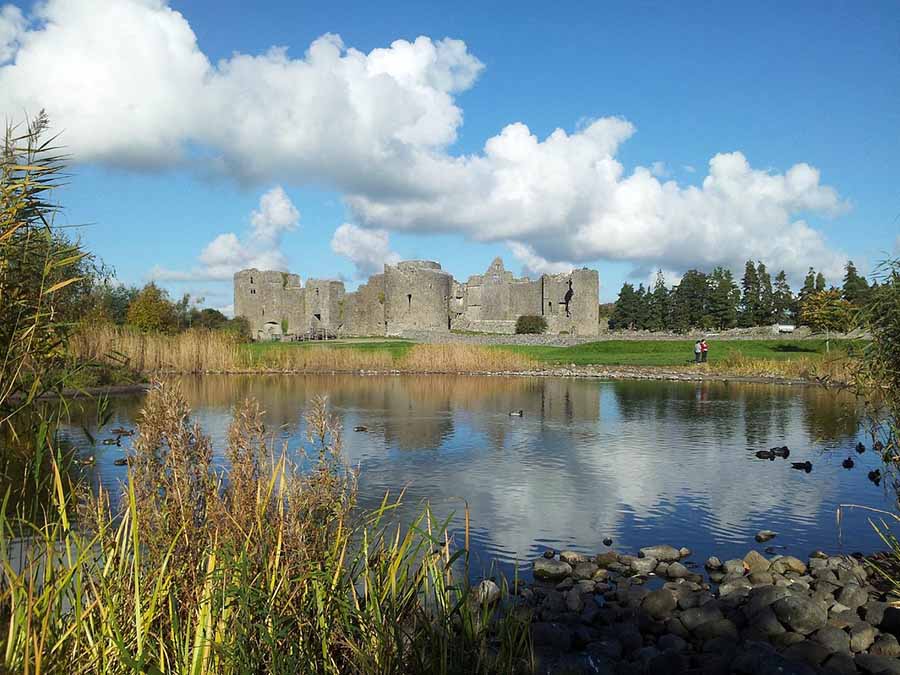
- Roscommon Castle: Roscommon Town, County Roscommon, approximately 1 km west of the town centre (Coordinates: 53.631°N, 8.202°W).. Built in 1269 by Robert de Ufford, Justiciar of Ireland, Roscommon Castle is a quadrangular Anglo-Norman fortress with four D-shaped corner towers, twin gate towers, and a curtain wall. Seized from an Augustinian priory, it was a key stronghold in Connacht, besieged by Connacht King Aodh Ó Conchobhair in 1272 and changing hands multiple times between English and Gaelic forces, notably the O’Connors. Cromwellian troops destroyed its fortifications in 1652, and a fire in 1690 left it in ruins. Archaeological finds, including a 1945 discovery of a Bronze Age gold lunula and discs (c. 2300–1800 BC) nearby, highlight the area’s prehistoric significance. The castle’s symmetrical design and cross-shaped arrow loops are notable. Managed by the Office of Public Works (OPW), the castle grounds are open year-round with free entry. No formal visitor centre, but interpretive signage is available. Check www.heritageireland.ie for details.
- Boyle Abbey: Boyle, County Roscommon, approximately 40 km north of Roscommon Town (Coordinates: 53.974°N, 8.297°W).. Founded in 1161 by the Cistercian order under the patronage of the MacDermot family, Boyle Abbey is one of Ireland’s best-preserved Cistercian monasteries. The abbey features a 12th-century church with Romanesque and Gothic arches, a cloister, and domestic buildings, some fortified in the 16th century. It was a major religious and economic centre until its suppression during the Dissolution of the Monasteries (1539), later serving as a military barracks. Archaeological excavations have revealed medieval tiles and artefacts, underscoring its wealth. The abbey reflects the spread of Cistercian monasticism in medieval Ireland. Managed by Heritage Ireland, the abbey is open seasonally (typically April–October) with guided tours and a small visitor centre. Admission fees apply; check www.heritageireland.ie for hours and tickets.
- Castlestrange La Tène Stone: Castlestrange Demesne, near Athleague, County Roscommon, approximately 10 km southeast of Roscommon Town (Coordinates: 53.581°N, 8.133°W).. The Castlestrange Stone is a rare Iron Age granite boulder (c. 200–100 BC) decorated with curvilinear La Tène-style carvings, one of only three such stones in Ireland. Likely a ritual or territorial marker, it is part of the Rathcroghan landscape and reflects Celtic artistic traditions introduced from Continental Europe. Archaeological surveys suggest it stood in a ceremonial context, possibly linked to nearby ring forts or burial mounds. Its intricate spirals and motifs highlight the sophistication of Iron Age Connacht. Located on private land but accessible with landowner permission. No formal facilities; check www.archaeology.ie or www.discoverireland.ie for access guidance.
- Ardcarn Ecclesiastical Site: Near Tumna, County Roscommon, approximately 5 km east of Boyle (Coordinates: 53.964°N, 8.208°W).. Ardcarn is an early Christian site, likely founded in the 6th century, with a medieval church ruin, graveyard, and cross-inscribed stones. It was associated with the Connachta dynasty and served as a local ecclesiastical centre. Archaeological evidence includes early Christian grave slabs and a possible monastic enclosure, indicating activity until the 12th century. The site’s location near the Shannon suggests its role in regional trade and religion, reflecting Roscommon’s early Christian heritage. Publicly accessible with free entry, though on private land. Limited signage; check www.archaeology.ie or www.roscommoncoco.ie for details.
Archaeological sites
Antrim – Armagh – Carlow – Cavan – Clare – Cork – Derry – Donegal – Down – Dublin – Fermanagh – Galway – Kerry – Kildare – Kilkenny – Laois – Leitrim – Limerick – Longford – Louth – Mayo – Meath – Monaghan – Offaly – Roscommon – Sligo – Tipperary – Tyrone – Waterford – Westmeath – Wexford – Wicklow
County Roscommon:
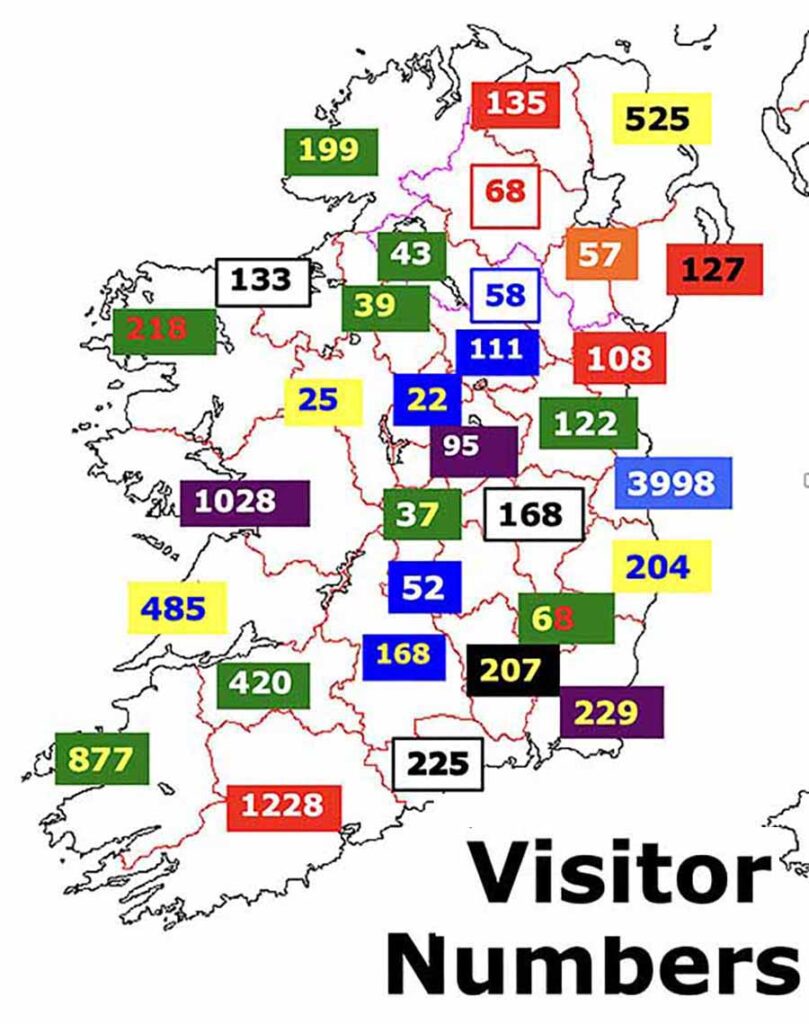
Ireland’s county Roscommon combines historic sites with tranquil landscapes, with Roscommon Castle’s imposing ruins offering a glimpse into medieval Ireland. Lough Key Forest Park provides boating and treetop canopy walks, while the Arigna Mining Experience explores the county’s industrial past. Other attractions include the sacred site of Rathcroghan, linked to ancient mythology. Roscommon is Ireland’s 11th largest county by size (2,463 square km) and eighth smallest by population (70,259). Population peaked at 253,591 in 1841 and reached its lowest point, 53,519 in 1971. In terms of hospitality, Roscommon is Ireland’s 31st most visited and Ireland’s second least visited tourist county with around 25,000 international visitors per year.
Introduction – Adventure – Anthem – Archaeology – Attractions – Awards – Birdwatching – Camping – Castles – Churches – Contact list – Cycling – Dining – Equestrian – Festivals – Fishing – Folklore – Gardens – Golf – Graveyards – Happening – Haunted – Highest – Hiking – History – Holy Wells – Hotels – Hotels top 8 – Hunting & shooting – Instagrammable – Itineraries – Largest town – Luxury – MICE – Movies – Music – Name – New – Novelists – Off the beaten track – Poets – Pubs – Quotes – Random Facts – Restaurant Awards – Sacred Places – Saints – Songs – Spas – Sports – Sunsets – Sustainable – Things to do – Towns – Video – Villages – Walking – Wanderlist – Weddings – Wild swimming – Writers – 1837 – 1846– 1852 – 1909 – 1955 – 1980 –