Pre-1000 The Gaelic Nation
County Roscommon, part of the ancient kingdom of Connacht, was dominated by the house of Briún and house of Maine dynasties, with the O’Connor (Ó Conchobhair) dynasty emerging as the leading Gaelic family by the 8th century. The county’s name derives from St. Comán, who founded a monastery at Ros Comáin (‘wood of Comán’) around the 6th century. Archaeological sites, such as Rathcroghan (Cruachan), a royal complex linked to the legendary Queen Medb, highlight Roscommon’s prehistoric significance, with tumuli and ringforts indicating a ritual landscape. Christianity spread early, with monasteries like Roscommon and Clonown shaping cultural life. Viking raids targeted the River Shannon, affecting Roscommon’s monastic wealth, as noted in The Annals of Ulster. The O’Connors consolidated power, ruling from Rathcroghan.
1000–1100: O’Connor Ascendancy and Monastic Influence
Roscommon remained a Gaelic stronghold under the O’Connors, who rose to prominence as Kings of Connacht. Rory O’Connor (Ruaidrí Ó Conchobhair), later High King (d. 1198), strengthened the clan’s influence. Monastic sites, including Roscommon Abbey and Clonown, flourished, producing manuscripts and attracting pilgrims. The Annals of the Four Masters record conflicts between the O’Connors and neighbouring house of Niall dynasty, with Roscommon as a strategic centre. The county’s fertile plains and Shannon access supported agriculture and trade. The Synod of Kells (1152) formalised Roscommon’s diocesan role, with Elphin emerging as a bishopric. Roscommon’s isolation from Viking strongholds preserved its Gaelic character.
1100–1200: Norman Incursion and Gaelic Resistance
The Norman invasion (1169) had a delayed impact on Roscommon due to its western location. By the late 12th century, Norman adventurers, led by the de Burghs (Burkes), entered Connacht, challenging the O’Connors. The construction of Ballintober Castle (c. 1200) marked early Norman influence, but the O’Connors resisted, retaining control of Roscommon. Rathcroghan remained a symbolic centre, as noted in The Annals of Tigernach. Monastic sites like Roscommon Abbey (founded 1253, but with earlier roots) supported Gaelic culture. The county’s bogs and rivers deterred large-scale Norman settlement, preserving O’Connor dominance.
1200–1300: Norman-Gaelic Coexistence
The Normans, particularly the Burkes, established a foothold in Roscommon, building castles like Roscommon Castle (c. 1269). The O’Connors, under leaders like Áed Ó Conchobhair (d. 1274), maintained significant autonomy, often allying with the Burkes to counter English control. The Black Death (1348–1350) reduced Roscommon’s population. Monastic foundations, such as Roscommon’s Dominican Priory (1253), grew in influence, driving local economy through agriculture. The Annals of Connacht detail the O’Connors’ conflicts with Normans and rival Gaelic clans, while Roscommon’s distance from the Pale preserved its Gaelic identity.
1300–1400: Gaelic Resurgence and O’Connor Dominance
The decline of Norman power allowed the O’Connors to reassert control over Roscommon. The clan, led by figures like Turlough O’Connor, ruled as Kings of Connacht, using Roscommon Castle and Rathcroghan as strongholds. The Burkes, increasingly Gaelicised, became allies rather than rivals. Monastic sites like Roscommon Abbey and Holy Trinity Abbey (Athlone, partly in Roscommon) remained cultural hubs. The county’s economy relied on cattle and oats, with trade along the Shannon. The Annals of Ulster record the O’Connors’ feuds with the O’Kellys of Uí Maine, reflecting Roscommon’s regional significance.
1400–1500: Late Medieval Autonomy
Roscommon remained a Gaelic stronghold under the O’Connors, who maintained autonomy despite growing English influence in Connacht. The county’s castles, including Roscommon and Ballintober, were fortified to counter threats from the Pale and rival dynasties like the O’Donnells. Monastic decline began, but sites like Roscommon Abbey continued to host pilgrims. The county’s fertile lands supported a stable population, with market towns like Boyle emerging. The Annals of Connacht note the O’Connors’ alliances with the Burkes and O’Neills. Roscommon’s isolation ensured limited English control, preserving Gaelic traditions.
1500–1600: Tudor Conquest and O’Connor Decline
The Tudor reconquest brought Roscommon under English scrutiny. The Composition of Connacht (1585) forced the O’Connors to submit, with their lands regranted under English law. Roscommon was shired as a county by 1565, formalising English administration. The Nine Years’ War (1593–1603) saw the O’Connors support Hugh O’Neill, with skirmishes in Roscommon, as noted in The Annals of the Four Masters. Early plantation efforts introduced English settlers, though less extensively than in Ulster. The O’Connors’ influence waned, with figures like Aedh Ó Conchobhair submitting to Elizabeth I. Roscommon Castle was seized by the English, marking the decline of Gaelic power.
1600–1700: Plantation and Cromwellian Upheaval
The plantation of Connacht intensified in Roscommon, with lands confiscated from the O’Connors and granted to English settlers like the King family (Lords Kingston). The 1641 Rebellion saw Gaelic and Old English forces, including the O’Connors, briefly reclaim Roscommon Castle. Cromwell’s campaign (1649–1653) crushed resistance, redistributing lands to Colonial/protestan settlers. The transplantation to Connacht forced many Gaelic families into Roscommon, reshaping its demographics. The Williamite War (1689–1691) saw Roscommon align with William III, with the Battle of Aughrim (1691, partly in Roscommon) a decisive victory for a new round of kleptocolonial settlers. The Confederate Wars documents detail these shifts.
1700–1800: Anglo-Irish Ascendancy
Roscommon’s Anglo-Irish landlords, including the Kings and Crofton families, dominated under the Penal Laws, building estates like Rockingham (near Boyle). The county’s economy relied on agriculture, with Boyle and Roscommon town as market centres. The 1798 Rebellion saw minor unrest, with French forces briefly occupying Roscommon during the ‘Year of the French’, entries on figures like Henry Crofton. The Act of Union (1800) integrated Roscommon into English rule, reducing local influence. The county’s Catholic majority faced restrictions, but Presbyterian settlers added diversity.
1800–1900: Famine and Land Reform
The Great Famine (1845–1852) devastated Roscommon, with its population falling from 253,000 in 1841 to 174,000 by 1851, per census records. Workhouses in Roscommon and Boyle were overwhelmed, and emigration surged to America and England. The county’s bogs supported turf production, but agriculture struggled. The Land League, active in Roscommon, pushed for tenant rights, challenging landlords like the Kings. The Gaelic Revival sparked interest in Rathcroghan and Roscommon’s mythological past, linked to the Táin Bó Cúailnge. Roscommon town grew as an administrative centre.
1900–2025: Independence and Modernisation
Roscommon played a role in the War of Independence (1919–1921), with IRA ambushes in Boyle and Strokestown, as documented in History Ireland. The county joined the Irish Free State in 1922, with Douglas Hyde becoming Ireland’s first President (1938–1945). The population stabilised, reaching 64,065 by 2022, per census data. Infrastructure, including the N5 and N61 roads, improved connectivity. Tourism grew, focusing on Rathcroghan, Roscommon Castle, and Strokestown Park’s Famine Museum, which highlights emigration history. The county’s economy diversified, with agriculture, tourism, and small-scale industry prominent. Roscommon is one of 24 Irish counties that still has a smaller population than it did in 1841.
History
Antrim – Armagh – Carlow – Cavan – Clare – Cork – Derry – Donegal – Down – Dublin – Fermanagh – Galway – Kerry – Kildare – Kilkenny – Laois – Leitrim – Limerick – Longford – Louth – Mayo – Meath – Monaghan – Offaly – Roscommon – Sligo – Tipperary – Tyrone – Waterford – Westmeath – Wexford – Wicklow
County Roscommon:
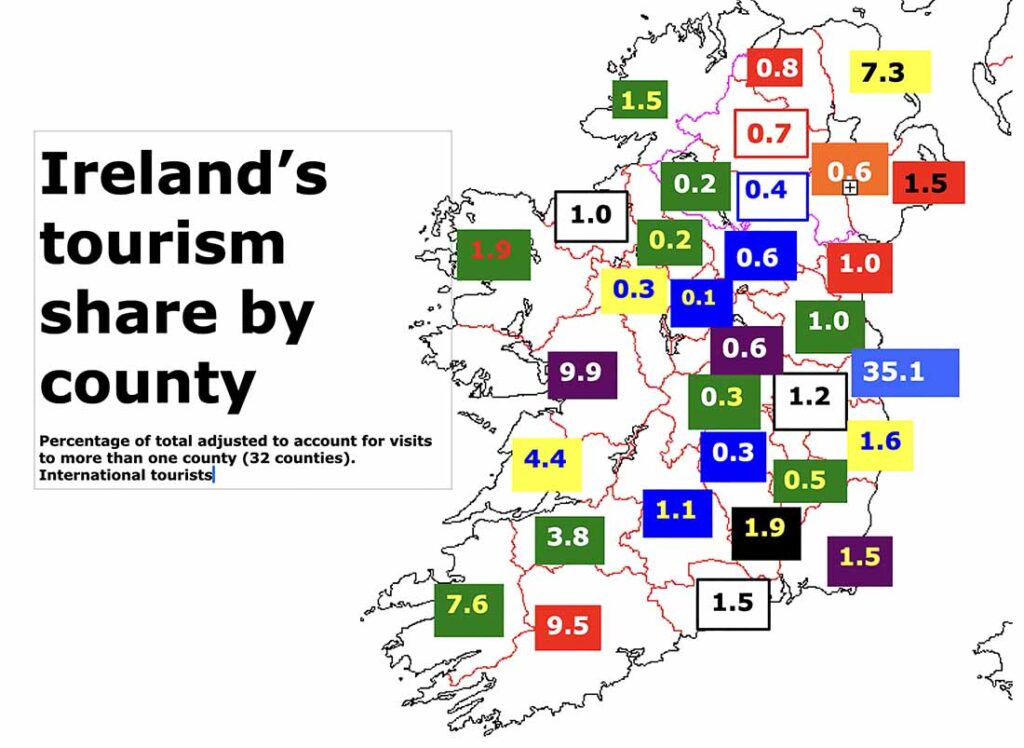
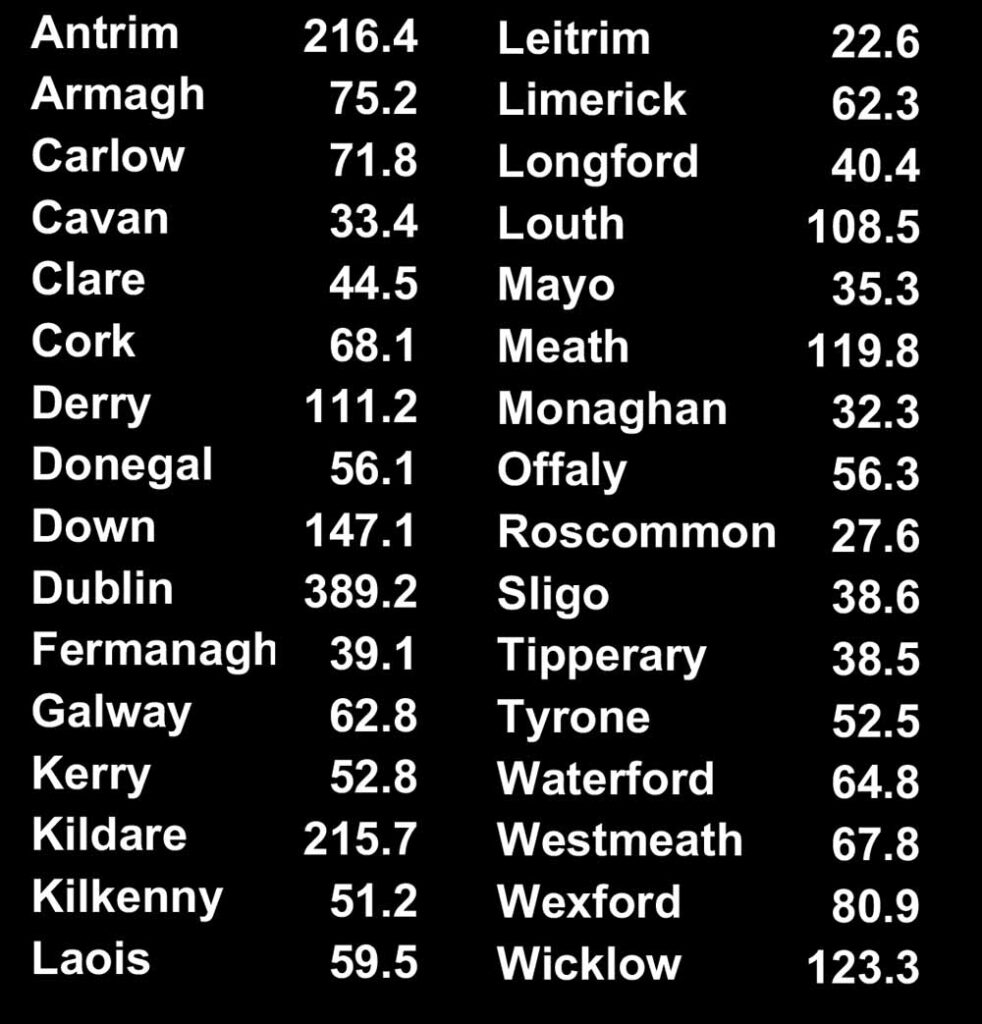
Ireland’s county Roscommon combines historic sites with tranquil landscapes, with Roscommon Castle’s imposing ruins offering a glimpse into medieval Ireland. Lough Key Forest Park provides boating and treetop canopy walks, while the Arigna Mining Experience explores the county’s industrial past. Other attractions include the sacred site of Rathcroghan, linked to ancient mythology. Roscommon is Ireland’s 11th largest county by size (2,463 square km) and eighth smallest by population (70,259). Population peaked at 253,591 in 1841 and reached its lowest point, 53,519 in 1971. In terms of hospitality, Roscommon is Ireland’s 31st most visited and Ireland’s second least visited tourist county with around 25,000 international visitors per year.
Introduction – Adventure – Anthem – Archaeology – Attractions – Awards – Birdwatching – Camping – Castles – Churches – Contact list – Cycling – Dining – Equestrian – Festivals – Fishing – Folklore – Gardens – Golf – Graveyards – Happening – Haunted – Highest – Hiking – History – Holy Wells – Hotels – Hotels top 8 – Hunting & shooting – Instagrammable – Itineraries – Largest town – Luxury – MICE – Movies – Music – Name – New – Novelists – Off the beaten track – Poets – Pubs – Quotes – Random Facts – Restaurant Awards – Sacred Places – Saints – Songs – Spas – Sports – Sunsets – Sustainable – Things to do – Towns – Video – Villages – Walking – Wanderlist – Weddings – Wild swimming – Writers – 1837 – 1846– 1852 – 1909 – 1955 – 1980 –