- Douglas Hyde (1860-1949) Douglas Hyde, also known by his pen name “An Craoibhín Aoibhinn,” was a scholar, poet, and the first President of Ireland (1938-1945). Born in Castlerea, Roscommon, he was a key figure in the Irish Revival, co-founding the Gaelic League to preserve Irish language and culture. His works include poetry, translations, and collections of Irish folklore, such as Beside the Fire (1890). Hyde’s literary efforts helped revive interest in Irish literature and identity.
- William Wilde (1815-1876) Born in Kilkeevin, Castlerea, Roscommon, William Wilde was a surgeon, antiquarian, and writer. Father of Oscar Wilde, he wrote extensively on Irish history, archaeology, and folklore, including The Beauties of the Boyne, and its Tributary, the Blackwater (1849). He also edited the Dublin Journal of Medical Science. His work as a polymath contributed to documenting Ireland’s cultural heritage.
- Percy French (1854-1920) Born in Cloonyquin, Roscommon, William Percy French was a songwriter, poet, and entertainer best known for humorous songs like “Phil the Fluter’s Ball” and “The Mountains of Mourne.” His light-hearted poetry and performances captured Irish rural life, making him a beloved figure in Irish cultural history.
- John O’Donovan (1806-1861) Born in Atateemore, Kilcolman, Roscommon, O’Donovan was a historian, scholar, and writer renowned for his work on Irish language and history. He edited and translated the Annals of the Four Masters and published A Grammar of the Irish Language (1845). His contributions to Irish scholarship were foundational for historical and linguistic studies.
- T.H. White (1906-1964) Terence Hanbury White, born in Bombay but with strong Roscommon connections through his family (his mother was from Roscommon), was a novelist and writer. Best known for The Once and Future King (1958), a retelling of the Arthurian legend, White spent time in Roscommon and drew inspiration from Irish landscapes for his writing. His work blends myth, history, and fantasy.
- Oliver Goldsmith (1728-1774) Born in Pallas, near Ballymahon (on the Roscommon-Longford border, often attributed to Roscommon), Goldsmith was a poet, novelist, and playwright. His works include The Vicar of Wakefield (1766), The Deserted Village (1770), and the play She Stoops to Conquer (1773). His writing is celebrated for its wit, social commentary, and depiction of rural life.
- Arthur Murphy (1727-1805) Born in Cloonyquin, Roscommon, Murphy was a playwright, actor, and writer who moved to London and wrote comedies such as The Way to Keep Him (1760). He also produced essays and biographies, contributing to the literary scene in 18th-century England while maintaining Irish roots.
- Thomas Heazle Parke (1857-1893) Born in Clogher, Roscommon, Parke was a surgeon and writer known for his travel memoir My Personal Experiences in Equatorial Africa (1891), documenting his journey with Henry Morton Stanley’s expedition. His writing provides vivid accounts of exploration and medical challenges in Africa.
- Charles Owen O’Conor (1838-1906) Born in Roscommon, O’Conor Don was a historian and writer who contributed to Irish historical scholarship. His works, such as The O’Conors of Connaught (1891), detailed the history of his family and Connacht’s heritage, preserving regional history.
Writers
Antrim – Armagh – Carlow – Cavan – Clare – Cork – Derry – Donegal – Down – Dublin – Fermanagh – Galway – Kerry – Kildare – Kilkenny – Laois – Leitrim – Limerick – Longford – Louth – Mayo – Meath – Monaghan – Offaly – Roscommon – Sligo – Tipperary – Tyrone – Waterford – Westmeath – Wexford – Wicklow
County Roscommon:
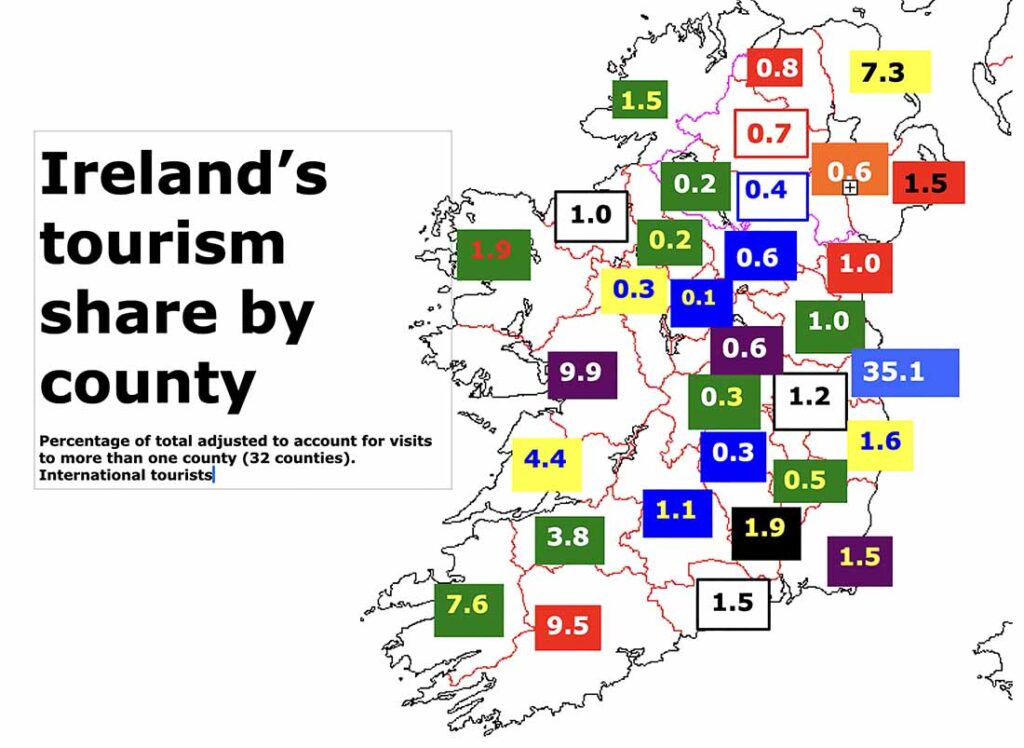
Ireland’s county Roscommon combines historic sites with tranquil landscapes, with Roscommon Castle’s imposing ruins offering a glimpse into medieval Ireland. Lough Key Forest Park provides boating and treetop canopy walks, while the Arigna Mining Experience explores the county’s industrial past. Other attractions include the sacred site of Rathcroghan, linked to ancient mythology. Roscommon is Ireland’s 11th largest county by size (2,463 square km) and eighth smallest by population (70,259). Population peaked at 253,591 in 1841 and reached its lowest point, 53,519 in 1971. In terms of hospitality, Roscommon is Ireland’s 31st most visited and Ireland’s second least visited tourist county with around 25,000 international visitors per year.
Introduction – Adventure – Anthem – Archaeology – Attractions – Awards – Birdwatching – Camping – Castles – Churches – Contact list – Cycling – Dining – Equestrian – Festivals – Fishing – Folklore – Gardens – Golf – Graveyards – Happening – Haunted – Highest – Hiking – History – Holy Wells – Hotels – Hotels top 8 – Hunting & shooting – Instagrammable – Itineraries – Largest town – Luxury – MICE – Movies – Music – Name – New – Novelists – Off the beaten track – Poets – Pubs – Quotes – Random Facts – Restaurant Awards – Sacred Places – Saints – Songs – Spas – Sports – Sunsets – Sustainable – Things to do – Towns – Video – Villages – Walking – Wanderlist – Weddings – Wild swimming – Writers – 1837 – 1846– 1852 – 1909 – 1955 – 1980 –