- Beaghmore Stone Circles: Near Cookstown, County Tyrone, approximately 15 km northwest of Cookstown (Coordinates: 54.701°N, 6.947°W, NISMR: TYR 035:008).. Beaghmore is a remarkable Bronze Age complex (c. 2000–1200 BC) comprising seven stone circles, multiple stone alignments, and cairns, discovered during peat cutting in the 1940s. The site includes three pairs of circles with a single larger circle, some with internal cairns, and over 1,200 standing stones in rows. Excavations revealed hearths and flint tools, suggesting ritual or astronomical functions, possibly linked to solstice alignments. The site reflects sophisticated prehistoric communities in Tyrone’s uplands, tied to broader megalithic traditions in Ireland. Its preservation in bogland offers insights into Bronze Age land use. Managed by the NI Environment Agency (NIEA), the site is open year-round with free access and interpretive signage. A small car park is available; check www.communities-ni.gov.uk for details.
- Ardboe High Cross: Ardboe, near Cookstown, County Tyrone, approximately 10 km east of Cookstown (Coordinates: 54.619°N, 6.510°W, NISMR: TYR 039:028).. Ardboe High Cross, erected c. 9th–10th century, is one of Ulster’s finest early Christian monuments, standing 5.5 metres tall in the grounds of a former monastery founded by St. Colman in the 6th century. Carved from sandstone, it features 22 panels depicting Old and New Testament scenes, including the Adoration of the Magi and the Last Judgement. The cross served as a teaching tool for the monastic community and pilgrims. Archaeological evidence suggests a larger ecclesiastical site, with a ruined church nearby. The cross reflects Tyrone’s role in early Christian Ireland. Freely accessible year-round in the Ardboe Old Cross graveyard, with parking nearby. No formal visitor centre; check www.discoverireland.ie or www.communities-ni.gov.uk for information.
- Harry Avery’s Castle: Newtownstewart, County Tyrone, approximately 2 km southwest of Newtownstewart (Coordinates: 54.716°N, 7.403°W, NISMR: TYR 009:016).. Built in the 14th century (c. 1320–1360), Harry Avery’s Castle is a rare example of a Gaelic Irish stone castle, attributed to Aodh Reamhar O’Neill (Harry Avery), a chieftain of the O’Neill dynasty. The castle features two towers connected by a curtain wall, with a gatehouse, overlooking the Mourne River. Unlike Anglo-Norman castles, it reflects native Irish design, possibly for ceremonial rather than defensive purposes. Archaeological surveys indicate a surrounding bawn and medieval settlement. The site highlights the O’Neill’s dominance in medieval Ulster. Managed by the NIEA, open year-round with free access and interpretive panels. A short walk from a car park is required; check www.communities-ni.gov.uk for details.
- Tullaghoge Fort: Near Cookstown, County Tyrone, approximately 5 km southeast of Cookstown (Coordinates: 54.607°N, 6.725°W, NISMR: TYR 045:013).. Tullaghoge Fort is an Iron Age and medieval hillfort (c. 500 BC–AD 1600), the ceremonial inauguration site of the O’Neill kings of Tír Eoghain. The site features a ringfort with earthworks and a central platform, where O’Neill chieftains were crowned on a stone chair until its destruction by English forces in 1602. Archaeological evidence suggests continuous use from the Iron Age, with medieval structures like a bawn. Tullaghoge’s significance lies in its role as a political and symbolic centre of Gaelic Ulster, tied to the O’Neill dynasty’s power. Publicly accessible with free entry via a walking trail, managed by the NIEA. Limited facilities; check www.communities-ni.gov.uk or www.discoverireland.ie for access guidance.
- Knockmany Passage Tomb: Near Augher, County Tyrone, approximately 10 km southeast of Clogher (Coordinates: 54.429°N, 7.159°W, NISMR: TYR 065:005).. Knockmany is a Neolithic passage tomb (c. 3000–2500 BC) on a hilltop, featuring a chamber with rare megalithic art, including spirals, zigzags, and lozenges, similar to Newgrange. Covered by a modern protective cairn, the tomb was likely a communal burial site with ritual significance. Excavations in the 19th century revealed cremated remains and pottery. The site’s elevated position offers views across Tyrone, suggesting its role in a prehistoric sacred landscape, possibly linked to the nearby Ancreevy cairns. Managed by the NIEA, open year-round with free access, though the chamber is locked (keys available via local arrangements). A short uphill walk is required; check www.communities-ni.gov.uk for details.
Archaeological sites
Antrim – Armagh – Carlow – Cavan – Clare – Cork – Derry – Donegal – Down – Dublin – Fermanagh – Galway – Kerry – Kildare – Kilkenny – Laois – Leitrim – Limerick – Longford – Louth – Mayo – Meath – Monaghan – Offaly – Roscommon – Sligo – Tipperary – Tyrone – Waterford – Westmeath – Wexford – Wicklow
County Tyrone:
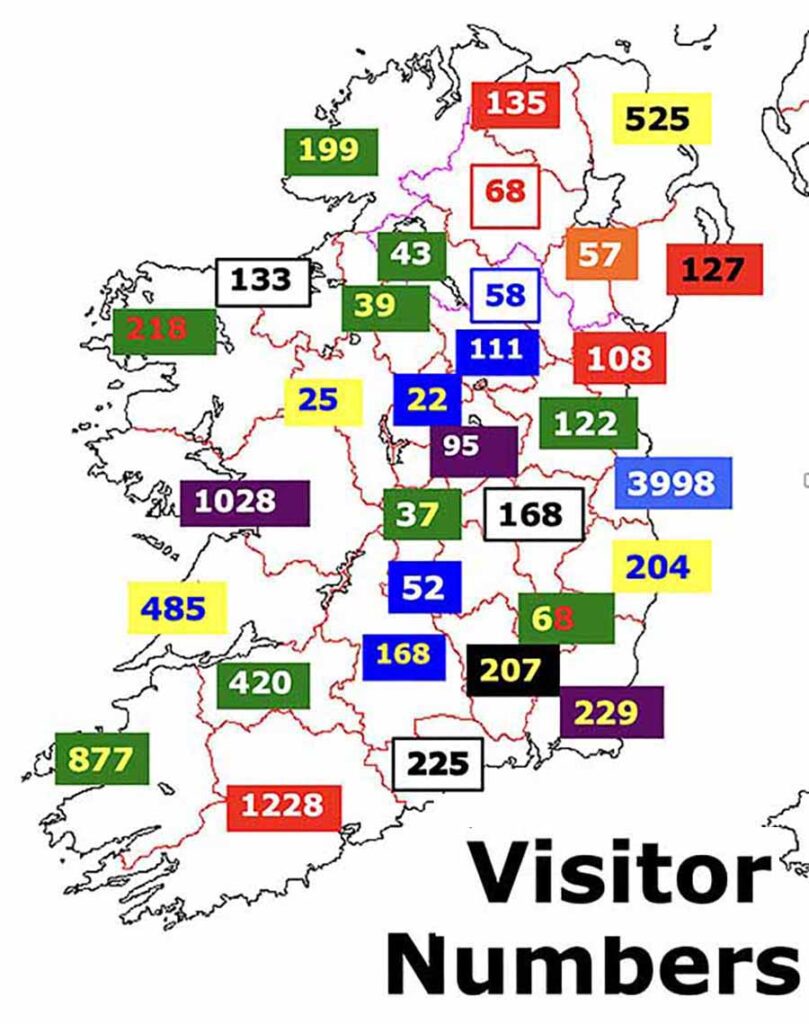
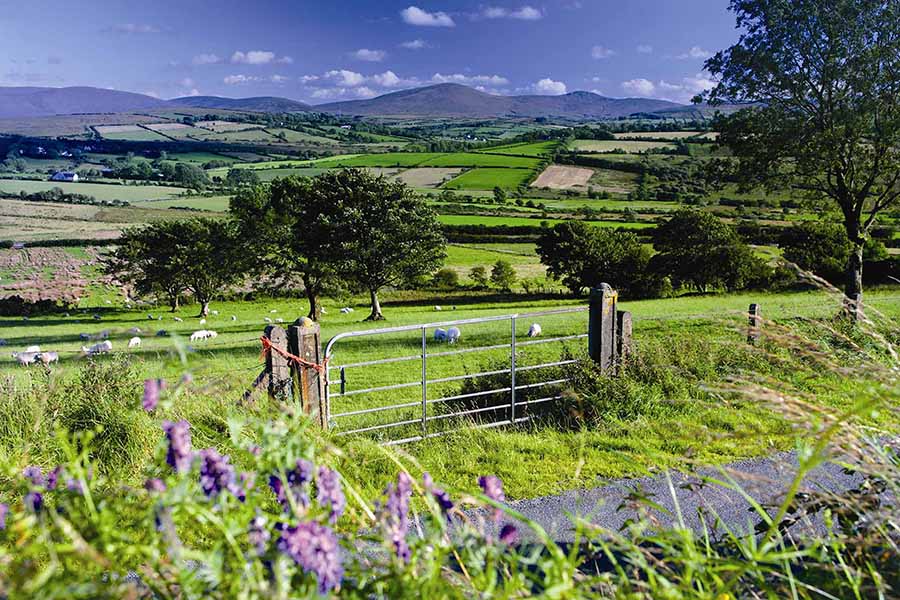
Ireland’s county Tyrone is a county of rolling landscapes and historic sites, with the Ulster American Folk Park in Omagh offering a fascinating look at emigration history through recreated villages. The Sperrin Mountains provide hiking trails with panoramic views, while the Beaghmore Stone Circles add ancient intrigue. Other attractions include the historic town of Dungannon and its castle ruins. Tyrone is Ireland’s seventh largest county by size (3,263 square km) and 11th largest by population (188,383). Population peaked at 312,956 in 1841 and reached its lowest point, 127,586 in 1936. In terms of hospitality, Tyrone is Ireland’s 24th most visited tourist county with around 68,000 international visitors per year.
Introduction – Adventure – Anthem – Archaeology – Attractions – Awards – Birdwatching – Camping – Castles – Churches – Contact list – Cycling – Dining – Equestrian – Festivals – Fishing – Folklore – Gardens – Golf – Graveyards – Happening – Haunted – Highest – Hiking – History – Holy Wells – Hotels – Hotels top 8 – Hunting & shooting – Instagrammable – Itineraries – Largest town – Luxury – MICE – Movies – Music – Name – New – Novelists – Off the beaten track – Poets – Pubs – Quotes – Random Facts – Restaurant Awards – Sacred Places – Saints – Songs – Spas – Sports – Sunsets – Sustainable – Things to do – Towns – Video – Villages – Walking – Wanderlist – Weddings – Wild swimming – Writers – 1837 – 1846– 1852 – 1909 – 1955 – 1980 –