- William Carleton (1794-1869) Born near Clogher, Tyrone, Carleton was a novelist and short-story writer whose works, such as Traits and Stories of the Irish Peasantry (1830-33) and The Black Prophet (1847), vividly depict pre-Famine Irish rural life. His epic novels are celebrated for their social insight and detailed portrayal of peasant struggles.
- Benedict Kiely (1919-2007) Born in Dromore, near Omagh, Tyrone, Kiely was a novelist, short-story writer, and broadcaster. His works, including Land Without Stars (1946) and Proxopera (1977), blend rural Tyrone’s earthy charm with cosmopolitan themes, delivered in a reflective, storytelling style. He also contributed to Irish radio and literary criticism.
- Brian Friel (1929-2015) Born in Omagh, Tyrone, Friel was a renowned playwright and short-story writer, often considered Ireland’s greatest dramatist. His plays, such as Dancing at Lughnasa (1990) and Translations (1980), explore family, identity, and Irish history. His work is deeply rooted in the cultural landscape of the divided province. He died in Greencastle, Donegal.
- Flann O’Brien (Brian O’Nolan) (1911-1966) Born in Strabane, Tyrone, O’Brien (also known as Myles na Gopaleen) was a novelist, satirist, and columnist. His novels At Swim-Two-Birds (1939) and The Third Policeman (published posthumously) are known for their innovative humor and surreal narratives. His Irish Times column under his pseudonym was widely influential.
- John Montague (1929-2016) Born in Brooklyn, New York, but raised in Garvaghey, Tyrone, Montague was a poet whose work, including The Rough Field (1972), reflects the history and landscape of rural Tyrone. His poetry explores themes of memory, identity, and the Troubles, earning him international acclaim.
- William Forbes Marshall (1888-1959) Born in Drumragh, Tyrone, Marshall was a poet, playwright, and Presbyterian minister known as the “Bard of Tyrone.” His collection Livin’ in Drumlister (1921) captures Ulster-Scots dialect and rural life. His works, including poems and plays, celebrate Tyrone’s cultural heritage.
- John Dunlap (1747-1812) Born in Strabane, Tyrone, Dunlap was a printer and journalist who emigrated to Philadelphia. He printed the first broadside of the U.S. Declaration of Independence (1776) and founded The Pennsylvania Packet, one of America’s first daily newspapers. His work shaped early American journalism.
- Alice Milligan (1865-1953) Born in Gortmore, near Omagh, Tyrone, Milligan was a poet, novelist, and nationalist. Her poetry and plays, such as The Last Feast of the Fianna (1900), contributed to the Irish Literary Revival. She co-edited the nationalist journal Shan Van Vocht, promoting Irish culture and independence.
- Nick Laird (1975-) Born in Cookstown, Tyrone, Laird is a contemporary poet, novelist, and screenwriter. His poetry collections, like To a Fault (2005), and novels, such as Utterly Monkey (2004), explore identity and Irish life. He has also written for films like High Life (2018).
- Mary Anne Madden (1817-1905) Born in Tyrone, Madden was a historian and writer who published The Memoirs of the Countess of Blessington (1852) and The Literary Life and Correspondence of the Countess of Blessington 1855). Her works focused on literary biography and social history, contributing to 19th-century Irish scholarship.
Writers
Antrim – Armagh – Carlow – Cavan – Clare – Cork – Derry – Donegal – Down – Dublin – Fermanagh – Galway – Kerry – Kildare – Kilkenny – Laois – Leitrim – Limerick – Longford – Louth – Mayo – Meath – Monaghan – Offaly – Roscommon – Sligo – Tipperary – Tyrone – Waterford – Westmeath – Wexford – Wicklow
County Tyrone:
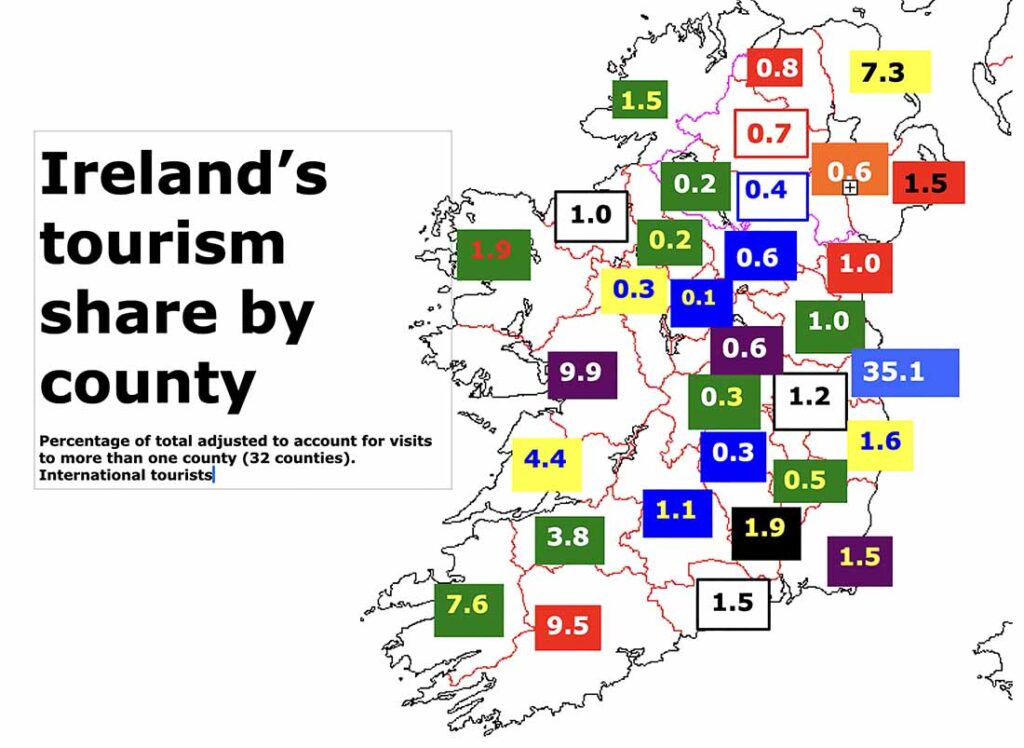
Ireland’s county Tyrone is a county of rolling landscapes and historic sites, with the Ulster American Folk Park in Omagh offering a fascinating look at emigration history through recreated villages. The Sperrin Mountains provide hiking trails with panoramic views, while the Beaghmore Stone Circles add ancient intrigue. Other attractions include the historic town of Dungannon and its castle ruins. Tyrone is Ireland’s seventh largest county by size (3,263 square km) and 11th largest by population (188,383). Population peaked at 312,956 in 1841 and reached its lowest point, 127,586 in 1936. In terms of hospitality, Tyrone is Ireland’s 24th most visited tourist county with around 68,000 international visitors per year.
Introduction – Adventure – Anthem – Archaeology – Attractions – Awards – Birdwatching – Camping – Castles – Churches – Contact list – Cycling – Dining – Equestrian – Festivals – Fishing – Folklore – Gardens – Golf – Graveyards – Happening – Haunted – Highest – Hiking – History – Holy Wells – Hotels – Hotels top 8 – Hunting & shooting – Instagrammable – Itineraries – Largest town – Luxury – MICE – Movies – Music – Name – New – Novelists – Off the beaten track – Poets – Pubs – Quotes – Random Facts – Restaurant Awards – Sacred Places – Saints – Songs – Spas – Sports – Sunsets – Sustainable – Things to do – Towns – Video – Villages – Walking – Wanderlist – Weddings – Wild swimming – Writers – 1837 – 1846– 1852 – 1909 – 1955 – 1980 –