Start your walking tour of the historic village of Castledermot in the serene grounds of St James’s Church of Ireland, the modern successor to the ancient hermitage founded in the early 9th century by St Diarmuid, known in Latin as Germanus, a hermit from the north who established Díseart Diarmada, the hermitage of Dermot, on the banks of the River Lerr.
Enter through the striking Romanesque archway, a remnant of a Norman-era church, and follow the path to the right to discover Ireland’s only Viking hogback stone, a distinctive granite tomb uncovered in 1967 shaped like a longhouse roof, carved with lozenge patterns on one side and a rough Christian cross likely added later on the other, hinting at Danish settlers who transitioned from raiders to residents after Viking incursions.
Nearby in the grass lies a prehistoric kern stone dating from 2000 to 4000 BC, a silent witness to human presence long before the saint’s arrival.
Continue to the first of two magnificent 10th-century high crosses, part of the Barrow Valley group crafted from local granite, adorned with biblical scenes including Noah’s Ark, serving as outdoor teaching aids in an era of widespread illiteracy; an informative exhibition in the nearby community centre offers deeper insights into these masterpieces. Turn left across the grass to the enigmatic swearing stone, a tall pillar etched with a plain cross and pierced by a hole through which hands were clasped to seal oaths and bargains on sacred ground, ensuring their binding sanctity.
Circling back towards the church entrance, note the large flat stone marked with a rough cross marking the burial place of the heart of Cormac mac Cuilennáin, the learned 10th-century Bishop-King of Munster educated at the monastery here, whose body rests in Cashel after his ambush at Ballaghmoon while his heart was interred at his request in Castledermot.
Cross to the second high cross, featuring scenes such as the miracle of the loaves and fishes, with the distinctive round tower rising imposingly behind, unusual for its ground-level door and built of granite field stones around the Viking period to protect the monastic treasures from raids that plagued the site until as late as 1106.
Exit through the Romanesque archway once more, pausing at the base of a third high cross of which little else survives, then cross the road to glimpse the former two-roomed Church of Ireland school before descending the tree-lined Laurels walkway to emerge onto Abbey Street. Turn left to pass the old vocational school with its carved depiction of trades above the door, followed by the site of the Castle Cinema once operated by local legend Peter Murphy, a hub of cinematic escapism.
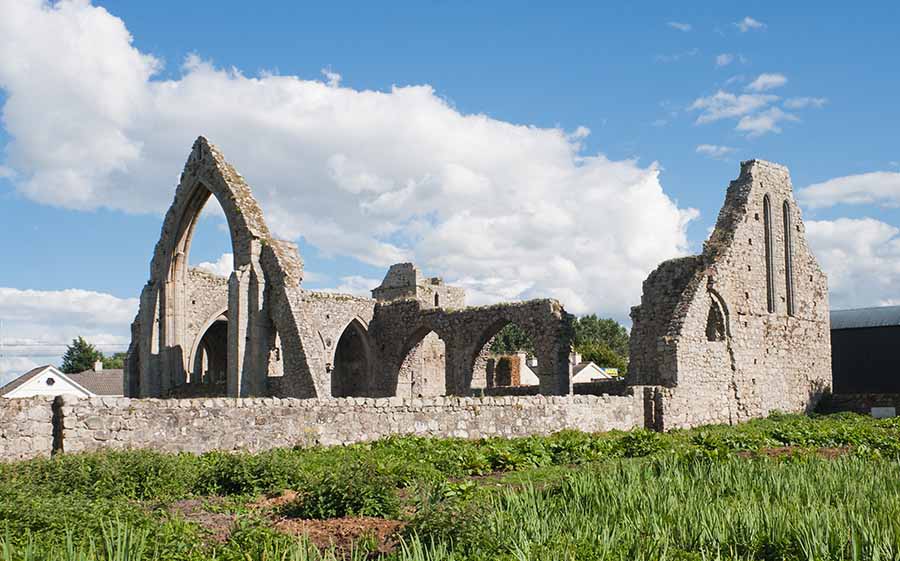
Cross to enter the atmospheric ruins of the Franciscan friary, founded around 1247 or earlier under Norman patronage, its church boasting a 13th-century nave and chancel extended in the 14th century with an aisle; though sacked by Robert Bruce and later Cromwellian forces, the impressive Gothic remnants endure, including a small tower, the Chapel of St Mary with its macabre early 16th-century cadaver tomb of Joanna Skelton and James Tallon featuring graphic skeletal carvings, an ancient baptismal font, and the soaring east window once famed for its stained glass, fragments of which were found into the 1860s.
For the adventurous, clamber over steps at the rear to view the ruins of the old parish church destroyed in 1799 amid a local feud rather than rebellion, and behind it the holy well reputed to cure lameness, where rags once adorned a thorn bush into the 1960s, set in the Cavalry Field named for Cromwellian troops who camped there post-sacking. Return along Abbey Street, passing the former convent site, once a Quaker meeting house and burial ground, and the Catholic church, then turn left up School Lane, flanked historically by national schools, one now the vibrant community centre.
At the top, veer left to Carlow Gate, the surviving fragment of the medieval town wall and toll gate where traders paid levies entering the French-speaking Norman enclave of Tristeldermot, beyond which lay the territories of the O’Byrnes, O’Tooles, and other Gaelic clans. Retrace to the town square, site of a vanished Norman castle built by de Riddlesford and later a travelling parliament and mint, now near Gannon’s public house and the butcher’s shop.
Cross towards the Fair Green, passing Keenan’s Lane, once home to a pitch-and-toss school, and surviving 18th- or 19th-century clay-walled cottages, the green itself a former venue for carnivals, travelling families, and a famine-era soup kitchen.
A short detour up a slip road past Doyle’s farm returns to the main street; turn right briefly to view in a garden the square Pigeon Tower or St John’s tower, the sole remnant of a medieval leper hospital run by the Crutched Friars, named for the large cross on their habits, who tended sufferers of leprosy and the Black Death that ravaged the town in 1348.
This leisurely circuit, roughly a mile or so through the village’s heart, captures Castledermot’s essence as a cradle of early Christian settlement, Viking influence, Norman fortification, and enduring spiritual legacy, a quiet gem in Ireland’s Ancient East where every stone tells a story of continuity amid change.
Ireland county by county
Antrim – Armagh – Carlow – Cavan – Clare – Cork – Derry – Donegal – Down – Dublin – Fermanagh – Galway – Kerry – Kildare – Kilkenny – Laois – Leitrim – Limerick – Longford – Louth – Mayo – Meath – Monaghan – Offaly – Roscommon – Sligo – Tipperary – Tyrone – Waterford – Westmeath – Wexford – Wicklow
Largest town walking tour
Antrim – Armagh – Carlow – Cavan – Clare – Cork – Derry – Donegal – Down – Dublin – Fermanagh – Galway – Kerry – Kildare – Kilkenny – Laois – Leitrim – Limerick – Longford – Louth – Mayo – Meath – Monaghan – Offaly – Roscommon – Sligo – Tipperary – Tyrone – Waterford – Westmeath – Wexford – Wicklow
Towns
Antrim – Armagh – Carlow – Cavan – Clare – Cork – Derry – Donegal – Down – Dublin – Fermanagh – Galway – Kerry – Kildare – Kilkenny – Laois – Leitrim – Limerick – Longford – Louth – Mayo – Meath – Monaghan – Offaly – Roscommon – Sligo – Tipperary – Tyrone – Waterford – Westmeath – Wexford – Wicklow
Villages
Antrim – Armagh – Carlow – Cavan – Clare – Cork – Derry – Donegal – Down – Dublin – Fermanagh – Galway – Kerry – Kildare – Kilkenny – Laois – Leitrim – Limerick – Longford – Louth – Mayo – Meath – Monaghan – Offaly – Roscommon – Sligo – Tipperary – Tyrone – Waterford – Westmeath – Wexford – Wicklow