Located in the picturesque Liffey Valley of County Kildare, the historic town of Celbridge invites explorers on a rewarding short walking tour that traces its ancient origins as a key crossing point on the great Slighe Mór road from Dublin Bay to Galway Bay, through layers of literary romance, brewing legacy, political triumph, and grand Palladian splendour, all within easy reach along or near the Main Street in a circuit of perhaps two miles.
Begin on the town’s sole road bridge over the River Liffey, where the name Celbridge, derived from the Irish Cealra or similar evoking the ancient ford, recalls the vital sixth-century crossing used by St Mochua, who reputedly tiptoed across the old fort here and erected a wooden church nearby, marking the site’s early Christian foundation.
Step off the bridge onto the Main Street, where opposite stand the Village Inn and the Duck pubs, successors to buildings that in the early 18th century formed Carbery’s malthouse; it was here on 24 September 1725 that Arthur Guinness was born, his father Richard, a tenant farmer from Dublin who sold milk roadside near Kilcullen, having met and married Elizabeth Read, daughter of an ale-brewing family, before securing employment with Reverend Arthur Price at Oakley Park. Price later purchased the malthouse, leased part to Richard, and became godfather to the infant Arthur, bequeathing him £100 that helped fund his entrepreneurial brewing ventures, first in Leixlip and famously the 9,000-year lease on St James’s Gate in 1759, launching the global Guinness dynasty from these modest Celbridge beginnings.
A short stroll along the Clane Road leads to the serene Celbridge Abbey grounds beside the abbey car park, just minutes from the Main Street; this estate was home to Esther Vanhomrigh, immortalised by Jonathan Swift as Vanessa, in the early 18th century, when as a young girl she lived there before moving to London, where she met and fell deeply in love with the Dean of St Patrick’s Cathedral.
Though Swift’s affection was more guarded, Vanessa followed him to Ireland in 1714, residing at Celbridge Abbey and persistently inviting him to visit; their romantic interludes unfolded for three years along the Liffey banks, particularly in a picturesque bower overlooking the weir that survives today as a spot of tranquil beauty. Heartbreak ensued when Vanessa discovered Swift’s ties to Stella (Esther Johnson), prompting a confrontation that ended their closeness; she died of tuberculosis in 1723 at age 35, nursed through her sister’s similar fate, and is buried in St Andrew’s Church in Dublin.
Return towards the bridge and turn onto Church Road for Tea Lane Graveyard, site of St Mochua’s ancient church and now home to the Grattan family vault; here lies Henry Grattan, the renowned 18th-century MP whose efforts secured Grattan’s Parliament, granting Ireland legislative independence, alongside his son Henry Grattan Jr, also an MP. Grattan’s connection stems from his mother Mary, who resided at Celbridge Abbey, where young Henry visited his grandfather Marley amid the groves and bowers once frequented by Swift and Vanessa, shaping his political convictions as he later reflected.
Back on the Main Street, ascend to the top where Kildrought House, the oldest dwelling dated 1719, stands as a fine merchant residence exemplifying the transformation William “Speaker” Conolly sought for the approach to his mansion; arriving in Celbridge pre-1719, the wealthiest man in Ireland, born in Donegal in 1662, barrister, politician, Speaker of the Commons, and beneficiary of post-Boyne land transfers, found the street beggarly with mud cabins, geese, and pigs, so he acquired properties and leased them to associates on condition they build substantial stone houses with gables and chimneys.
Nearby on the Maynooth Road lies the former Celbridge Workhouse, opened in 1841 to house 519 inmates during famine times, later an army barracks post-1922 where Michael Collins inspected Free State troops, and today occupied by the Colourtrend paint factory under the O’Connor family.
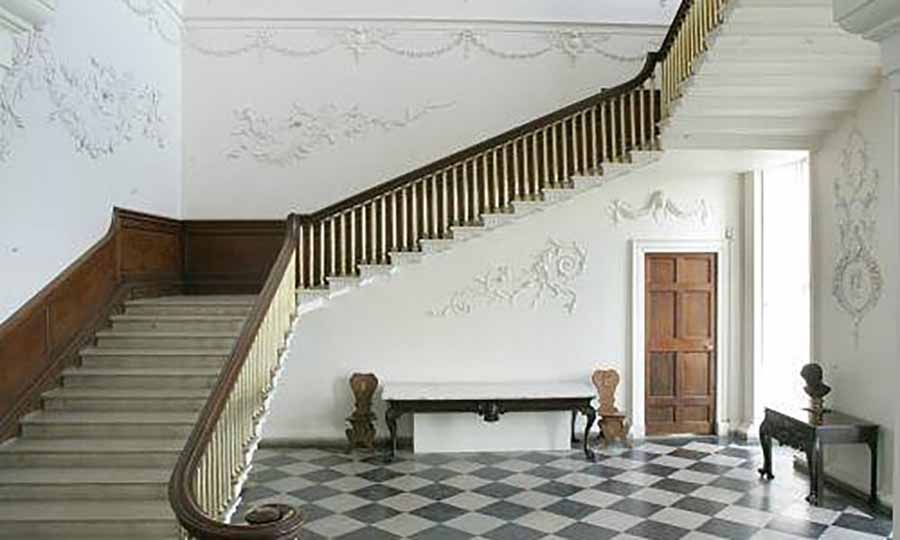
Pass through the majestic gates into the lime-tree-lined avenue of Castletown House, Ireland’s grandest Palladian mansion built between 1722 and 1729 for Conolly to designs evoking Italian influences via architects like Alessandro Galilei and Edward Lovett Pearce; this imposing central block with flanking pavilions and colonnades, boasting originally 230 windows, matched to Buckingham Palace, prompting one to be blocked for rivalry, served as a statement of wealth and power, later transformed by Lady Louisa Conolly from 1759 with neoclassical interiors, the Long Gallery, great staircase, and extensive parklands including river walks, lake, temple, ice house, bath house, and pleasure gardens. Managed today by the Office of Public
Works following restoration from original drawings, the estate offers 120 acres of open parkland bounded by the Liffey, where the gentle flow of water provides a soothing soundtrack from the house steps.
This compact yet profound ramble through Celbridge celebrates a truly historic village, where ancient fords, literary passions, brewing innovation, revolutionary politics, and architectural majesty converge in harmonious proximity along the ever-present Liffey.
Ireland county by county
Antrim – Armagh – Carlow – Cavan – Clare – Cork – Derry – Donegal – Down – Dublin – Fermanagh – Galway – Kerry – Kildare – Kilkenny – Laois – Leitrim – Limerick – Longford – Louth – Mayo – Meath – Monaghan – Offaly – Roscommon – Sligo – Tipperary – Tyrone – Waterford – Westmeath – Wexford – Wicklow
Largest town walking tour
Antrim – Armagh – Carlow – Cavan – Clare – Cork – Derry – Donegal – Down – Dublin – Fermanagh – Galway – Kerry – Kildare – Kilkenny – Laois – Leitrim – Limerick – Longford – Louth – Mayo – Meath – Monaghan – Offaly – Roscommon – Sligo – Tipperary – Tyrone – Waterford – Westmeath – Wexford – Wicklow
Towns
Antrim – Armagh – Carlow – Cavan – Clare – Cork – Derry – Donegal – Down – Dublin – Fermanagh – Galway – Kerry – Kildare – Kilkenny – Laois – Leitrim – Limerick – Longford – Louth – Mayo – Meath – Monaghan – Offaly – Roscommon – Sligo – Tipperary – Tyrone – Waterford – Westmeath – Wexford – Wicklow
Villages
Antrim – Armagh – Carlow – Cavan – Clare – Cork – Derry – Donegal – Down – Dublin – Fermanagh – Galway – Kerry – Kildare – Kilkenny – Laois – Leitrim – Limerick – Longford – Louth – Mayo – Meath – Monaghan – Offaly – Roscommon – Sligo – Tipperary – Tyrone – Waterford – Westmeath – Wexford – Wicklow