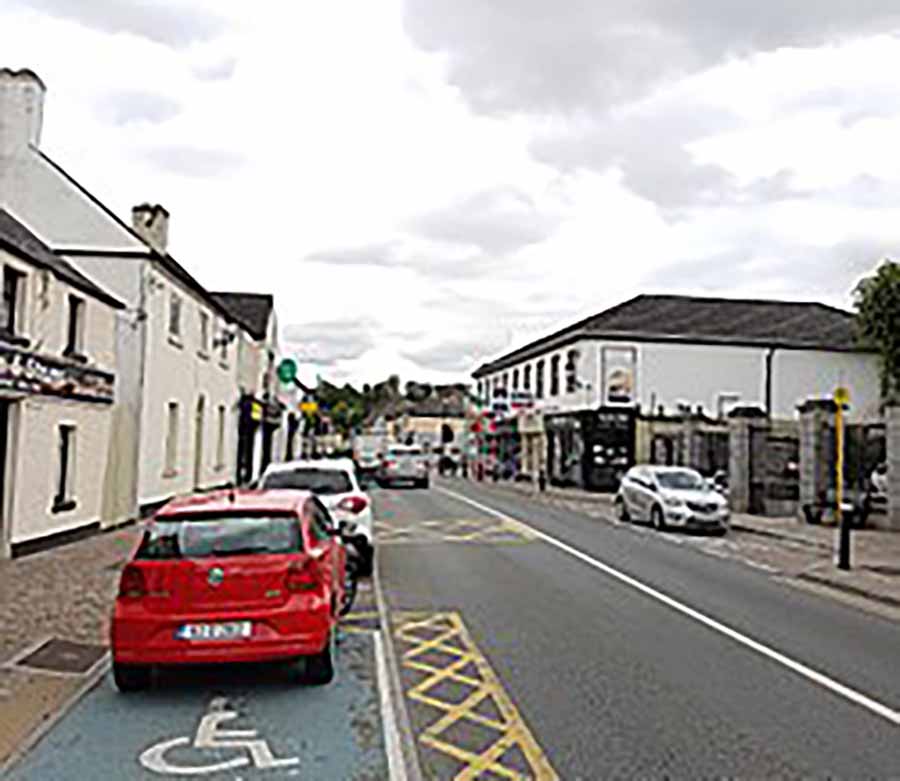
Start your walking tour of Leixlip in Ireland’s county Kildare at the oldest house in the town facing the fire station on the Sileachain Lane named after the Sileachain Stream from the Irish sailleachán meaning shedding tears. The Silleachain is a stream and stream-lane that rises in a former wetland area known as the Moor of Meath, located north of Leixlip, just over the border into County Meath. It was once the main road to Dunboyne by Confey Castle but now a cul-de-sac blocked by the Royal Canal at the top.
The lane descends steeply from the village. The Black Castle a tower house on Mill Lane a short extension of the Main Street served as the residence of young man Lisa O’Connor who died around 1626. In 1429 England’s King Henry VI offered a grant of ten pounds for tower houses usually three or four stories tall distinguished by a semi-cylindrical projection at the back containing a staircase.
Walter Fitzgerald founder of the County Kildare Archaeological Society recorded that during the 1798 Rebellion a gallows stood in front of the Black Castle though no record exists of its use. The Yorkshire family occupied the Black Castle for a time with the Dublin Newsletter reporting in August 1740 that the first strawberries grown in Ireland came from the garden there for James Usher. Leixlip has long been a place of industry with water power from at least three watercourses supporting flour mills six stories high at the foot of Mill Lane once owned by Samuel Beckett’s grandfather with Beckett’s mother Maria Roe born and raised in Leixlip. Several millers lived in the Black Castle and in Bridge House now the Toll House on Leixlip Bridge.
Adjoining the flour mills County Kildare’s only iron mills date to the early 1700s with plentiful local timber for charcoal a raw material for melting iron. Townlands Collins Town and Kelly’s Town and a derrick nearby take names from types of wood. Richard Turner famous for iron glasshouses at Kew Gardens and Dublin’s Botanic Gardens was probably born in Leixlip with his wife and children buried in Saint Mary’s churchyard on Main Street. Turn behind the fire station towards Dublin direction to Saint Catherine’s Park established around 1219 as an Augustinian priory by Norman lord of Leixlip Adam de Hereford in collaboration with his counterpart in Lucan Warisius de Peche. The priors built a weir to raise water levels and a mill at the foot of Mill Lane.
Saint Catherine’s Park passed to the president when he served as minister for state and local control went to county councils for management as a park.
Access from Leixlip occurs via the Black or Back Avenue at the top crossing the border from Kildare to Dublin with the gate lodge birthplace of Captain later Commandant James O’Neill of the Irish Army in Easter Week 1916 in charge of munitions including canister bombs he made after greeting Volunteers marching into the GPO along the Royal Canal towpath handing them their bombs. Return up the lane to the Main Street then left to the long five-arch bridge of Leixlip across which the Salmon Leap dates from at least 1713 in Kildare townland ten miles from the capital.
In 1728 ground rents of the town sold by John White estate agent whose family occupied Leixlip Castle and Saint Catherine’s Priory went to Speaker of the Irish House of Commons Conolly of Castletown for eleven thousand pounds. Conolly built a new road to Kinnegad and later to Mullingar around 1730 including this bridge with a house to collect tolls. The first house on the left or south side of the Main Street Shingle House dates from 1740 or earlier leased by Conolly in 1740 to John Barton a Lucan brewer ,possibly Arthur Guinness’s brewer. More recently Quaker families Shackleton, flour millers and cousins of the Ballitore family, of which Mary was a community activist lived here. Lily of the Valley was the Shackletons’ fine quality calico brand made football shorts giving the Kildare team the name Lilywhites.
Across the street Ivy House an 18th-century house built for Robert Law barrack master of Ireland around 1740 lived in a fine Georgian house called after himself Robertsville now known as Raival Laos. Proceed to Captain’s Hill T-junction north formerly Priest Lane after Caesar Atway local Church of Ireland curate with a glebe house at Newtown House recently home of Leixlip Town Council before its abolition the last town council established in Ireland. Captain’s Hill replaced Silian Lane as the road north from town crossing the Royal Canal at Cope Bridge. Leixlip House the first house built for General William Brady received pikes from local men of 1798.
A terrace of eight houses on the north side once called the Parade now the Mall has streets extending under them with cobbles still there forming a square for marching soldiers based at Leixlip Castle. To the left derelict number 33 marks birthplace of General William Francis Roantree one of the top Fenians.
A few doors away the site of Arthur Guinness’s first brewery built under lease around 1755 in courtyard fashion after a few years he leased a brewery in James Street Dublin leaving his father and brother to run Leixlip until early in the 19th century. Further along Saint Mary’s Church of Ireland Norman church served as deanery or local head church of the area accounting for Archbishop Price buried there.
A little further the Rye Bridge links Main Street to Pound Street towards Leixlip Castle on a hill overlooking the Rye River confluence with the Liffey the Rye, from generic old Irish for river, not from rí as in king.
Vikings from Scandinavia gave Leixlip its name Lax-hlaup salmon leap in 1207 English translation of Norse Leixlip main ranges salmon harvesting in baskets at waterfalls some 150 feet wide noise heard half a mile away now hidden beneath ESB dam. Local townlands Ravensdale and Blakestown signal Viking presence. From end of Main Street rise up Leixlip Station Road north on turnpike road to the west a new town next on the hill just west the Catholic parish church of Leixlip first dedicated to Saint Charles Borromeo pope’s nephew in 15th century.
Across the street down steps to Rye Water banks the former Catholic chapel dates to about 1720 hidden out of the way. Further out the Royal Canal aqueduct over the Rye Water a former hot spring and Romanesque bath next for the next kilometre Intel’s microprocessor factory established thirty years providing employment for five thousand workers and more than half rateable income in the area.
Ireland county by county
Antrim – Armagh – Carlow – Cavan – Clare – Cork – Derry – Donegal – Down – Dublin – Fermanagh – Galway – Kerry – Kildare – Kilkenny – Laois – Leitrim – Limerick – Longford – Louth – Mayo – Meath – Monaghan – Offaly – Roscommon – Sligo – Tipperary – Tyrone – Waterford – Westmeath – Wexford – Wicklow
Largest town walking tour
Antrim – Armagh – Carlow – Cavan – Clare – Cork – Derry – Donegal – Down – Dublin – Fermanagh – Galway – Kerry – Kildare – Kilkenny – Laois – Leitrim – Limerick – Longford – Louth – Mayo – Meath – Monaghan – Offaly – Roscommon – Sligo – Tipperary – Tyrone – Waterford – Westmeath – Wexford – Wicklow
Towns
Antrim – Armagh – Carlow – Cavan – Clare – Cork – Derry – Donegal – Down – Dublin – Fermanagh – Galway – Kerry – Kildare – Kilkenny – Laois – Leitrim – Limerick – Longford – Louth – Mayo – Meath – Monaghan – Offaly – Roscommon – Sligo – Tipperary – Tyrone – Waterford – Westmeath – Wexford – Wicklow
Villages
Antrim – Armagh – Carlow – Cavan – Clare – Cork – Derry – Donegal – Down – Dublin – Fermanagh – Galway – Kerry – Kildare – Kilkenny – Laois – Leitrim – Limerick – Longford – Louth – Mayo – Meath – Monaghan – Offaly – Roscommon – Sligo – Tipperary – Tyrone – Waterford – Westmeath – Wexford – Wicklow