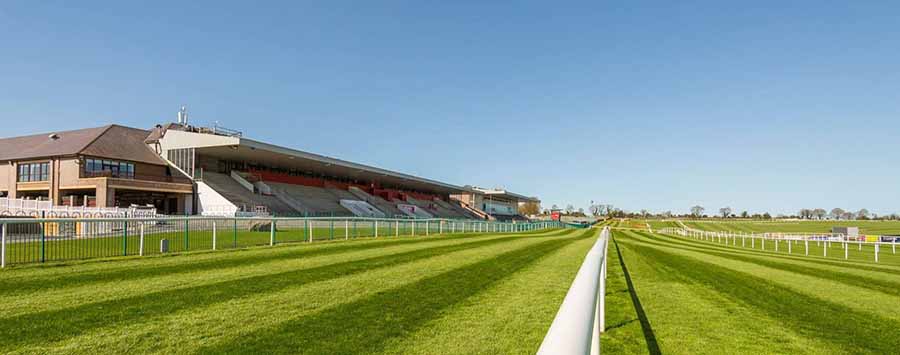
Start your walking tour of Punchestown in Ireland’s county Kildare at the crossroads known as Watch House Cross beneath Ballymore Eustace Road. The name derives from an old guard house on the Woolpack Road once used by merchants transporting wares from the Curragh area to Dublin parallel to the main Naas-Dublin road. Proceed up the hill on part of the Woolpack Road to the main gate of Punchestown emblazoned with the signature fox emblem of the Kildare Hunt. Through the gates look left to the Punchestown Long Stone a tall needle-like standing stone leaning in the field.
Speculation surrounds such stones as possible boundary markers or other purposes one of three in the area with others near the Dublin gate into Punchestown and on hills behind Johnstown. Local childhood explanation held that Finn McCool in rage picked three stones from the Hill of Allen hurled them at a horizon and they landed at Punchestown. Turn attention to the racecourse proper cross the vast grass sward which on racing days accommodates thousands of cars. To the right stands the Big Yellow Shed used in recent times as a Covid-19 testing and vaccination centre.
Continue towards the enclosure area paddock and stands quiet on non-racing days reach the racetrack at its highest point a favoured venue for daily exercise during the pandemic. From the summit the natural amphitheatre of east Kildare countryside becomes visible explaining why the Kildare Hunt committee in the 1850s selected Punchestown for a racecourse visible from all points of its circumference. Begin the sweep downhill along the path of galloping hooves taking in views to the Wicklow Hills southwards to Lugnaquilla the highest point in Leinster.
At the bottom of the hill the former water jump appears where the Morell River formed part of the obstacle. England’s Princess Anne Windsor visited Punchestown in the early 1990s for international horse trials inspecting obstacles with detectives despite political sensitivities at the time. The track swings into countryside through the townland of Blackhall then back over the Big Double a notorious jump on the banks course where many gathered to watch horses clear obstacles one race day Liam Cosgrave former Taoiseach stood there with bowler hat and binoculars.
Continue clockwise passing the stone wall fence maintained from the days of bank races two races during the Punchestown Festival including the La Touche Cup over four miles across old banks ditches. To the left landscaped sandpits once overlooked Priest Hill where priests in the late 1800s forbidden from gambling or attending races gathered to view some of the sport.
Swing uphill before the finishing straight where many races are lost or won neighbouring Lawler family farm at Bonnocks bred Mill House in the early 1960s contested premier national hunt races in England against Arkle with Irish and English supporters cheering their horses to the finish of the Cheltenham Gold Cup Mill House perceived as English challenger Arkle as Irish yet Mill House bred here fully Irish in an early career outing at Punchestown he fell unseating his jockey local theory suggested he bent to graze thinking himself in his old paddock. Pass the finishing post and stands look back over the circuit.
Adjacent in Blackhall townland an old stone castle covered with ivy once belonged to the Eustaces who owned land on which Punchestown stands reflected in the modern name Ballymore Eustace in the 20th century inhabitant of the farmhouse at Eustace Castle Miss Sheila Burke an experienced horsewoman and small-scale breeder sold young horse ESB to England entered in the 1956 Grand National. In that race Devon Loch owned by the Queen Mother led approaching the finishing straight stalled at an invisible fence dug heels refused to budge despite jockey Francis Winter’s efforts ESB under David Dick stormed past from second place to win in the most extraordinary Grand National. Return through the grounds to the starting point at Watch House Cross.
Ireland county by county
Antrim – Armagh – Carlow – Cavan – Clare – Cork – Derry – Donegal – Down – Dublin – Fermanagh – Galway – Kerry – Kildare – Kilkenny – Laois – Leitrim – Limerick – Longford – Louth – Mayo – Meath – Monaghan – Offaly – Roscommon – Sligo – Tipperary – Tyrone – Waterford – Westmeath – Wexford – Wicklow
Largest town walking tour
Antrim – Armagh – Carlow – Cavan – Clare – Cork – Derry – Donegal – Down – Dublin – Fermanagh – Galway – Kerry – Kildare – Kilkenny – Laois – Leitrim – Limerick – Longford – Louth – Mayo – Meath – Monaghan – Offaly – Roscommon – Sligo – Tipperary – Tyrone – Waterford – Westmeath – Wexford – Wicklow
Towns
Antrim – Armagh – Carlow – Cavan – Clare – Cork – Derry – Donegal – Down – Dublin – Fermanagh – Galway – Kerry – Kildare – Kilkenny – Laois – Leitrim – Limerick – Longford – Louth – Mayo – Meath – Monaghan – Offaly – Roscommon – Sligo – Tipperary – Tyrone – Waterford – Westmeath – Wexford – Wicklow
Villages
Antrim – Armagh – Carlow – Cavan – Clare – Cork – Derry – Donegal – Down – Dublin – Fermanagh – Galway – Kerry – Kildare – Kilkenny – Laois – Leitrim – Limerick – Longford – Louth – Mayo – Meath – Monaghan – Offaly – Roscommon – Sligo – Tipperary – Tyrone – Waterford – Westmeath – Wexford – Wicklow