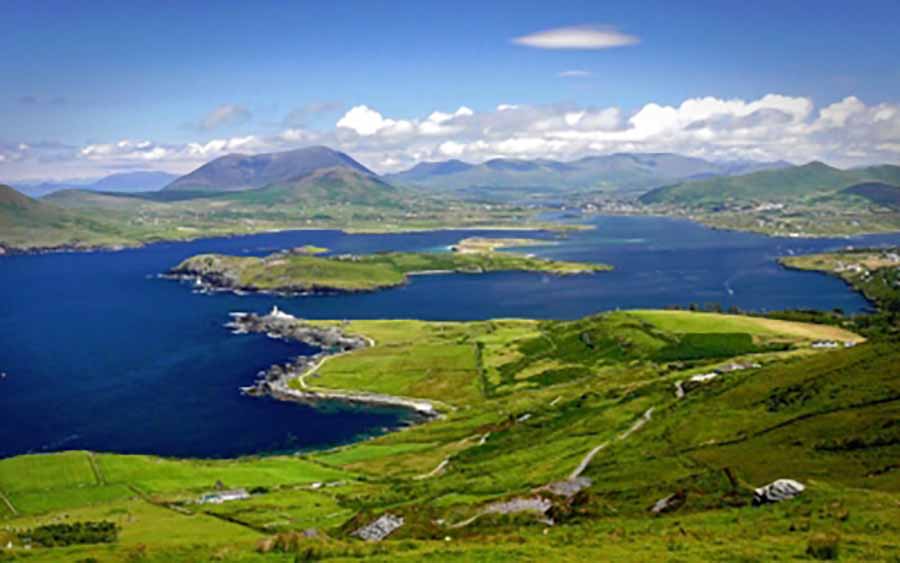
- Skellig Michael (Sceilg Mhichíl), a UNESCO World Heritage Site rising sharply from the Atlantic, hosts one of Ireland’s most iconic early monastic settlements, founded around the 6th century by St Fionán. The remote rock island features beehive huts, oratories, and a dramatic stairway climb, drawing pilgrims and visitors for its austere spiritual legacy of isolation and prayer, with possible pre-Christian roots in its extreme, elemental setting.
- Mount Brandon (Cnoc Bréanainn), Ireland’s second-highest peak, serves as a renowned pilgrimage mountain where tradition holds the 6th-century St Brendan the Navigator climbed for visions and spiritual retreats. The Cosán na Naomh (Saints’ Path) leads to the summit oratory and holy well, attracting pilgrims for pattern days and reflection, blending saintly asceticism with ancient mountain veneration.
- Kilmalkedar Church on the Dingle Peninsula preserves a 12th-century Romanesque complex with earlier roots, including a sundial, ogham stones, and high crosses. Part of the ancient pilgrimage route to Mount Brandon, it honours St Maolcethair and echoes pre-Christian sacred enclosures through its alignment and landscape significance.
- Gallarus Oratory on the Dingle Peninsula stands as a perfectly preserved early Christian stone chapel, possibly 7th–8th century, aligned with other sites along the ley-like path linking it to Mount Brandon and Skellig Michael. Its corbelled construction invites contemplation of monastic simplicity amid pre-Christian ritual alignments.
- St John’s Holy Well (Tobar Eoin) near Minard on the Dingle Peninsula overlooks Dingle Bay, with folklore of a fish appearing in the water signalling a cure. Pilgrims perform rounds and leave offerings, preserving ancient hydrolatry customs tied to the saint, in a scenic hillside setting.
- St Finian’s Well (or similar wells linked to St Fionán) in various Kerry locations, including near Fenit or Ardfert, draw on traditions of the saint’s blessings for healing, such as against plague. These springs continue pre-Christian water cults adapted to Christian devotion, often with associated rituals and offerings.
- Ardfert Cathedral ruins mark the site of St Brendan’s monastic foundation, where he was baptised nearby at Tubrid Well. The medieval cathedral and graveyard honour the Navigator saint’s legacy, with connections to early evangelisation in this fertile plain.
County Kerry:
Ireland’s county Kerry is renowned for its dramatic landscapes, with the Ring of Kerry offering scenic drives past lakes and coastal cliffs. Killarney National Park features the serene Lakes of Killarney and historic Muckross House, while Dingle’s coastal trails and dolphin-watching opportunities add natural allure. Accessible by seasonal ferry, the Skellig Islands’ ancient monastic ruins make Kerry a compelling choice for outdoor adventure and history. Kerry is Ireland’s fifth largest county by size (4,701 square km) and 15th largest by population (156,458). Population peaked at 293,880 in 1841 and reached its lowest point, 112,785 in 1966. In terms of hospitality, Kerry is Ireland’s fourth most visited tourist county with around 877,000 international visitors per year.
Introduction – Adventure – Anthem – Archaeology – Attractions – Awards – Birdwatching – Camping – Castles – Churches – Contact list – Cycling – Dining – Equestrian – Festivals – Fishing – Folklore – Gardens – Golf – Graveyards – Happening – Haunted – Highest – Hiking – History – Holy Wells – Hotels – Hotels8 – Instagrammable – Itineraries – Largest town – Luxury – MICE – Movies – Musicians – Name – New – Novelists – Off the beaten track – Poets – Pubs – Quotes – Random Facts – Restaurant Awards – Sacred Places – Saints – Spas – Sports – Sunsets– Sustainable – Things to do – Towns – Video – Villages – Walking – Wanderlist – Weddings – Wild swimming – Writers – 1837 – 1846 – 1852 – 1909 – 1955 – 1980 –
Sacred Places
Antrim – Armagh – Carlow – Cavan – Clare – Cork – Derry – Donegal – Down – Dublin – Fermanagh – Galway – Kerry – Kildare – Kilkenny – Laois – Leitrim – Limerick – Longford – Louth – Mayo – Meath – Monaghan – Offaly – Roscommon – Sligo – Tipperary – Tyrone – Waterford – Westmeath – Wexford – Wicklow