- Ross Castle: Built in the late 15th century by the O’Donoghue Ross clan, Ross Castle is a well-preserved tower house on the shores of Lough Leane in Killarney National Park. Later seized by the Browne family during the 17th century, it served as a military barracks during the Confederate Wars. Its strategic lakeside location and intact medieval structure make it one of Kerry’s most iconic castles. Open March–October (9:30 AM–5:45 PM, last entry 5 PM, check heritageireland.ie), visitors can take guided tours (€5 adults, €4 seniors, €3 children/students, €13 family) of the tower’s furnished interiors, including the great hall and battlements, offering views of Lough Leane and the McCarthy Mór tower. Expect a 45–60 minute visit with historical insights into Gaelic chieftains and Cromwellian sieges. Amenities include parking, toilets, and a small gift shop. The castle is a 10-minute drive from Killarney, with nearby boat tours to Innisfallen Island’s monastic ruins. Partial wheelchair access (ground floor only). The scenic park setting is ideal for walks or jaunting car rides. A must-visit for its accessibility, historical significance, and Killarney National Park setting.
- Ballybunion Castle: Located on a cliff overlooking Ballybunion’s beach, Ballybunion Castle is a 16th-century ruin built by the Fitzmaurice family, lords of Kerry. Once a formidable coastal fortress, it was destroyed during the Desmond Rebellions (1580s) and further damaged by coastal erosion. Only a single wall remains, but its dramatic clifftop position makes it a striking landmark. Open year-round (free, no formal hours), visitors can view the castle’s remaining wall from a public path near Ballybunion’s cliffs. Expect a 15–30 minute stop to appreciate the ruins and sweeping Atlantic views. Information boards provide historical context. No facilities like restrooms or a visitor center are available, but parking and cafes are nearby in Ballybunion town. The site suits those exploring the Wild Atlantic Way or enjoying the beach and cliff walks. Best for a quick stop, appealing to photographers and coastal explorers.
- Listowel Castle: Built in the 15th century by the Fitzmaurice family, Listowel Castle is a medieval tower house on the River Feale in Listowel town. A key stronghold during the Desmond Rebellions, it was partially destroyed in 1600 but restored in the 2000s. Now a National Monument, its two surviving towers offer a glimpse into Kerry’s turbulent Gaelic history. Open June–September (Wednesday–Sunday, 10 AM–5 PM, free guided tours, check heritageireland.ie), visitors can explore the restored towers and vaulted chambers via 30–45 minute guided tours, learning about the Fitzmaurices and the castle’s role in the rebellions. Expect a 45-minute visit with views of the River Feale. No formal facilities, but parking and toilets are available in Listowel town. The site is compact, ideal for history buffs visiting the nearby Kerry Writers’ Museum or Listowel’s literary festivals. A concise but engaging stop for those interested in medieval history and literature.
- Ballyheigue Castle: Originally a 15th-century tower house built by the Crosbie family, Ballyheigue Castle near Ballyheigue village was rebuilt in 1810 as a Gothic-style mansion. Damaged by fire in 1921 during the Irish War of Independence, it’s now a partial ruin with remnants of its towers and estate walls. The site is privately owned but visible from public areas, set against the backdrop of Ballyheigue Bay. Not open for interior tours due to private ownership, visitors can view the ruins from the roadside or nearby paths, appreciating the Gothic arches and coastal setting. Expect a 15–30 minute stop, with no facilities on-site. Parking is available near Ballyheigue village, and the beach offers scenic walks. The castle’s history is tied to the Crosbies’ Anglo-Irish legacy, detailed in local guides. Best for those exploring the north Kerry coast. A minor but picturesque ruin, suitable for a brief visit en route to other coastal sites.
- Carrigafoyle Castle: Built in the late 15th century by Conor Liath O’Connor near Ballylongford, Carrigafoyle Castle is a tower house on the Shannon Estuary. A stronghold of the O’Connor Kerry clan, it was besieged and destroyed by Elizabethan forces in 1580 during the Desmond Rebellions. Its ruins, including a five-story tower and bawn, are a National Monument, notable for their dramatic riverside setting. Open year-round (free, no formal hours, managed by the Office of Public Works), visitors can explore the ruins, climbing the spiral staircase for estuary views if safe (caution advised due to uneven terrain). Expect a 30–60 minute visit, with information boards detailing the siege. No facilities like restrooms or a cafe, but parking is nearby. The castle’s remote location suits adventurers and history enthusiasts, especially those exploring the Shannon Estuary or nearby Tarbert. A rugged, atmospheric site for those seeking off-the-beaten-path history.
Kerry has numerous lesser-known ruins, such as Minard Castle (16th-century, Dingle Peninsula, a storm-damaged ruin, free but remote), Gallarus Castle (15th-century, near Gallarus Oratory, privately owned, exterior viewing only), and Rahinnane Castle (15th-century, near Ventry, private farmland, limited access). These are less prominent due to their state or restricted access but add to Kerry’s medieval tapestry.
Kerry’s castles are deeply tied to its Gaelic and Norman history, often set in spectacular locations like Killarney National Park or the Wild Atlantic Way. Ross and Listowel are the most visitor-friendly.
Castles
Antrim – Armagh – Carlow – Cavan – Clare – Cork – Derry – Donegal – Down – Dublin – Fermanagh – Galway – Kerry – Kildare – Kilkenny – Laois – Leitrim – Limerick – Longford – Louth – Mayo – Meath – Monaghan – Offaly – Roscommon – Sligo – Tipperary – Tyrone – Waterford – Westmeath – Wexford – Wicklow
County Kerry:
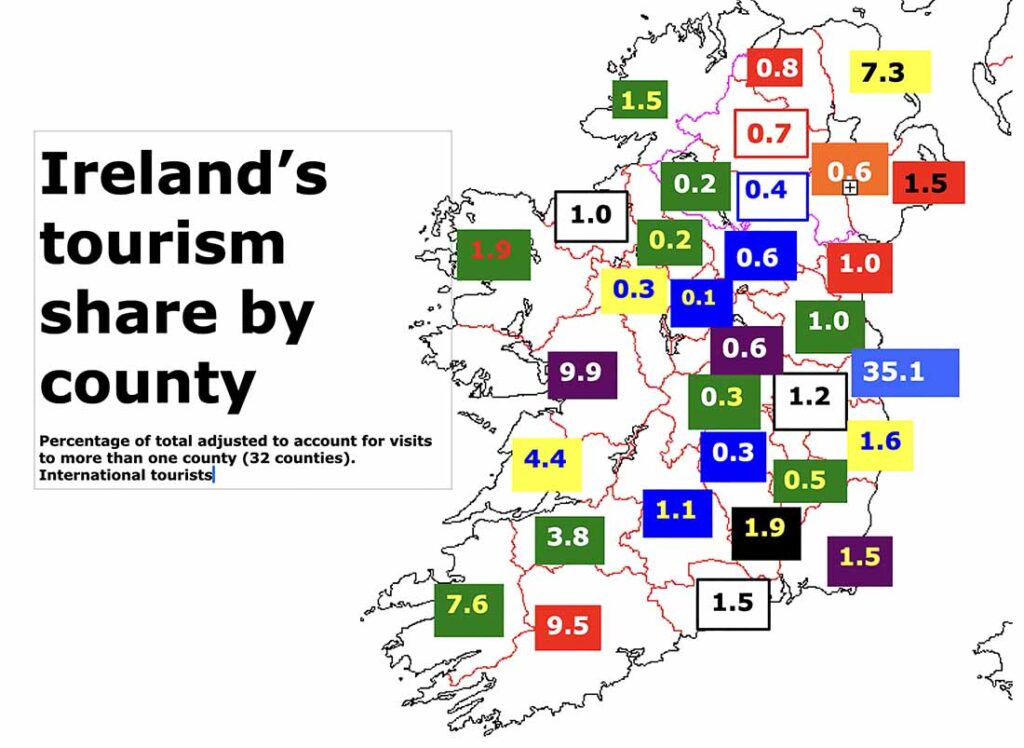
Ireland’s county Kerry is renowned for its dramatic landscapes, with the Ring of Kerry offering scenic drives past lakes and coastal cliffs. Killarney National Park features the serene Lakes of Killarney and historic Muckross House, while Dingle’s coastal trails and dolphin-watching opportunities add natural allure. Accessible by seasonal ferry, the Skellig Islands’ ancient monastic ruins make Kerry a compelling choice for outdoor adventure and history. Kerry is Ireland’s fifth largest county by size (4,701 square km) and 15th largest by population (156,458). Population peaked at 293,880 in 1841 and reached its lowest point, 112,785 in 1966. In terms of hospitality, Kerry is Ireland’s fourth most visited tourist county with around 877,000 international visitors per year.
Introduction – Adventure – Anthem – Archaeology – Attractions – Awards – Birdwatching – Camping – Castles – Churches – Contact list – Cycling – Dining – Equestrian – Festivals – Fishing – Folklore – Gardens – Golf – Graveyards – Happening – Haunted – Highest – Hiking – History – Holy Wells – Hotels – Hotels top 8 – Hunting & shooting – Instagrammable – Itineraries – Largest town – Luxury – MICE – Movies – Music – Name – New – Novelists – Off the beaten track – Poets – Pubs – Quotes – Random Facts – Restaurant Awards – Sacred Places – Saints – Songs – Spas – Sports – Sunsets – Sustainable – Things to do – Towns – Video – Villages – Walking – Wanderlist – Weddings – Wild swimming – Writers – 1837 – 1846 – 1852 – 1909 – 1955 – 1980 –